If a public EV charger won’t start a session, try a different cable or stall first, then move to a nearby station before your range gets critical. Public networks like ChargePoint, EVgo, and Electrify America fail more often than Tesla Superchargers, and in San Diego it usually happens at the worst possible time, mid-errand, low on range, with somewhere to be. Here’s what actually works, and when it’s time to stop chasing chargers and call for a charge to come to you instead.

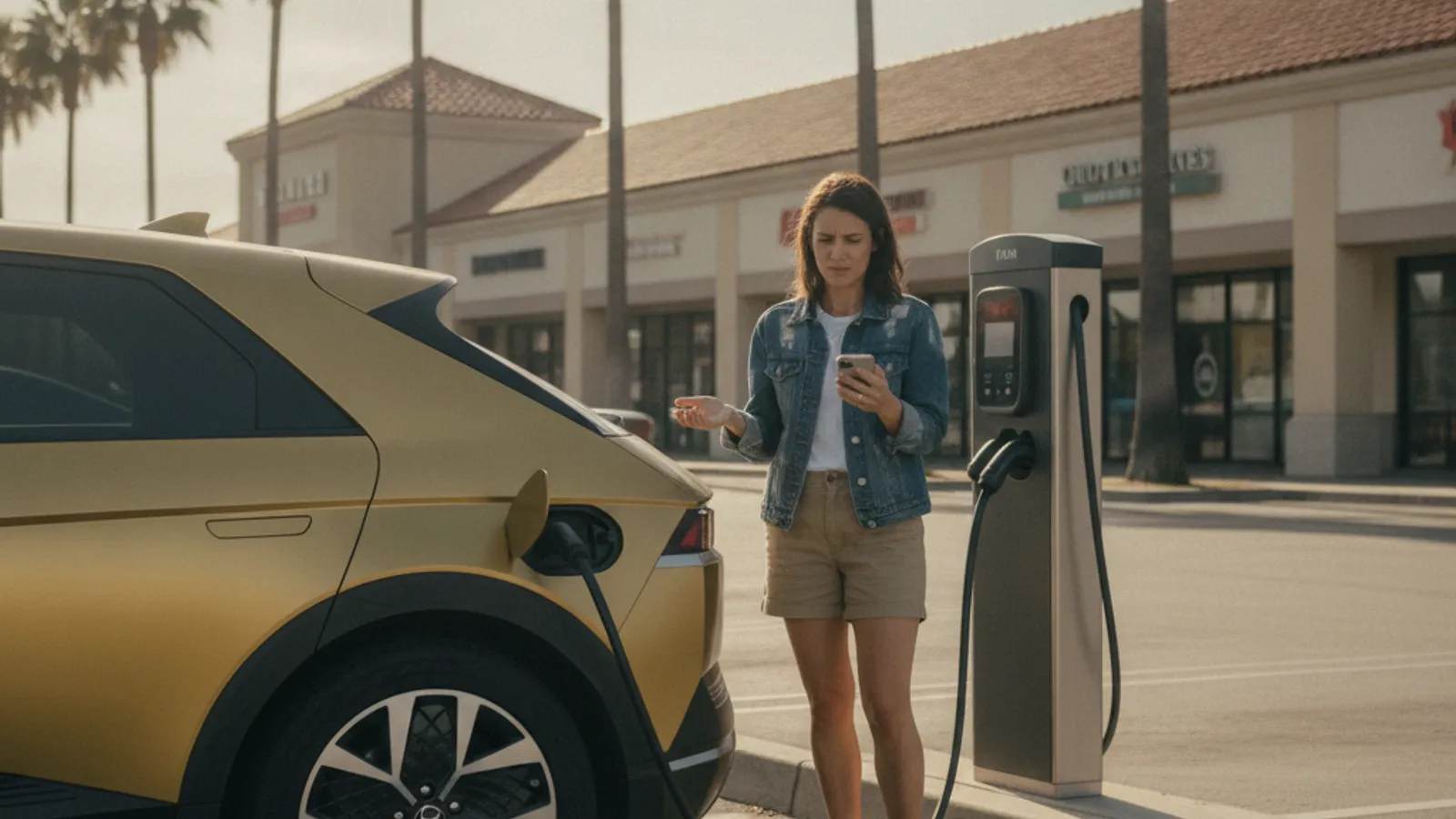
A Hyundai Ioniq 5 driver stands beside a public DC fast charging kiosk showing an error light in a San Diego shopping center parking lot

What should you do the moment a public charger won’t start?

Work through this in order before you decide the charger is truly dead.

Try the cable and connector first. Unplug fully, check the connector for debris or bent pins, and plug back in firmly. A loose seat is the single most common reason a session won’t start.

Try the adjacent stall. Fast-charging stations share power cabinets between stalls. One stall going dark or throwing an error doesn’t mean the whole station is down. Move one spot over before you give up on the location.

Restart the session through the app, not just the screen. Most network errors, ChargePoint, EVgo, and Electrify America included, happen in the handshake between your phone app and the charger, not the hardware itself. Force-close the app, reopen it, and start the session again from your phone rather than tapping the kiosk screen repeatedly.

Check the network’s status page or app for a known outage. All three major networks show real-time stall status. If the screen shows red or “unavailable” before you even plug in, that’s already answered your question.

Try a different payment method. A declined card or an expired plan can look exactly like a broken charger. Try the RFID card if you have one, or a different card in the app, before assuming it’s a hardware fault.

If none of that gets a session started within five to ten minutes, stop troubleshooting. Move on to a different station or call for help, especially if your range is already tight.

Why do ChargePoint, EVgo, and Electrify America chargers fail more than Tesla Superchargers?

It comes down to who owns the hardware and who’s responsible for fixing it.

Tesla builds, owns, and maintains its own Supercharger network end to end, which is a big reason it’s more reliable than public fast charging. ChargePoint, EVgo, and Electrify America run a different model. In many cases, a business or property owner buys the charging hardware and a network company like ChargePoint just provides the software and payment processing. That splits responsibility for maintenance between two companies, and repairs can sit in a queue for weeks.

The charging cable and connector also take more physical abuse on public networks. Unlike a Tesla driver plugging into the same home outlet every night, dozens of different drivers a day yank the same public cable, drop the same connector on the pavement, and sometimes force it into the wrong port. Add in San Diego’s coastal salt air corroding contacts and inland heat stressing the electronics, and failures add up faster than the networks can service them.

Network connectivity is the other weak point. A DC fast charger needs to talk to a central server to authenticate your account and start billing. If that connection drops, even a mechanically perfect charger won’t start a session. That’s a software problem wearing a hardware disguise, and it’s exactly why restarting the app before giving up matters.

Where can you find a working charger nearby?

Close-up of a CCS charging cable and adapter connected to the rear quarter-panel charge port of a Hyundai Ioniq 5 during a mobile charging session

San Diego has enough charging density that a broken stall usually isn’t your only option, but it takes knowing where to look. Mission Valley is the most charger-dense stretch in the county, with fast chargers spread across both Fashion Valley and Westfield Mission Valley, so a dead stall at one mall often just means a short drive to the other. Carlsbad drivers have backup options between the Shoppes at Carlsbad and the Carlsbad Premium Outlets. Near the border, Otay Mesa and Otay Ranch Town Center give South County drivers a second option when the closest station is down.

Before you drive anywhere on low range, check an app like PlugShare rather than trusting your car’s built-in map. PlugShare pulls recent driver check-ins, so you’ll often see “this stall is broken” reported before your car’s software catches up.

If you don’t have a CCS adapter in the car and your only nearby option is a Tesla Supercharger location, note that some San Diego sites, including El Cajon, now have Magic Dock stalls that accept non-Tesla vehicles directly. That’s one more backup worth checking before you write off a location.

Is it risky to keep driving on low range looking for another station?

Sometimes, yes, and it’s worth being honest with yourself about it.

If you’ve got 20% or more, driving a few miles to a backup station is a reasonable bet. Under 10%, it stops being a reasonable bet and starts being a gamble. Traffic, hills, and air conditioning all eat into the range your car’s estimate assumes, and “the app says I’ll make it with 3% to spare” is exactly the math that leaves people stuck on the shoulder. Our guide on what to do before you’re stranded on low battery covers how to stretch what you have left if you do need to keep moving.

The safer version of “keep looking” is doing it from a parked, safe spot rather than while driving on fumes. Sit in the lot, check PlugShare, confirm the next station is actually working, and only move the car once you know where you’re headed. Chasing a rumor of a working charger on a nearly empty battery is how a broken-charger problem turns into a real roadside emergency.

When does a broken charger turn into a call for mobile rescue?

Some situations aren’t worth gambling on at all. Call for mobile charging instead of hunting for another station when:

  • You’re already under 10% and the nearest confirmed working station is more than a few miles away.
  • You’ve tried two stalls or two networks at the same location and neither will start a session.
  • You have somewhere to be, a flight out of San Diego International, a shift starting soon, an appointment, and you can’t afford an open-ended wait.
  • It’s late at night or you’re in an unfamiliar area and don’t want to be hunting for chargers alone.

This is exactly the gap our mobile EV charging service fills. A Cybertruck rescue truck comes to wherever you’re parked, whether that’s the dead charger itself or your own driveway, and delivers charge directly to your car with a CCS adapter for non-Tesla EVs. You don’t have to find a working station at all, and you don’t have to trust a nearly-empty battery to get you somewhere new. Most calls in San Diego County dispatch in 25 to 60 minutes, and if you’re curious what a visit runs, our mobile EV charging cost breakdown walks through the numbers.

If your problem turns out to be more than a charging session, a dead 12V battery or a mechanical issue, our non-Tesla EV rescue service covers that too, so one call handles either scenario.

When to call Charge Pro

A broken public charger isn’t your fault and it isn’t always fixable by waiting around. If you’ve tried another stall, restarted the app, and you’re still stuck with a car that won’t charge, call us before your range gets critical.

Call (858) 400-4465, we’ll roll a Cybertruck rescue truck to you anywhere in San Diego County.

Frequently asked questions

Why won’t a public EV charger start a charging session?

Most failures come down to one of a few things: a loose connector, a network communication error between the charger and your phone app, a declined or expired payment method, or a genuine hardware fault in that specific stall. Try re-seating the cable, restarting your app rather than the kiosk screen, and trying an adjacent stall before assuming the whole station is down.

Is it the charger or my car when a session won’t start?

Usually the charger or the network, not your car. If your car charges fine at home or at a different public station, the problem is almost always on the charging network’s side, either the hardware in that stall or the connection between the charger and its billing server. A true vehicle-side charging fault is less common and tends to show an error on your own dashboard, not just at the kiosk.

What’s the fastest way to find a working charger near me in San Diego?

Check PlugShare instead of your car’s built-in navigation. PlugShare relies on recent driver reports, so a broken stall is often flagged there before your car’s map catches up. Mission Valley, Carlsbad, and the Otay Mesa area all have multiple charging locations close together, so a dead stall at one site usually means a short drive to a working backup.

Does Charge Pro SD charge non-Tesla EVs when a public charger is down?

Yes. Our mobile rescue trucks carry a CCS adapter and can deliver charge directly to Rivian, Ford, Hyundai, Kia, and most other non-Tesla EVs anywhere in San Diego County. You don’t need to find a working public station at all, we bring the charge to wherever you’re parked.

How fast can Charge Pro SD get to me if I’m stuck at a broken charger?

Typical dispatch runs 25 to 60 minutes depending on where you are in San Diego County. Call (858) 400-4465 and we’ll confirm an estimated arrival time based on your location and current dispatch load.

Can I get money back if a charging station overcharged me or a session failed?

That’s a billing dispute you’ll need to take up directly with the network, ChargePoint, EVgo, or Electrify America, through their app or customer support. We don’t operate those networks and can’t issue refunds on their behalf, but we can get your car moving again while you sort out the billing issue separately.