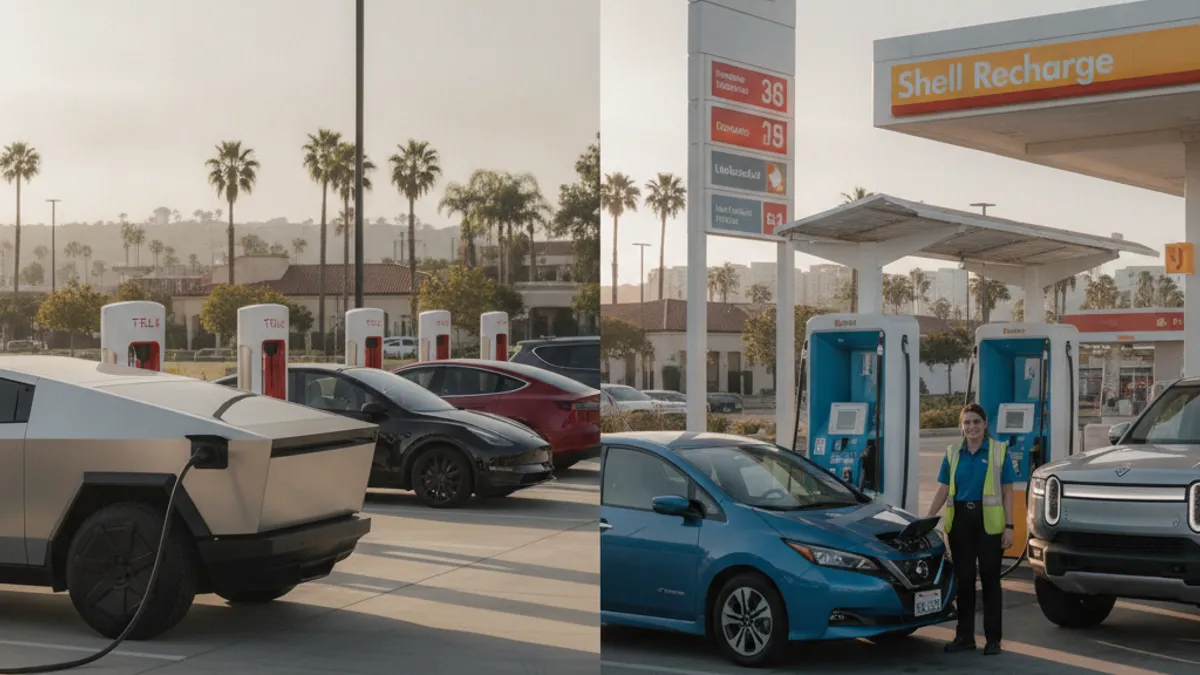
If you drive an EV in San Diego and you’re not exclusively using Tesla’s network, you’ve probably run into Shell Recharge stalls at gas stations around the county. Tesla Supercharger and Shell Recharge are both public DC fast charging networks, but they differ in size, reliability, and which cars can use them, and the right choice usually depends on what you’re driving, not just which one is closer.
Tesla Supercharger: the bigger, more consistent network
Tesla built the Supercharger network specifically for its own vehicles, and it shows in how it runs. Stations are dense across San Diego County, from Mission Valley to Sorrento Valley to North County, and reliability has historically outpaced most third-party networks, since Tesla controls the hardware, the software, and the vehicles all at once.
Many Superchargers now support non-Tesla EVs through a CCS adapter, often called the Magic Dock, though not every station has one. If you drive a Rivian, Ford, Hyundai, or another non-Tesla EV, check the Tesla app for station compatibility before you route there, since coverage varies stall by stall. We cover what to do when a Supercharger station itself has an outage in our Supercharger down guide.
Shell Recharge: gas-station convenience, more variable reliability
Shell Recharge runs CCS fast chargers, often installed at Shell gas stations, giving it a different kind of convenience: familiar locations, sometimes paired with a convenience store or restroom nearby. It works natively with the CCS plug used by most non-Tesla EVs, no adapter required, and Tesla owners with a CCS adapter can use it too.
The tradeoff is consistency. Third-party networks including Shell Recharge have historically shown more variability in uptime and charging speed than Tesla’s own network, partly because the hardware, software, and vehicles come from different companies that all have to work together correctly. It’s usable and often fine, but it’s worth having a backup plan if a stall is down when you arrive, which our public charger not working guide covers in more detail.
Other networks worth knowing in San Diego
Shell Recharge isn’t the only third-party option. Electrify America and EVgo both run DC fast chargers around San Diego County too, often at shopping centers and along major corridors like the I-5 and I-15. Each network has its own app and its own account or membership setup, which is the biggest everyday annoyance of relying on multiple non-Tesla networks: you end up with several apps and payment methods instead of one. ChargePoint is more common for slower Level 2 public charging, at places like offices, hotels, and parking structures, rather than the DC fast charging this comparison focuses on.
Pricing structures also vary by network and sometimes by session, some charge per kWh, others per minute, and a few add idle fees if you leave your car plugged in after it finishes charging. None of these differences are dealbreakers on their own, but they add friction that Tesla’s more unified Supercharger experience mostly avoids for Tesla drivers.
Which one should you actually use
If you drive a Tesla, the Supercharger network is generally the more reliable default across San Diego, with Shell Recharge and other CCS networks as a backup when you’re outside Tesla’s coverage. If you drive a non-Tesla EV, you’re choosing between Shell Recharge and other CCS networks like Electrify America and EVgo as your primary option, with Tesla’s Magic Dock-enabled stations as an increasingly common secondary choice where available.
Either way, the smartest habit for any EV owner in San Diego is not relying on a single network. Check your car’s native navigation or a charging app like PlugShare before a longer trip, and have a second option in mind in case your first choice is occupied, offline, or incompatible that day.
Planning a route that doesn’t depend on one network
The most reliable approach for any EV owner in San Diego, Tesla or otherwise, is treating public charging as a backup plan built on more than one option, not a single trusted stop. Before a longer drive, especially anything heading up the I-15 corridor or out toward the backcountry where stations thin out, check two networks instead of one and note a fallback stop along your route. It costs nothing and it’s the difference between a five-minute detour and an actual roadside emergency.
What to do if a charging stop falls through
Public charging gaps still happen, whether it’s a full Supercharger, a Shell Recharge stall stuck in an error state, or a station that simply isn’t there anymore when the app said it was. If that leaves you critically low on range anywhere in San Diego County, Charge Pro SD brings a mobile Level 2 charger directly to you. Our out-of-charge recovery service adds enough range on-site to reach the nearest working charger or get you home.
Frequently asked questions
Can I charge a non-Tesla EV at a Tesla Supercharger in San Diego?
At many stations, yes, using a CCS adapter through what Tesla calls the Magic Dock, though not every Supercharger location has one. Check the Tesla app for compatibility before you route there.
Is Shell Recharge reliable in San Diego?
It’s generally usable but has shown more variability in uptime than Tesla’s Supercharger network. It’s worth having a backup charging option in mind for longer trips.
Do Tesla owners need Shell Recharge at all?
Not usually, since the Supercharger network covers most of San Diego County well. It’s most useful as a backup when you’re outside Supercharger coverage or a nearby Supercharger is full.
What should I do if my planned charging stop doesn’t work?
If it leaves you critically low on range, call Charge Pro SD for mobile charging that comes directly to you, rather than driving further on a battery that’s nearly empty.
Stuck between charging stops anywhere in San Diego County? Call (858) 400-4465 for same-day mobile charging.