A disabled non-Tesla EV in East County needs the right kind of help. Before choosing charging, low-voltage support, or transport, identify the warning, vehicle, connector, and exact location.
Charge Pro SD connects drivers with licensed, independent local operators. We don’t perform roadside work, own rescue equipment, or set the operator’s price. The operator must confirm the requested service before accepting the referral.
Identify the vehicle and exact warning
Start with the make, model, model year, and trim if known. Don’t stop at “electric Hyundai” or “Ford EV.” Procedures and compatible equipment can differ between models and years.
Photograph the full warning exactly as it appears. Include any symbols, remaining charge shown, and whether the displays still work. Don’t clear alerts or guess what they mean before recording them. The owner’s manual and the vehicle manufacturer remain the authorities for model-specific guidance.
Tell the operator what happened immediately before the problem. Useful details include whether the vehicle was driving, parked, or connected to charging equipment. Report whether it responds to the key, phone app, brake pedal, or start control. Describe sounds or visible changes without diagnosing them.
The difference between “won’t move,” “won’t start,” and “won’t charge” matters. So does the difference between a low-charge message and a low-voltage warning. Those phrases shouldn’t be treated as interchangeable.
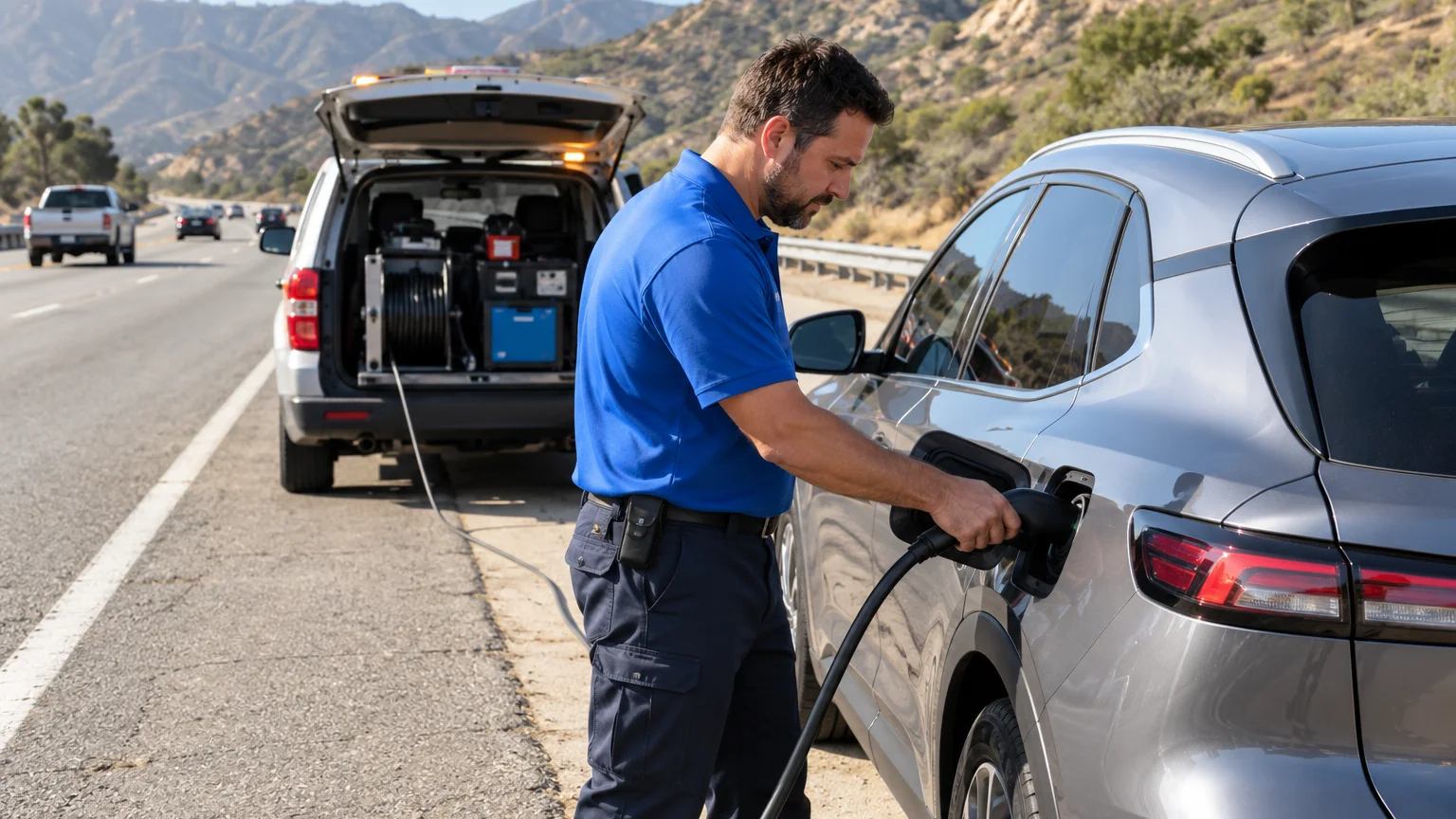
Our non-Tesla EV rescue service is built around this first screening step. Charge Pro SD passes the information to an independent operator. The operator then decides whether the vehicle and requested work match its equipment and scope.
Keep personal belongings, keys, and any manufacturer-supplied adapters accessible. Don’t open electrical enclosures or attempt wiring work. If the manual gives a vehicle-specific roadside instruction, follow that manual instead of advice written for another EV.
Account for I-8 and inland route access
“East County” isn’t a precise pickup point. A vehicle beside I-8 near Alpine presents a different access question than one in an El Cajon parking area. The same applies around La Mesa, Santee, and Lakeside.
Give the operator the road name, direction of travel, nearest exit, and a dropped map pin. State whether the EV is on I-8, SR-67, SR-52, or SR-125. If it’s off the highway, provide the parking lot entrance or nearest cross street.
Mention anything that could affect access. Examples include a parking structure, gate, narrow shoulder, locked property, or vehicle positioned against a wall. Don’t claim the location can accommodate a particular truck or charger. Let the operator assess access from the details and images.
Safety comes first when the vehicle is exposed to traffic. The California Highway Patrol says to call 911 when a disabled vehicle is in a traffic lane or dangerous location. Don’t wait for a referral service when there’s an immediate hazard.
East County requests also shouldn’t be handled as copies of coastal or northern calls. Our guide to EV roadside assistance in Lakeside and Alpine focuses on that local corridor. Drivers farther north can use the separate North County non-Tesla rescue guide.
Charge Pro SD serves San Diego County, but an operator’s acceptance isn’t automatic. Exact location, access, vehicle details, equipment, price, and timing still need confirmation.
Separate low charge from low-voltage trouble
A low displayed driving charge doesn’t automatically explain every disabled EV. A separate low-voltage problem may leave the vehicle unable to wake, shift, unlock, or begin charging. Those symptoms require model-specific review, not a generic battery assumption.
Report what the vehicle actually shows. If the main display lists remaining charge, record it. If nothing illuminates, say that plainly. If an app shows a warning or last-known charge, provide a screenshot and its timestamp.
Don’t request a jump only because the vehicle appears dead. First identify the exact model year and consult its owner’s manual. The approved connection points, power supply, sequence, and post-start instructions can differ. Some manufacturer instructions also warn against using an EV to jump another vehicle.
Likewise, don’t assume mobile charging solves a low-voltage fault. Charging the traction battery and supporting a low-voltage system are different requests. The operator needs to know which symptoms are present before proposing service.
Avoid touching high-voltage components, exposed cables, or damaged charging hardware. This page doesn’t provide jump-start, wiring, or fault-diagnosis instructions. Those steps must come from the current manufacturer documentation and a qualified provider.
When you contact emergency EV roadside assistance, describe both the displayed charge and the low-voltage symptoms. Charge Pro SD will share that information with a local operator. The operator must confirm the proposed service, equipment, price, and timing directly with you.
If the symptoms remain unclear, say so. An honest “no display and no confirmed warning” is more useful than a confident but unsupported diagnosis.
Confirm the connector before charging
“Non-Tesla” doesn’t identify a connector. Give the operator the exact make, model, model year, and charge-port type. Photograph the inlet, any adapter, and the connector you were trying to use.
The U.S. Department of Energy distinguishes AC charging from DC fast charging. J1772 and J3400, also called NACS, can be used for AC Level 2 equipment. A CCS vehicle inlet uses the J1772 section for AC charging and adds lower pins for DC charging.
That distinction matters during roadside screening. A plug that appears to fit doesn’t prove that the equipment, voltage, power, adapter, and vehicle are compatible. The operator must verify the whole setup.
Don’t describe an adapter by appearance alone. Share its manufacturer, label, and intended use if known. Confirm whether it came with the vehicle or was purchased separately. Don’t use an adapter outside its documented purpose.
Also report the difference between an empty battery and a failed charging attempt. If the car was connected but didn’t charge, record any station message and vehicle warning. Note whether the connector latched or released, but don’t force it.
No operator capability should be assumed from a service name. An independent operator must confirm that it has suitable equipment for that vehicle and location. It must also explain the proposed service before you agree.
Charge Pro SD doesn’t guarantee a charging result. Battery condition, starting charge, vehicle limits, equipment output, and electrical service can affect charging time.
Choose roadside help or transport
The final decision is whether on-site help fits the vehicle’s condition. A low-charge situation may support a charging discussion. A low-voltage symptom may require a different service. Damage, unresolved faults, inaccessible positioning, or incompatible equipment may point toward transport instead.
Don’t decide based only on distance to a charger. First ask what the operator proposes to do and whether that method matches the current owner’s manual. Confirm the vehicle, model year, charge port, approved adapter, symptoms, and exact position.
For roadside help, ask the operator to name the equipment it plans to use. Confirm the service goal and what happens if the vehicle still won’t move. Charging output and vehicle acceptance can vary, so don’t treat a promised amount of range as certain.
For transport, ask how the vehicle will be loaded and handled. Share whether it can shift, steer, unlock, or enter the manufacturer’s required transport setting. Don’t attempt an unfamiliar release or tow procedure from a different model’s guide.
Price and timing come from the independent operator. Charge Pro SD doesn’t set either one. Get those terms directly before accepting service. You should also confirm the intended destination when transport is proposed.
A referral works best when the request is specific. “Non-Tesla EV on eastbound I-8 near an identified exit, exact warning photographed, connector confirmed” gives an operator far more context than “car dead in East County.”
That detail helps separate a suitable roadside request from a situation needing transport. It doesn’t guarantee acceptance or a particular outcome.
When to call us
Call when your non-Tesla EV is disabled in El Cajon, La Mesa, Santee, Lakeside, Alpine, or elsewhere in San Diego County and you need an operator to assess mobile rescue or transport. Call us at (858) 400-4465 and we’ll connect you with a local EV rescue operator.