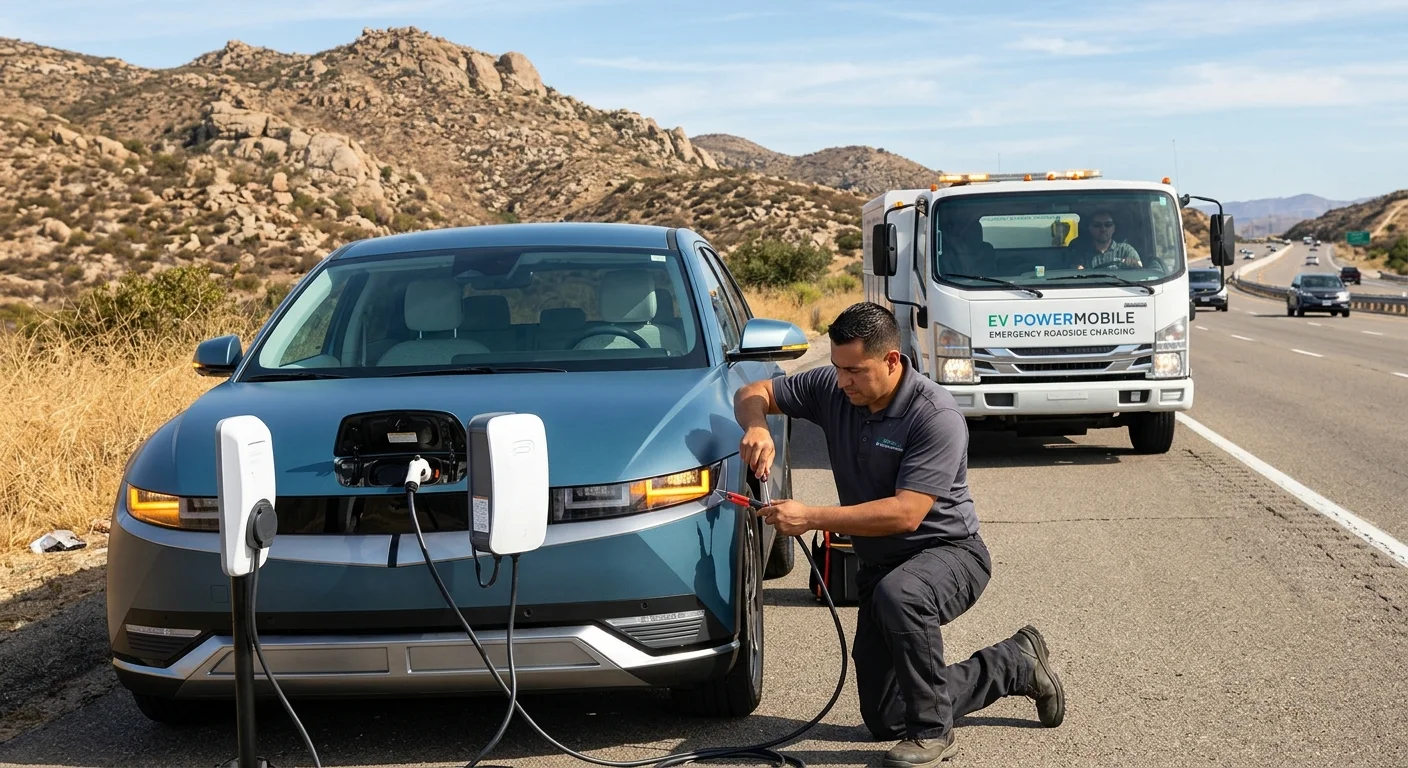
Driving an EV through Lakeside or Alpine offers unique beauty, but also unique challenges for battery range. When your electric vehicle unexpectedly runs out of charge on a rural road or a steep I-8 grade in East San Diego County, it’s more than an inconvenience, it’s a critical safety concern. Knowing who to call for rapid, reliable emergency EV roadside assistance can make all the difference.
Why Lakeside and Alpine EV trips end short
Lakeside and Alpine are beautiful communities, but their distinct geography poses specific range challenges for EV owners. Unlike flat coastal drives, the terrain here features rolling hills and significant elevation changes, especially as you head further east. Climbing those grades, like those around El Capitan or into Alpine itself, requires more battery power than you might expect. This increased energy demand, combined with higher speeds on highways like SR-67 and I-8, can quickly deplete an EV’s charge. Drivers often underestimate how much range these conditions consume.
Many EV apps and in-car estimates are based on flatter, more consistent driving. They don’t always factor in the sustained climbs common to East County. If you’re coming from a lower elevation, say downtown San Diego or even El Cajon, and heading up to Alpine, your battery works harder for longer. Hot summer days in Lakeside and Alpine also affect battery performance and cabin cooling needs, further drawing down your charge. Winter conditions, while less common for extreme cold, can still impact range if you’re using more heating.
It’s common for drivers in areas like Winter Gardens, Bostonia, and Flinn Springs to find themselves with less charge than anticipated. Perhaps they made an extra stop, a detour, or simply misjudged the impact of the terrain. This isn’t a problem with your EV; it’s a characteristic of driving electric in a geographically diverse region like East San Diego County. Understanding these factors is the first step in preventing an out-of-charge EV recovery situation.
I-8 east, SR-67, and the climb past Alpine
The I-8 corridor through East County is a critical artery, but for EV drivers, it’s also a gauntlet. Beyond Alpine, the freeway truly begins its climb towards the higher elevations of Pine Valley, Descanso, and eventually into Imperial County. This sustained ascent, often at freeway speeds, is a major factor in unexpected range depletion. Similarly, SR-67, winding its way through Lakeside and toward Ramona, involves significant grades that stress EV batteries. These routes are notorious for catching EV drivers off guard.
When you’re driving an EV on I-8 east, particularly past the Alpine exit, you’re entering an area with fewer public charging stations. The infrastructure thins out considerably compared to more urban parts of San Diego County. This means your margin for error shrinks. If you’ve been pushing your range and then hit a long uphill section, suddenly your estimated miles-to-empty can drop dramatically. We see this often with drivers who might be commuting, heading out for a weekend trip, or simply exploring the beautiful but remote areas beyond Alpine.
For example, the stretch from Alpine up towards the Viejas Grade can be especially challenging. It’s not just the incline, but also the limited opportunities to pull off or find a charging point. This makes proactive planning crucial. However, even the most meticulous planners can encounter unforeseen circumstances, like unexpected traffic, a longer-than-planned detour, or even just a miscalculation of how much power that last hill consumed. That’s when a rapid response for EV roadside assistance in El Cajon or further east becomes vital.
Rural East County: cell coverage and shoulder safety
Rural East County presents unique safety challenges when an EV runs out of charge. Unlike urban areas with consistent cell service and well-lit shoulders, the remote stretches around Lakeside, Alpine, and especially along I-8 east can be isolated and dangerous. Cell phone reception often becomes spotty or non-existent in certain canyons and passes. This makes calling for help, or even reaching emergency services, significantly more difficult and time-consuming. Imagine being stranded with a dead phone battery too, and suddenly you’re truly isolated.
Shoulder safety is another critical concern. Many roads in this region, including sections of I-8 and SR-67, have narrow or non-existent shoulders. This puts you and your vehicle perilously close to fast-moving traffic, especially large trucks, which are common on these routes. Visibility is also a major issue, particularly at dusk or night. Without power, your vehicle’s lights may be dim or non-functional, making you hard to spot. These conditions significantly increase the risk of a secondary accident.
Staying safe while waiting for help is paramount. If you do find yourself stranded, try to pull over as far as possible from the flow of traffic. Engage your hazard lights immediately, if your 12V battery allows. Use reflective triangles or flares if you have them. Your priority is to ensure your visibility and minimize your exposure to potential hazards. These remote locations aren’t just an inconvenience; they’re a legitimate safety hazard that demands a fast and capable rescue response. Our dedicated teams understand the specific dangers of EV roadside assistance along I-8 east San Diego and the surrounding rural areas.
Response from our East County staging
Understanding the unique challenges of East County, Charge Pro SD has strategically positioned resources to provide rapid EV rescue services for Lakeside and Alpine drivers. We’re not just a dispatcher; we have dedicated mobile charging units staged to serve these specific communities and the I-8 corridor efficiently. This local presence means quicker response times when every minute counts, especially in remote or unsafe locations. When you call us, you’re connecting directly with a team that knows the terrain and understands the urgency.
Our technicians are equipped with purpose-built mobile EV charging trucks that can deliver a sufficient charge to get your EV back on the road. We don’t just provide a trickle charge; we deliver enough power to help you reach the nearest reliable charging station or your destination, depending on your needs. This eliminates the need for a tow in many out-of-charge situations, saving you time, hassle, and potential damage to your vehicle. We focus on getting you moving again with minimal disruption.
We also understand the specific needs of various EV makes and models, including Tesla and other non-Tesla brands. Our equipment is compatible with all major EV types, ensuring we can assist you regardless of what you drive. Our goal is to provide a seamless and professional rescue experience, even when you’re in a tough spot in rural East County. We prioritize safety, efficiency, and clear communication from the moment you call until you’re safely back on your way.
Mobile charge vs tow for rural East County drivers
When your EV runs out of charge in rural East County, you typically have two main options: a mobile charge service or a traditional tow. For drivers in Lakeside, Alpine, and the I-8 corridor, a mobile charge often presents significant advantages, making it the preferred solution for an out-of-charge recovery. The primary benefit is convenience and speed. Instead of waiting for a tow truck to transport your vehicle to a charger, our mobile unit comes directly to you, delivers a charge, and gets you back on your way quickly. This means less downtime and a faster resolution to your predicament.
Towing an EV, especially one with a completely dead 12V battery, can be complex and potentially lead to damage if not done correctly. Many tow truck operators may not have the specialized equipment or training required for safely transporting a wide range of electric vehicles. A flatbed tow is often recommended, but even then, connecting to a vehicle with no power requires specific procedures. With a mobile charge, you avoid these risks entirely. You simply get the power you need to drive your EV as it was designed.
Furthermore, consider the logistics and cost. A tow to the nearest charging station might be a significant distance in rural areas, leading to higher towing fees. Once there, you still need to wait for your vehicle to charge. Mobile charging offers a direct solution right where you are. It’s typically a more cost-effective and less complicated process, especially when you’re stuck in a remote location with limited options. For the unique challenges of East County driving, a mobile charge is usually the safest, quickest, and most economical choice.
When to call us
When your EV’s battery warning light turns red, or you find yourself unexpectedly out of charge on the challenging roads of Lakeside, Alpine, or I-8 East County, it’s time to call the experts. Don’t risk waiting in an unsafe location or attempting a risky solution. Our team is ready to provide fast, professional EV roadside assistance and out-of-charge recovery. Call us at (858) 400-4465 for a same-day estimate.