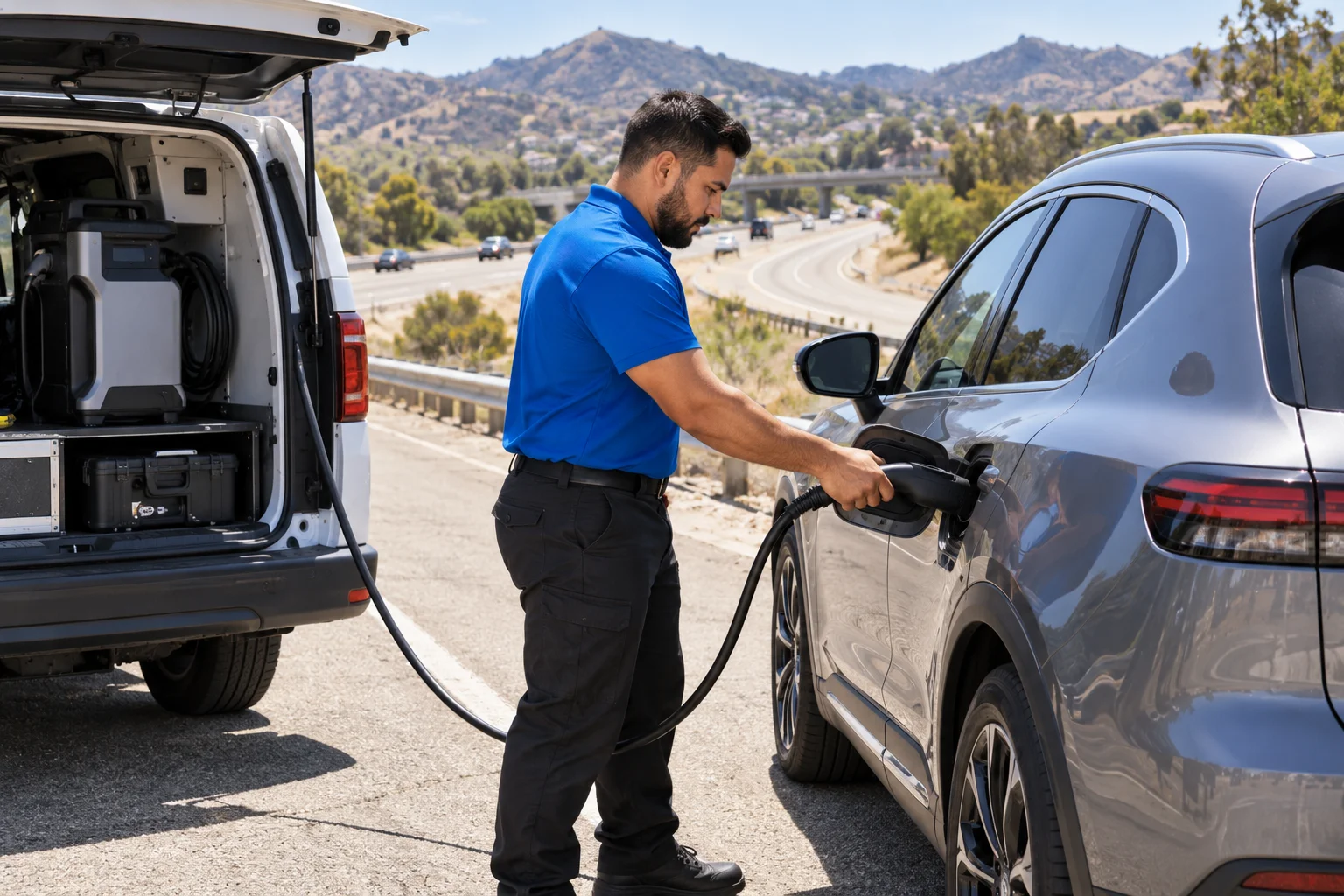
A stalled EV in Santee creates one immediate decision. You need to determine whether mobile charging or vehicle transport fits the situation. That starts with your location, vehicle symptoms, charge port, and access conditions.
Share your SR-52 or SR-125 location
Start with a location another person can identify without guessing. “Santee” alone covers too much ground for an operator to evaluate access. State whether you’re on SR-52, SR-125, Mission Gorge Road, Mast Boulevard, or a nearby property.
On a freeway, share the route and travel direction. Add the last exit you passed or the next visible exit sign. If you’re near the SR-52 and SR-125 connection, don’t describe the location as simply “near the interchange.” Your direction and position matter.
Explain whether the EV is in a traffic lane, on a shoulder, at an exit, or off the freeway. The California Highway Patrol says to call 911 when a disabled vehicle is in a traffic lane or dangerous location. Other roadside requests in metropolitan areas can go through 511 by asking for roadside assistance. Don’t assume either service provides mobile EV charging.
For a stall near Mission Gorge Road or Mast Boulevard, send the business name, street address, or map pin. Mention which entrance provides access. Large parking areas can have several driveways that don’t connect internally.
Photos can clarify the vehicle’s position without a long explanation. Include the surrounding space, nearby barriers, and the side containing the charge port. Our guide to an EV running out of charge on SR-52 covers the corridor decision in more detail.
Tell empty charge from low-voltage trouble
An EV that won’t move isn’t automatically out of propulsion-battery charge. The operator needs the symptoms before deciding whether mobile EV charging deserves consideration.
Report what happened before the stall. Share the displayed charge level, warnings, and whether the vehicle gradually lost usable range. State whether the screens remain on and whether the car recognizes the key. Don’t interpret a warning from memory. Send its exact wording or a clear photo.
A dark display, failed door response, or inability to enter a driving mode may point away from a simple empty-charge event. Those observations don’t confirm the cause. EVs have separate high-voltage and low-voltage systems, but the correct recovery process depends on the exact vehicle.
Avoid experimenting with wiring, jump points, or charging hardware. Model years can differ, even within the same vehicle line. The owner’s manual and manufacturer support material remain the proper sources for vehicle-specific procedures.
Also report whether the EV is plugged in. If it is, explain what the charging screen, station, or vehicle app shows. Don’t force a connector or attempt an unverified release method.
Charge Pro SD is a referral service. We connect drivers with licensed, independent local operators. The matched operator reviews the symptoms and proposed service. The operator may decide that charging doesn’t match the reported problem and discuss another recovery option.
Account for parking and driveway access
Mobile charging depends on more than reaching a Santee address. The vehicle’s exact position may affect whether an independent operator can safely and lawfully provide the proposed service.
Describe the setting clearly. A driveway off Mast Boulevard differs from a marked freeway shoulder. A parking space near Mission Gorge Road differs from a gated garage, narrow carport, or underground level.
Tell the operator about gates, height limits, tight turns, security desks, blocked driveways, or assigned parking. If the EV is behind another vehicle, say so. Mention whether the charge-port side faces a wall, fence, traffic lane, or neighboring space.
Don’t assume a property owner allows roadside equipment on the premises. Charge Pro SD couldn’t confirm a universal parking or access rule for Santee properties. Apartment managers, businesses, homeowners associations, and lot operators may set their own conditions. Confirm access with the person controlling the property.
If you’re in a commercial lot, provide the business name and the entrance you used. If you’re at a residence, explain whether the operator can approach the EV from the street or driveway. Don’t promise access until any gate or property restrictions are checked.
These details let the matched operator evaluate the request before accepting it. They don’t guarantee that mobile charging is suitable. Our broader Santee EV roadside assistance guide explains how location and symptoms shape other rescue choices.
Prepare the details an operator needs
Gather the vehicle information before requesting emergency EV charging in Santee. Start with the make, model, model year, and displayed battery level. Include the exact charge port and any approved adapter you have.
Don’t identify compatibility from the connector’s shape alone. The U.S. Department of Energy’s charging guidance explains that charging involves different equipment and power levels. Actual charging time depends on factors including battery state, vehicle capacity, equipment output, and electrical service.
Share the following details in plain language:
- Your exact location and travel direction
- Whether the EV is in a dangerous location or traffic lane
- The make, model, and model year
- The displayed charge level and warning messages
- The charge port and approved adapters present
- Whether screens, locks, and driving controls respond
- Parking, gate, clearance, and charge-port access
- The destination you’re trying to reach
The independent operator must confirm the vehicle, equipment match, proposed service, price, and timing. Charge Pro SD doesn’t set those terms. We also don’t promise a specific amount of delivered charge or driving range.
Ask what service is being proposed before accepting it. Confirm where the vehicle must remain and whether property permission is needed. If the request involves a garage or private lot, verify that the operator has received an accurate access description.
For a confirmed empty-charge event, review the out-of-charge recovery service before calling. It explains the referral process without assuming charging will fit every vehicle or location.
Choose mobile charging or transport
The goal after a stall isn’t always a full battery. It’s a recovery plan that matches the vehicle, location, access, and reported problem.
Mobile charging may be considered when the propulsion battery is depleted, the vehicle and equipment are compatible, and the location allows the proposed service. The matched operator decides whether those conditions are met. Ask the operator what charging equipment is proposed and what result can reasonably be discussed for your vehicle.
Transport may be the better path when charging isn’t compatible or access prevents the proposed work. It may also fit when the symptoms don’t indicate an empty propulsion battery. A failed low-voltage system, vehicle fault, damaged charge port, or unresponsive controls requires a different assessment. These examples aren’t a remote diagnosis.
On SR-52 or SR-125, location safety can control the decision before charging compatibility does. A vehicle in a dangerous position needs emergency guidance first. Don’t treat a mobile-charging request as a substitute for 911 when the vehicle is in a traffic lane or another dangerous location.
In a Santee driveway or parking lot, access and property permission may carry more weight. Share those limits before an operator accepts the request. Don’t wait until arrival to mention a gate, low clearance, or blocked charge-port side.
The final choice belongs to you and the independent operator after the details are reviewed. Charge Pro SD makes the connection. It doesn’t perform the charging or transport, own the equipment, set the price, or warrant the operator’s work.
When to call us
Call when your EV has stalled in Santee and a licensed local operator needs to assess mobile charging or transport. Have your vehicle, symptoms, connector, location, and access details ready.
Call us at (858) 400-4465 and we’ll connect you with a local EV rescue operator.