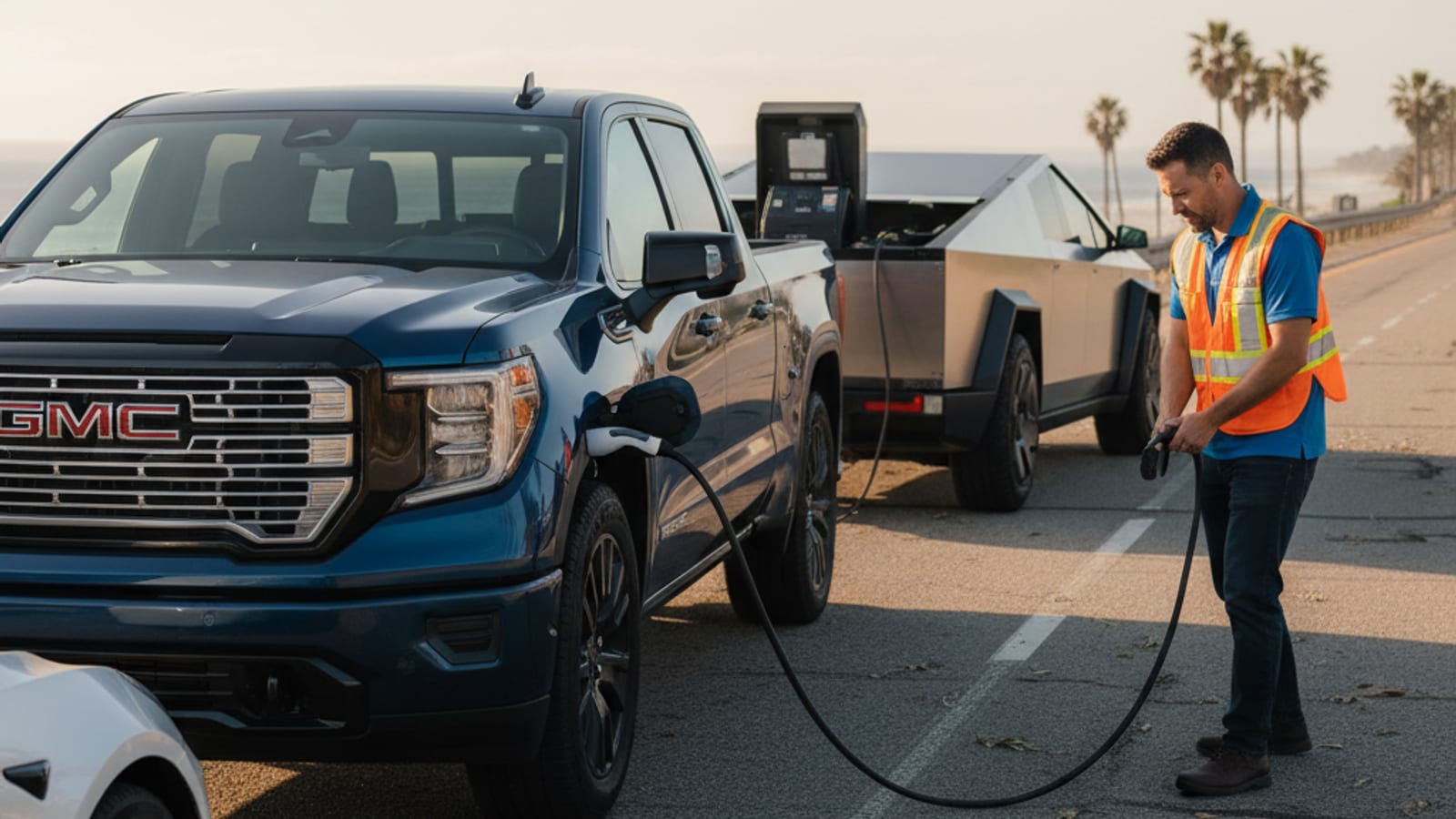
Imagine driving your new GMC Sierra EV along I-5 near Camp Pendleton, maybe heading north from Oceanside. You’ve been enjoying the smooth ride and quiet cabin, but you miscalculated the range. The battery indicator drops rapidly, then the dreaded warning light appears. Soon, your powerful electric truck coasts to a stop, leaving you stranded with no power. This scenario, while unsettling, is a real possibility for any EV driver, even in advanced vehicles like the Sierra EV. Knowing your options for GMC Sierra EV emergency charging can make all the difference between a minor inconvenience and a major headache.

San Diego County boasts one of the highest EV adoption rates in the US. However, this doesn’t mean the charging infrastructure is perfect everywhere. Pockets of sparse chargers exist, especially in East County’s mountain areas like Julian or Ramona, or along the I-5 stretch near Camp Pendleton, creating a 20-mile charging desert. When your GMC Sierra EV runs out of charge, you need a quick, efficient solution. This guide covers what to do, what to expect, and how Charge Pro SD can get your Sierra EV moving again.

Understanding your GMC Sierra EV’s range and charging needs

The GMC Sierra EV is a robust electric truck designed for impressive range and capability. Its large battery pack offers significant mileage on a full charge. However, several factors can impact your real-world range, especially in San Diego’s diverse environment.

Factors affecting GMC Sierra EV range

  • Driving style: Aggressive acceleration and high speeds consume more energy. Freeway driving, particularly on major arteries like I-15 or I-8, can reduce efficiency compared to city driving.
  • Payload and towing: The Sierra EV is built for work. Hauling heavy loads or towing a trailer significantly decreases range. Planning for extra charging stops becomes essential when using your truck for its full capabilities.
  • Terrain: San Diego’s varied topography plays a role. The I-8 climb from El Cajon to Alpine, gaining over 1,500 feet of elevation, demands substantial power. While regenerative braking helps on the downhill, the uphill segment is a heavy draw.
  • Temperature: While San Diego’s mild coastal climate rarely causes cold-weather range loss, hot inland summer temperatures are a concern. Areas like Escondido, El Cajon, and Santee can hit 100°F+, potentially reducing EV range by 10-20% due to battery cooling demands and cabin air conditioning.
  • Accessory use: Using the climate control, infotainment system, or power outlets for tools can subtly chip away at your range.

Battery management tips for San Diego drivers

To avoid needing GMC Sierra EV emergency charging, consider these practices:

  • Plan your route: Before longer trips, especially to areas with fewer chargers like Anza-Borrego or Julian, use your truck’s navigation or a charging app to identify charging stations. Know where Level 2 and DC fast chargers are located.
  • Charge regularly: Make home charging your primary method. SDG&E offers TOU-EV rates, which make charging overnight (midnight to 6 AM) more economical.
  • Monitor your consumption: Pay attention to your Sierra EV’s energy usage display. Understand how your driving habits affect range in real-time.
  • “Buffer” your range: Aim to arrive at your destination or next charging stop with at least 10-20% battery remaining. This buffer accounts for unexpected detours, closed chargers, or miscalculations.

When your GMC Sierra EV runs out of charge: immediate steps

Despite careful planning, it can happen. Your GMC Sierra EV might give you warnings, but eventually, it will power down to protect its battery. When this occurs, your immediate actions are critical for safety and recovery.

Safety first: pulling over and securing your vehicle

The moment you receive a low battery warning, begin looking for a safe place to pull over.

  1. Activate hazard lights: Make your vehicle highly visible to other drivers.
  2. Maneuver to the shoulder: If possible, pull completely off the road or into a safe parking area. On busy freeways like I-805 or SR-163, this is paramount.
  3. Stay inside: Unless it’s absolutely unsafe, remain in your vehicle. It offers the best protection from traffic. If you must exit, do so carefully and stand well away from the road.
  4. Assess your surroundings: Note your exact location. Are you on a busy freeway, a quiet residential street, or a remote mountain road in East County? This information helps roadside assistance locate you quickly.

For more detailed safety advice when stranded, read our post on [/blog/out-of-charge-on-freeway-what-to-do/].

What your GMC Sierra EV does when the battery is critically low

Modern EVs, including the Sierra EV, have sophisticated battery management systems. They don’t just “die” instantly.

  • Reduced power: You’ll likely experience a significant reduction in power output. The vehicle might limit acceleration and top speed to conserve energy.
  • Accessory shutdown: Non-essential systems like climate control or infotainment might shut down to preserve the remaining power for propulsion.
  • “Limp mode”: Your Sierra EV might enter a “limp home” mode, allowing you to travel a very short distance at low speed to a safer location or a nearby charger.
  • Complete shutdown: Eventually, the traction battery will reach its minimum safe operating level, and the vehicle will stop. The 12V auxiliary battery, however, usually retains enough charge for basic functions like hazard lights, door locks, and communication systems for a while. If your 12V battery also dies, you might need a [/services/tesla-12v-battery-jump/], though this is less common for the traction battery.

Emergency charging options for your GMC Sierra EV

Once you’re safely pulled over, it’s time to consider how to get your GMC Sierra EV charged.

1. Public charging stations (if you can reach one)

If you have a sliver of range left, or you’re very close to a charger, this might be an option.

  • CCS compatibility: The GMC Sierra EV uses the CCS (Combined Charging System) standard for DC fast charging and Level 2 AC charging. This is important to remember when searching for stations. While many new EVs are adopting NACS, the Sierra EV is still CCS.
  • Using charging apps: Apps like ChargePoint, PlugShare, or your vehicle’s built-in navigation can help you locate nearby chargers. Filter for CCS compatibility. In San Diego, you’ll find a good number of public charging ports (~2,000+ Level 2 and DCFC), but coverage is uneven. For example, while coastal cities like La Jolla and Carlsbad have ample options, parts of East County like Julian or Ramona have very few. You can find charger locations through sources like the DOE Alternative Fuels Data Center.
  • The “charging desert” reality: Be aware of areas like the 20-mile stretch of I-5 around Camp Pendleton where public charging is virtually non-existent. Planning ahead for these zones is key.

2. Portable EV chargers (if you have one)

Some EV owners carry portable Level 1 or even Level 2 chargers.

  • Level 1 (120V) limitations: A Level 1 charger plugs into a standard household outlet. While it can provide a trickle charge, it’s incredibly slow. For a large battery like the Sierra EV’s, a Level 1 charger might only add 3-5 miles of range per hour. Getting enough charge to move your truck could take many hours, if not a full day. This is rarely a viable emergency solution on the roadside.
  • Level 2 (240V) portability: Some more powerful portable chargers exist that can plug into a 240V outlet (like those for RVs or electric dryers). If you happen to be near such an outlet and have the right adapter, this could offer a faster charge (around 20-30 miles per hour). However, finding such an outlet when stranded is highly unlikely.

3. Calling for mobile EV roadside assistance

For most stranded GMC Sierra EV drivers in San Diego, mobile EV roadside assistance is the most practical and efficient solution. This is where Charge Pro SD excels.

  • On-site charging: Instead of towing your vehicle to a charger, we bring the charger to you. Our service eliminates the need for a tow truck and the associated delays.
  • Our specialized rescue vehicle: Charge Pro SD dispatches a Tesla Cybertruck equipped with a 240V / 9.6 kW bed outlet. This powerful setup allows us to deliver a significant charge directly to your stranded EV.
  • Universal compatibility: While our rescue vehicle is a Tesla Cybertruck, we carry both a NACS (North American Charging Standard) plug and a CCS adapter. This means we can provide emergency charging for any EV on the road, including your GMC Sierra EV.
  • Fast, efficient power: A 9.6 kW charge rate provides approximately 30-40 miles of range per hour, depending on your Sierra EV’s efficiency and battery state. This is enough to get you to the nearest reliable charging station or even home for overnight charging.
  • Service across San Diego County: Whether you’re stuck on I-8 heading towards the desert, on SR-52 in Mission Valley, or navigating the winding roads of Ramona, our team can reach you. We understand the specific challenges of each area, from the high EV density of Del Mar to the charger scarcity in East County.

When you’re out of charge, a mobile EV charging service saves time and stress. Learn more about our approach at [/services/mobile-ev-charging/]. You can also read about the benefits over traditional towing in our article [/blog/mobile-ev-charging-vs-tow/].

Why towing your GMC Sierra EV might not be the best option

While towing is a traditional roadside assistance method, it often presents more challenges than solutions for a dead EV, especially a large truck like the GMC Sierra EV.

  • Cost and complexity: Towing an EV can be more expensive due to specialized equipment requirements. Many EVs, including the Sierra EV, should not be flat-towed (towed with all four wheels on the ground) if the drive wheels are engaged. This often requires a flatbed tow truck.
  • Time consumption: Waiting for a flatbed tow truck, loading the vehicle, transporting it to a charging station, and then waiting for it to charge can take many hours.
  • Potential for damage: Improper towing can cause damage to the EV’s drivetrain or battery system. It’s crucial that tow operators understand EV-specific towing procedures.
  • Limited charging options at dealerships: Even if towed to a dealership, they might not have immediate fast-charging availability. You could still face a long wait.

For comprehensive out-of-charge recovery, Charge Pro SD offers a better alternative. Visit our [/services/out-of-charge-recovery/] page to understand how we can help.

Preventing future GMC Sierra EV range anxiety in San Diego

Being stranded is a valuable lesson. Here are strategies to minimize the chances of needing GMC Sierra EV emergency charging again.

Pre-trip planning and route optimization

  • Utilize your truck’s navigation: The Sierra EV’s infotainment system likely integrates charging station information and can help plan routes with charging stops.
  • Use third-party apps: Supplement your vehicle’s system with apps like PlugShare or A Better Routeplanner (ABRP). These often have more up-to-date information on charger availability and status.
  • Consider elevation changes: When planning trips to Julian or down to Anza-Borrego, factor in the significant elevation changes. Driving east on I-8 from El Cajon to Alpine, for instance, consumes much more energy than driving west.
  • Account for hot weather: On hot summer days in inland areas like Santee or El Cajon, assume a 10-20% reduction in your expected range. Adjust your charging stops accordingly.

Home charging habits and SDG&E programs

  • Install a Level 2 home charger: This is the most convenient and cost-effective way to keep your Sierra EV charged. You can wake up to a “full tank” every day.
  • Take advantage of SDG&E TOU-EV rates: SDG&E’s Time-Of-Use rates for electric vehicles incentivize charging during off-peak hours, typically midnight to 6 AM. This significantly reduces your electricity costs.
  • Smart charging: Many home chargers and EV apps allow you to schedule charging sessions to automatically start during off-peak hours.

Monitoring battery health and software updates

  • Regular service: Follow GMC’s recommended service schedule for your Sierra EV. This helps ensure all systems, including the battery, are functioning optimally.
  • Software updates: Keep your Sierra EV’s software up to date. Manufacturers frequently release updates that improve battery management, charging efficiency, and overall performance.
  • Understand your battery degradation: All EV batteries degrade over time. While modern batteries are designed for longevity, understanding your battery’s current health can help you estimate real-world range more accurately.

San Diego’s unique EV charging challenges and solutions

San Diego County is a hub for EV innovation, but it has its quirks when it comes to charging infrastructure.

  • Coastal vs. inland disparities: While coastal cities like La Jolla, Del Mar, and Carlsbad have a high density of EVs and chargers, areas further inland or in the mountains, such as Alpine, Ramona, and Julian, have significantly fewer public charging options. This creates real range anxiety for drivers venturing into these regions.
  • Freeway gaps: The I-5 corridor through Camp Pendleton presents a unique challenge, acting as a “charging desert” for about 20 miles between Oceanside and San Clemente. Drivers need to ensure they have sufficient charge before entering this stretch. The I-8 climb eastbound from El Cajon is another area where range can deplete faster than expected.
  • Road trip planning: Popular EV road trips from San Diego, like those to Anza-Borrego Desert State Park, Julian (for apple pie), or Temecula wine country (via I-15), require careful charging planning. Anza-Borrego, in particular, has very sparse charging infrastructure.
  • Public charger availability: San Diego has over 2,000 public charging ports, but finding an available and functional DC fast charger can still be a challenge during peak times or in popular locations. This underscores the value of mobile emergency charging.

Comparing emergency EV charging options

OptionProsConsIdeal Scenario
Mobile EV Rescue (Charge Pro SD)- Charger comes to you
- Fast, on-site charge (9.6 kW)
- Avoids towing damage
- Quickest solution to get moving
- Not a full charge (enough to reach next station)
- Service fee applies
Stranded far from chargers, on a freeway, or in a remote area in San Diego
Traditional Towing- Moves vehicle regardless of charge
- Can take vehicle to service center
- Expensive, slow, complex
- Risk of drivetrain damage if not flat-bedded
- Still need to wait for charge at destination
Vehicle needs mechanical repair, not just a charge
Portable Charger (Level 1)- Uses standard household outlet
- Always an option if near an outlet
- Extremely slow (3-5 miles/hour)
- Not practical for roadside emergency
- Requires access to an outlet
Overnight trickle charge at a friend’s house in an absolute pinch
Calling a Friend (ICE)- Free, familiar face- Cannot directly charge EV
- Only useful for ride, not vehicle recovery
- Limited assistance
If you just need a ride home and can leave your vehicle safely

Frequently asked questions

How much does GMC Sierra EV emergency charging cost?

The cost for GMC Sierra EV emergency charging from Charge Pro SD varies based on your location within San Diego County and the time of day. We provide transparent pricing upfront when you call. This fee covers the dispatch of our specialized Tesla Cybertruck, the on-site charging service, and getting you enough range to reach a public charger or your home.

How long does a mobile charge take for a GMC Sierra EV?

With our 240V / 9.6 kW mobile charging setup, we can typically add between 30-40 miles of range per hour to your GMC Sierra EV. Our goal is to provide enough charge to get you to the nearest reliable Level 2 or DC fast charging station, or to safely reach your home for overnight charging. The actual time spent charging on-site is usually 30-60 minutes.

Can I charge my GMC Sierra EV from another EV?

While it is technically possible for some EVs with bi-directional charging capabilities to charge another EV, this feature is not widespread or standardized for emergency roadside use. The GMC Sierra EV does have ProPower Onboard, which provides external power outlets, but this is for AC loads and not designed to charge another EV’s traction battery directly. Relying on another EV for a roadside charge is generally not a practical or recommended emergency solution. For more on this, see our blog post about [/blog/charging-ev-from-another-ev/].

What’s the best way to avoid running out of charge in San Diego?

The best way to prevent needing emergency charging in San Diego is consistent planning. Always start long trips with a full charge, use your vehicle’s navigation or a charging app to plan stops, and factor in San Diego’s unique terrain (like the I-8 climb) and summer heat. Regular home charging, especially during SDG&E’s off-peak TOU-EV hours, also helps maintain a healthy charge level.

Does my GMC Sierra EV have roadside assistance coverage?

Most new GMC Sierra EVs come with a manufacturer’s roadside assistance plan, typically for a few years or a certain mileage. This coverage might include towing or basic assistance. However, it’s essential to check the specifics of your plan. Many traditional roadside assistance plans primarily offer towing, which, as discussed, isn’t always the best solution for an out-of-charge EV. Charge Pro SD offers specialized mobile EV charging that often bypasses the limitations of standard roadside assistance.

When your GMC Sierra EV battery runs dry in San Diego, you have options. Understanding them and knowing who to call can turn a stressful situation into a manageable one. Charge Pro SD is here to provide fast, reliable, and specialized mobile EV charging service across San Diego County. If you find yourself stranded and needing GMC Sierra EV emergency charging, do not hesitate to call us directly.

For immediate assistance, call Charge Pro SD at (858) 400-8901. You can also learn more about our specific services for non-Tesla vehicles on our [/services/non-tesla-ev-rescue/] page.