The Hyundai Ioniq 5 quickly became a favorite among San Diego EV drivers. Its distinctive retro-futuristic design and impressive charging capabilities make it a common sight from La Jolla to Chula Vista. For any electric vehicle owner, understanding the battery is fundamental. Knowing your Hyundai Ioniq 5 battery size and its real-world implications helps manage range, plan trips, and avoid unexpected strandings. This guide explains everything you need to know about the Ioniq 5’s battery, its capacity, and how it performs in San Diego’s unique driving environment.
Hyundai Ioniq 5 battery options: a closer look
Hyundai offers the Ioniq 5 with two primary battery configurations. These options cater to different needs, balancing initial cost with extended range. Both battery packs use advanced lithium-ion technology. They integrate with the Ioniq 5’s 800-volt electrical architecture, a feature typically found in more expensive EVs. This architecture allows for remarkably fast DC fast charging speeds.
Standard range battery
The Standard Range Ioniq 5 comes with a smaller battery pack. This option is ideal for drivers with shorter commutes or those who primarily use their EV for city driving. It offers a balance of affordability and sufficient daily range.
- Gross Capacity: 58.0 kWh
- Usable Capacity: Approximately 54.0 kWh
- Motor: Typically paired with a single rear-wheel drive (RWD) motor.
- EPA Estimated Range: Around 220 miles (depending on model year and trim).
While it has a lower range, the Standard Range still benefits from the Ioniq 5’s fast charging. This means quicker top-ups when you find a DC fast charger. For San Diego residents primarily driving within urban areas, this battery size often provides more than enough daily range.
Long range battery
The Long Range Ioniq 5 is the more popular choice, especially in a region like San Diego County with its high EV adoption and varied driving terrain. This battery significantly extends the vehicle’s range, making longer commutes and road trips much more feasible. It’s particularly useful for those heading out to Julian or Anza-Borrego, where charging infrastructure is sparse.
- Gross Capacity: 77.4 kWh (for 2022-2024 models)
- Usable Capacity: Approximately 74.0 kWh
- Motor: Available with both RWD and all-wheel drive (AWD) configurations. AWD models offer more power but slightly less range.
- EPA Estimated Range:
- RWD: Around 303 miles (2022-2024 models)
- AWD: Around 260 miles (2022-2024 models)
The larger battery pack provides greater flexibility. It reduces range anxiety when navigating longer stretches of I-5, I-15, or I-8. This is especially true when passing through areas like the Camp Pendleton “charging desert” between Oceanside and San Clemente.
Hyundai Ioniq 5 battery specifications table
Understanding the numbers helps clarify the differences between the Ioniq 5’s battery options. Here’s a breakdown of key specifications for the common model years.
| Feature | Ioniq 5 Standard Range (2022-2024 RWD) | Ioniq 5 Long Range (2022-2024 RWD) | Ioniq 5 Long Range (2022-2024 AWD) |
|---|---|---|---|
| Gross Battery Capacity | 58.0 kWh | 77.4 kWh | 77.4 kWh |
| Usable Battery Capacity | ~54.0 kWh | ~74.0 kWh | ~74.0 kWh |
| Drivetrain | RWD | RWD | AWD |
| EPA Estimated Range | 220 miles | 303 miles | 260 miles |
| Horsepower | 168 hp | 225 hp | 320 hp |
| Torque | 258 lb-ft | 258 lb-ft | 446 lb-ft |
| AC Charging (Level 2 Max) | 10.9 kW | 10.9 kW | 10.9 kW |
| DC Fast Charging (Max) | Up to 239 kW | Up to 239 kW | Up to 239 kW |
| 0-60 mph Acceleration | 7.4 seconds | 7.3 seconds | 4.7 seconds |
Note: EPA estimates and charging speeds can vary slightly based on specific trim, environmental conditions, and driving habits. Usable capacity is an approximation as manufacturers often buffer a portion of the battery for longevity.
Understanding battery capacity and range
Battery capacity, measured in kilowatt-hours (kWh), directly relates to how much energy an EV can store. Think of it like a fuel tank. A larger kWh number means a larger “tank” and generally, more range. However, range isn’t just about battery size. Many factors influence how far your Ioniq 5 can travel on a single charge.
What is usable capacity?
You’ll notice two capacity figures: gross and usable. Gross capacity is the total energy the battery can hold. Usable capacity is the portion of the battery that the vehicle makes available for driving. Manufacturers intentionally “buffer” the battery, meaning they don’t allow it to charge to 100% or discharge to 0%. This practice helps protect the battery’s longevity and performance over its lifespan. For the Ioniq 5, the usable capacity is typically about 95% of the gross capacity. This buffer is a good thing for your battery’s health.
Factors influencing real-world range
The EPA estimated range is a useful benchmark. However, your actual range will vary. Here’s what affects it:
- Driving Style: Aggressive acceleration and high speeds consume more energy. Maintaining a steady speed on freeways like I-5 or I-805 helps conserve range.
- Temperature: Extreme temperatures affect battery performance.
- Terrain: Uphill climbs require more energy. The I-8 eastbound ascent from El Cajon to Alpine, for example, gains over 1,500 feet of elevation. This climb can significantly impact your range on that segment.
- Accessory Use: Heating, air conditioning, and infotainment systems draw power from the battery.
- Tire Pressure and Type: Properly inflated tires reduce rolling resistance.
- Payload: Carrying more weight reduces range.
Real-world range in San Diego: what to expect
San Diego County presents a unique set of challenges and advantages for EV drivers. While the region boasts one of the highest EV adoption rates in the US, understanding local conditions is key to maximizing your Ioniq 5’s range.
Impact of San Diego’s climate on range
- Hot Inland Summers: Areas like Escondido, El Cajon, and Santee frequently see summer temperatures exceeding 100°F. High heat can reduce an EV’s range by 10-20% because the battery management system works harder to keep the battery cool. Using air conditioning also draws significant power. Planning your charging stops for these hotter areas is smart.
- Mild Coastal Climate: Fortunately, San Diego’s mild coastal climate means EVs rarely face cold-weather range loss. Unlike regions with harsh winters, Ioniq 5 owners here don’t typically see the 20-30% range reduction associated with freezing temperatures. This is a big advantage for drivers in La Jolla, Del Mar, and Carlsbad.
Elevation changes and range consumption
San Diego’s diverse geography includes flat coastal plains, rolling hills, and significant mountain ascents.
- I-8 Climb to Alpine: The eastbound journey on I-8 from El Cajon towards Alpine involves a sustained climb of over 1,500 feet. This elevation gain requires heavy range consumption. Drivers heading to Julian or other mountain areas should account for this. Always start with a good charge.
- Regenerative Braking: While uphill driving uses more energy, the Ioniq 5’s excellent regenerative braking helps recover some of that energy on descents. This is particularly effective coming down from areas like Ramona or Palomar Mountain.
San Diego’s EV infrastructure and range anxiety
San Diego has over 2,000 public charging ports, including Level 2 and DC fast chargers. However, coverage is uneven.
- Charging Deserts: East County (Alpine, Ramona, Julian) and mountain areas have significantly fewer chargers. Range anxiety is a real concern on these roads. The 20-mile stretch of I-5 through Camp Pendleton also creates a charging desert between Oceanside and San Clemente. Drivers need to plan carefully for these segments.
- Popular Road Trips:
- Anza-Borrego Desert: Charging is very sparse. A Long Range Ioniq 5 is almost a necessity for this trip.
- Julian: Mountain driving and limited chargers make a full charge essential.
- Temecula Wine Country: Accessible via I-15, which has better charging options.
Understanding these local nuances helps Ioniq 5 owners better predict their real-world range. It allows them to plan charging stops effectively, preventing unexpected out-of-charge situations. You can learn more about planning for these situations in our blog post on /blog/out-of-charge-on-freeway-what-to-do/.
Charging the Ioniq 5: speeds and infrastructure
The Hyundai Ioniq 5 stands out for its charging capabilities, largely due to its 800-volt architecture. This advanced system allows for some of the fastest charging speeds available in a non-Tesla EV.
Level 1 (120V) home charging
- Speed: Extremely slow. Adds only about 2-4 miles of range per hour.
- Use Case: Best for occasional overnight trickle charging or emergencies when no other option is available. It’s not a practical daily charging solution for the Ioniq 5’s battery size.
Level 2 (240V) home charging
- Speed: The Ioniq 5 can accept up to 10.9 kW on Level 2 AC charging. This translates to adding roughly 35-40 miles of range per hour.
- Charging Time: To fully charge a Long Range Ioniq 5 (77.4 kWh) from empty to full would take approximately 7-8 hours.
- San Diego Specifics: SDG&E offers Time-of-Use (TOU-EV) rates for home charging. The cheapest electricity rates are typically from midnight to 6 AM. This makes overnight Level 2 charging an economical and convenient option for Ioniq 5 owners in San Diego. Installing a Level 2 charger at home is a recommended upgrade for any EV owner.
DC fast charging (DCFC)
This is where the Ioniq 5 truly shines. Its 800-volt system allows for incredibly rapid charging at compatible DC fast charging stations.
- Speed: The Ioniq 5 can accept peak charging rates of up to 239 kW.
- Charging Time: Under ideal conditions, the Ioniq 5 can charge its battery from 10% to 80% in about 18 minutes. This is a game-changer for long trips or quick top-ups on the go.
- Connectors: The Ioniq 5 uses the CCS (Combined Charging System) connector. With an adapter, it can also use NACS (North American Charging Standard) chargers, including many Tesla Superchargers.
- San Diego Public Charging: While San Diego has a good number of public chargers, their distribution is uneven.
- Tesla Superchargers: Locations like Mission Valley, Carlsbad, Escondido, Chula Vista, and National City provide fast charging. Remember, a CCS-to-NACS adapter is needed for your Ioniq 5 to use these.
- Other Networks: ChargePoint, Electrify America, EVgo, and others offer CCS fast chargers across the county. You can find available stations using apps or websites like ChargePoint’s station finder.
- Gaps: Be mindful of charging gaps in East County and mountain areas. Always check your route for charger availability before heading out.
Regularly using DC fast charging is convenient but can generate more heat in the battery than Level 2 charging. For everyday use, Level 2 home charging is often preferred for battery health and cost.
Maximizing your Ioniq 5’s battery life and range
Proper care helps extend the life and efficiency of your Hyundai Ioniq 5’s battery. These practices are especially useful for San Diego drivers who experience varied conditions.
- Avoid Extreme Charging/Discharging: Try to keep your battery charge between 20% and 80% for daily driving. Only charge to 100% when you need the full range for a long trip. Avoid letting the battery drop below 10% frequently.
- Preconditioning: In hotter San Diego summers, use the Ioniq 5’s preconditioning feature while plugged in. This brings the battery to an optimal temperature before you drive, improving efficiency from the start and reducing strain on the battery.
- Maintain Tire Pressure: Properly inflated tires reduce rolling resistance, which directly impacts range. Check your tire pressure regularly.
- Utilize Regenerative Braking: The Ioniq 5 has excellent regenerative braking, including “i-Pedal” for one-pedal driving. Maximize its use, especially on downhill sections like coming off the I-8 towards Mission Valley. This recovers energy back into the battery.
- Drive Smoothly: Avoid aggressive acceleration and hard braking. A smooth driving style conserves energy.
- Minimize High-Speed Driving: On freeways like I-5 or I-15, speeds above 70 mph significantly reduce range compared to 60-65 mph.
- Hyundai’s Battery Warranty: Hyundai offers a robust warranty on its EV batteries. For the Ioniq 5, this typically covers the battery for 10 years or 100,000 miles, whichever comes first. This provides peace of mind regarding long-term battery health. You can find more details on Hyundai’s official website.
By following these tips, Ioniq 5 owners can ensure their battery performs optimally for years to come, whether cruising the coast or venturing inland.
When your Ioniq 5 runs out of charge in San Diego
Despite the Ioniq 5’s impressive range and San Diego’s growing charging infrastructure, running out of charge can still happen. This is particularly true on less-serviced routes or during unexpected detours. Imagine running low on power on I-8 east of Alpine, or on SR-79 heading towards Julian. Or perhaps you’re near Camp Pendleton on I-5, realizing the next charger is further than your remaining range allows.
This is where Charge Pro SD steps in. We specialize in mobile EV roadside rescue for all electric vehicles, including your Hyundai Ioniq 5. We understand that finding a working charger quickly isn’t always possible, especially when you’re stranded. Towing can be slow, expensive, and sometimes difficult to arrange for EVs. Our service offers a direct solution.
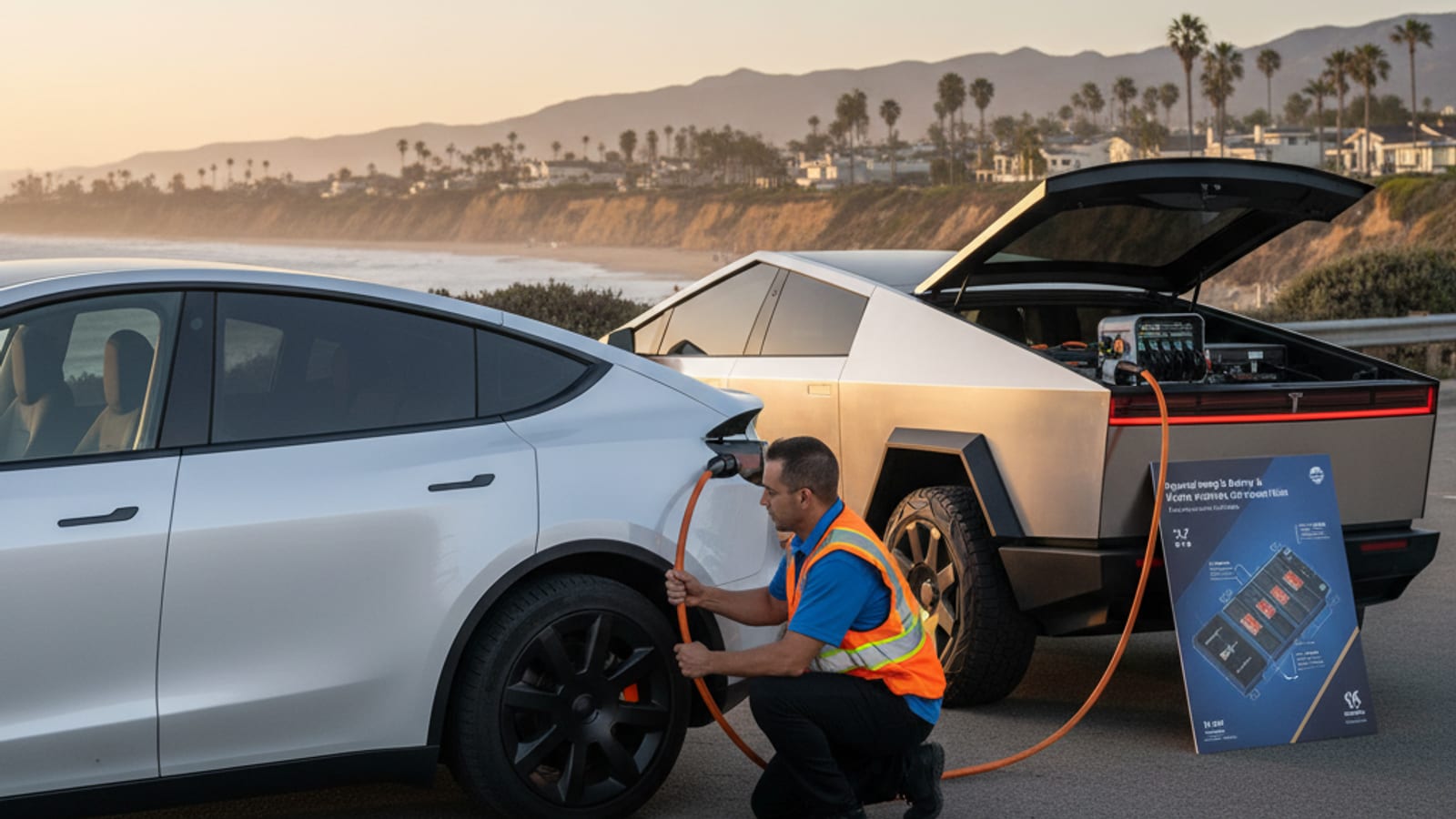
When you call us, we dispatch our custom-equipped Tesla Cybertruck. This unique rescue vehicle carries a 240V / 9.6 kW bed outlet, capable of delivering a significant boost of power directly to your Ioniq 5. Our technicians arrive with both a NACS plug and a CCS adapter, ensuring compatibility with your non-Tesla EV. We provide enough charge to get you safely to the nearest public charging station or your home.
Whether you’re stuck on I-15 in Escondido, I-805 near Chula Vista, or a less-traveled road in Ramona, we cover all of San Diego County. We’re here to help with:
Don’t let range anxiety ruin your drive in San Diego. If your Ioniq 5 needs a charge, we’re just a call away.
Frequently asked questions
What is the usable battery capacity of the Hyundai Ioniq 5?
The Hyundai Ioniq 5 has two main battery options. The Standard Range model offers approximately 54.0 kWh of usable capacity. The Long Range model, more common in San Diego, provides about 74.0 kWh of usable capacity, allowing for longer drives and reducing range anxiety.
How long does it take to fully charge a Hyundai Ioniq 5?
Charging times vary significantly by charger type. On a Level 2 (240V) home charger at 10.9 kW, a Long Range Ioniq 5 can charge from empty to full in about 7-8 hours. Using a DC fast charger at its peak rate (up to 239 kW), the Ioniq 5 can go from 10% to 80% charge in a remarkably fast 18 minutes under optimal conditions.
Does the Ioniq 5 battery degrade over time?
Yes, like all lithium-ion batteries, the Ioniq 5’s battery will experience some degradation over time and use. However, Hyundai designs its batteries for longevity and backs them with a strong 10-year or 100,000-mile warranty. Following best practices like avoiding frequent deep discharges or charges to 100% can help minimize degradation.
What is the difference between gross and usable battery capacity?
Gross battery capacity is the total energy a battery pack can physically hold. Usable battery capacity is the portion of that energy that the vehicle’s system makes available for driving. Manufacturers leave a buffer at the top and bottom of the battery’s total capacity to protect its health and extend its lifespan, which is why usable capacity is always slightly less than gross.
Can a Hyundai Ioniq 5 charge another EV?
Yes, the Hyundai Ioniq 5 features Vehicle-to-Load (V2L) technology. This allows the car to act as a mobile power bank, providing up to 3.6 kW of AC power through standard household outlets located inside and outside the vehicle. While primarily designed for powering appliances or tools, it could theoretically provide a very slow trickle charge to another EV with the right adapters.
Don’t get stranded in San Diego with an out-of-charge Ioniq 5
Understanding your Hyundai Ioniq 5’s battery size and capacity is essential for confident EV ownership in San Diego. From navigating hot inland summers to planning trips through mountain roads, knowing your range limits helps keep you moving. But if the unexpected happens and your Ioniq 5 runs out of charge, remember that Charge Pro SD is here to help. Our mobile EV rescue service dispatches a Tesla Cybertruck with a 240V / 9.6 kW outlet and the necessary adapters directly to your location, providing a fast, convenient charge.