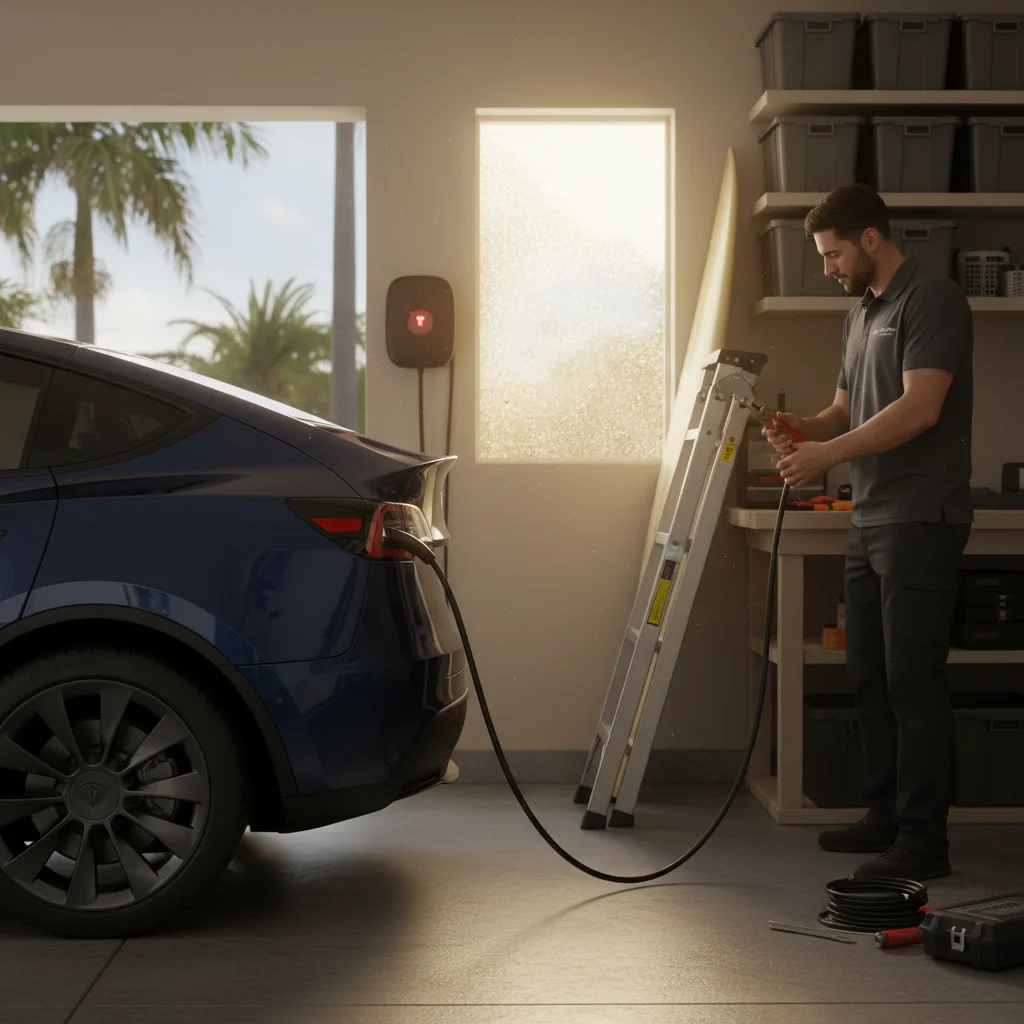
Installing a Level 2 charger at your San Diego home is one of the best parts of EV ownership. You plug in at night and wake up to a full battery. But that convenience vanishes the morning you find your charger failed, your car is nearly empty, and you have a full day ahead.
You might be searching for “ev charger installation in El Cajon” or a “home ev charger installer in Santee.” We see those searches, and we want to be upfront: that’s not what we do. This post will explain who handles installations in San Diego County and, more importantly, what we do when that new charger eventually fails and leaves you stranded in your own driveway.
Why we don’t install — and who in San Diego does
At Charge Pro SD, our specialty is mobile rescue. When an EV runs out of power on the I-15 or a 12V battery dies at Petco Park, we’re the ones who show up. Our fleet is built for emergency roadside service, not for running conduit or pulling permits.
EV charger installation is a job for a licensed electrical contractor. Specifically, you’re looking for an electrician with a C-10 license from the state of California. This isn’t just a recommendation; it’s a requirement for any electrical work that involves hardwiring circuits into your home’s main panel. A proper installation involves assessing your home’s electrical capacity, installing a dedicated 240-volt circuit with the correct gauge wiring, and securing a permit from your local jurisdiction, whether that’s the City of San Diego, Chula Vista, or an unincorporated area of the county.
Attempting to do this yourself or hiring a general handyman is risky. An incorrect installation can damage your EV’s expensive battery, create a fire hazard, and void your homeowner’s insurance. The peace of mind that comes from a professional, permitted job is well worth the cost. To find a qualified installer, we recommend searching for “licensed C-10 electrical contractor specializing in EV chargers” in your specific area, like Escondido or Oceanside.
What to ask before hiring a Level 2 installer
Once you have a list of potential electricians, you need to vet them carefully. Installing an EV charger, or EVSE (Electric Vehicle Supply Equipment), is more specialized than wiring a standard outlet. Here are the key questions to ask any contractor before you sign a contract for a home EV charger installation in San Diego.
Are you a licensed C-10 electrical contractor in California?
This is the most important question. Ask for their license number and verify it on the California Contractors State License Board (CSLB) website. This ensures they have the proper qualifications and are legally allowed to perform the work.
Are you insured and bonded?
A professional contractor will carry liability insurance and be bonded. This protects you and your property in the unlikely event that something goes wrong during the installation. Don’t be shy about asking for proof of insurance.
Do you have specific experience with my charger brand?
While most Level 2 chargers are similar, there can be small but important differences between a Tesla Wall Connector, a ChargePoint Home Flex, or an Emporia charger. An installer familiar with your specific model will be more efficient and less likely to make mistakes.
Will you handle the entire permitting process?
A good installer will manage the permit application and inspection scheduling with your local building department. This process can be tedious, and having an expert handle it saves you a major headache. The quote they provide should ideally include the cost of the permit itself.
Is your quote a flat rate or an estimate?
Ask for a detailed, itemized quote that clearly states whether it’s a fixed price or an estimate that could change. The quote should include all costs for labor, materials (conduit, wiring, breaker), the permit, and any necessary panel upgrades.
What is the warranty on your workmanship?
The charger itself will have a manufacturer’s warranty, but your installer should also offer a warranty on their labor. A one-year warranty is standard and shows they stand behind the quality of their work.
Common home-charger failure modes that strand drivers
Even with a perfect installation, home chargers can fail. And they almost always seem to fail overnight, when you’re counting on them the most. You wake up, check your app, and see that your car only has 10% battery instead of the 90% you expected. Panic sets in.
Here are some of the most common reasons your home charging session might have failed:
- Tripped circuit breaker: This is the first thing to check. The high, continuous power draw of an EV charger can sometimes trip the breaker in your electrical panel, especially in older homes. While a simple reset might fix it, a breaker that trips repeatedly signals a deeper issue that needs an electrician.
- GFCI fault: Modern electrical codes often require a GFCI (Ground Fault Circuit Interrupter) breaker for garage outlets. These are sensitive devices designed to prevent electric shock, but they can sometimes “nuisance trip” from the electronics within the EV charger itself.
- Charger error light: Your charger will have indicator lights. A solid green light usually means everything is fine, but a blinking red or amber light indicates a fault. Your charger’s manual will tell you what the error codes mean, which could range from overheating to an internal component failure.
- Vehicle-side charging error: Sometimes the problem isn’t the charger, but the car. The vehicle’s onboard charger might have detected a problem with the power quality or a communication issue with the EVSE and stopped the session to protect the battery.
- Faulty cable or connector: The charging cable and its connector (the part you plug into your car) are the most handled parts of the system. Over time, they can suffer wear and tear, internal wire damage, or bent pins, leading to failed charging sessions.
Most of these issues aren’t something you can fix yourself at 7 AM on a Tuesday. And an electrician likely can’t come out for hours, or even days.
When a failed home charger means calling for mobile rescue
So, your charger is on the fritz, your battery is in the red, and you have to get the kids to school in Carmel Valley and then commute to your office in Sorrento Valley. A tow truck is an option, but it’s a slow and disruptive one. They’ll have to drag your car to the nearest public charging station, where you’ll have to wait an hour or more just to get enough range to continue your day.
This is the exact scenario where we come in.
Instead of taking your car to a charger, our mobile EV charging service brings the charger to you. One of our Cybertruck rescue vehicles will arrive at your home and deliver a DC fast charge directly to your car. In about 20-30 minutes, we can add 15-25 miles of range—more than enough to get you to work, to an appointment, or to a high-speed public charger where you can fill up completely.
It’s the fastest, most convenient solution for a home charging emergency. Our service is a crucial form of EV roadside assistance that bridges the gap between a dead battery and a working car, all without you ever having to leave your driveway. We turn a day-ruining event into a minor inconvenience.
How to bridge the gap between install jobs
A home charger failure isn’t always a one-day problem. After you discover the issue, you have to find and schedule an electrician to diagnose and fix it. In a busy market like San Diego, that could take several days. What do you do in the meantime? Relying solely on public fast chargers can be time-consuming and expensive.
Our mobile charging service can be your lifeline during this period. We can schedule daily or every-other-day “top-up” visits to your home or office. This ensures you have the range you need to live your life while you wait for the permanent fix from your electrician. It’s a flexible, on-demand solution that keeps you on the road.
You might be wondering about the price. We’ve broken down exactly what to expect in our guide that explores how much mobile EV charging costs. Often, when you factor in the cost of a tow and the value of your lost time, our service proves to be the most efficient and economical option for getting out of a low-charge jam.
When to call Charge Pro
If you’re looking for a C-10 electrician to install a new Level 2 charger, we recommend checking local listings for a qualified contractor. But if that charger—or any charger—fails and leaves you with a dead battery and no way to get where you’re going, we are exactly who you should call. We solve the immediate problem: a lack of range.
Call us at (858) 808-6055 — we’ll roll a Cybertruck rescue truck to you.