An EV out of charge on SR-163 needs a location check before anything else. Identify your direction, nearest exit, vehicle symptoms, and whether an operator can safely reach the car.
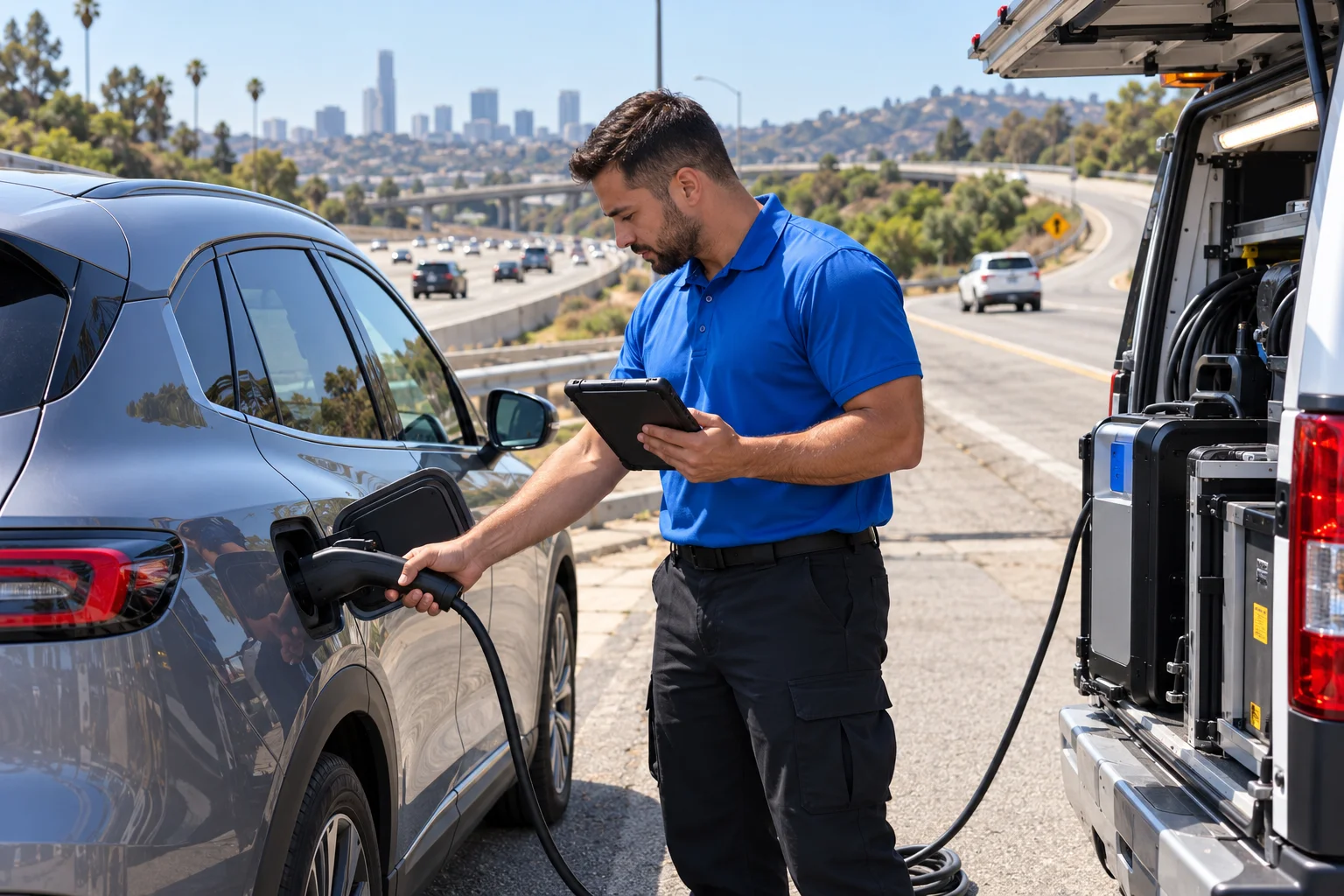
Identify your direction and nearest exit
Start with northbound or southbound SR-163. Don’t rely only on a navigation pin. Tell the operator the last exit you passed and the next one shown. Include whether you’re near Mission Valley, Hillcrest, Balboa Park, I-8, or I-805.
That information separates several very different access situations. “SR-163 in San Diego” isn’t precise enough for a roadside request. A stopped vehicle near the I-8 connection needs different directions than one near Hillcrest. The same applies near Balboa Park or the I-805 connection.
Record what you can see without leaving a safe location. Useful details include:
- Your direction of travel
- The closest visible exit or interchange sign
- Whether you passed or haven’t reached that exit
- Your lane or shoulder position
- A nearby bridge, ramp, barrier, or recognizable landmark
- The location pin shown by your vehicle or phone
- Your EV’s make, model, and model year
If your route included I-8 or I-805, explain which freeway you entered from. Also state whether you’re on SR-163 itself, an entrance ramp, or an exit ramp. Those aren’t interchangeable pickup locations.
Share the location pin along with the written description. Either one can be misunderstood by itself. If you’re unsure about the exit name, say that plainly. Don’t guess. Our broader freeway out-of-charge guide explains what information helps during other San Diego freeway stops.
Follow current roadside safety guidance
Location safety comes before charging or transport. The California Highway Patrol says to call 911 when a disabled vehicle is in a traffic lane or another dangerous location. In metropolitan areas, other roadside-assistance requests can go through 511 by saying “Roadside Assistance.” You can review the current guidance in the CHP FAQ.
There isn’t one verified instruction telling every stranded driver to remain inside or exit the vehicle. The right action depends on traffic, barriers, vehicle position, and other conditions. Follow instructions from emergency personnel when they’re involved.
If you can report the location from where you are, do that. Tell the operator about traffic exposure before discussing equipment.
A vehicle partly blocking a lane isn’t a routine mobile charging request. Report that condition to emergency services. Charging compatibility and transportation choices can wait until the immediate traffic risk is addressed.
For a vehicle outside a traffic lane, describe the available space accurately. Don’t call it a wide shoulder unless an operator could actually use it. Note barriers, curves, narrow pavement, ramp traffic, or anything else affecting access.
Charge Pro SD is a referral service. We connect drivers with licensed, independent local operators. We don’t control emergency traffic response, roadway access, operator availability, or arrival timing. Our emergency EV roadside assistance service can help you request an operator after the situation and location are clearly described.
Tell empty charge from low-voltage trouble
“Dead EV” can describe more than one problem. An empty high-voltage traction battery and a low-voltage electrical issue aren’t the same service request. Don’t diagnose the vehicle from the roadside. Report exactly what the vehicle does.
Start with the dashboard and app. Tell the operator what charge percentage or estimated range appears, if either is visible. Read warning messages exactly. Mention whether the screens turn on, whether the vehicle recognizes the key, and whether it enters its normal driving state.
Also report what happened before the stop. Did the displayed charge fall until the vehicle stopped moving? Did the car retain a displayed charge but refuse to enter its driving state? Did the screens remain dark? These observations help an operator ask the right next questions. They don’t prove the cause by themselves.
Don’t attempt unverified jump-start, wiring, or charging procedures. Low-voltage systems and access points differ by vehicle and model year. The vehicle’s current owner’s manual controls any model-specific procedure.
Before accepting a referral, the independent operator should confirm:
- Exact make, model, and model year
- Displayed charge and warning messages
- Charge-port type and any approved adapter
- Whether the vehicle can enter its driving state
- Whether the vehicle is accessible for charging or transport
- Proposed service, price, and timing
If the traction battery appears empty, out-of-charge EV recovery may fit the request. If the symptoms don’t match an empty battery, tell the operator before service is accepted.
Share shoulder and access details
SR-163 access changes as the route moves through central San Diego. A Mission Valley location, Hillcrest ramp, Balboa Park segment, or I-805 connection gives an operator a better starting point than the freeway name alone.
Describe the car’s position from the operator’s perspective. State whether it’s on the right shoulder, left side, ramp, gore area, parking area, or another location. If you can’t confirm the position safely, say so.
Mention physical access details without assuming equipment will fit. These can include a concrete barrier, locked gate, low-clearance entrance, steep driveway, narrow shoulder, or limited space beside the charge port. Report which side of the vehicle faces traffic and where its charge port is located.
If the vehicle left SR-163 before stopping, give the actual surface-street or parking location. Don’t continue calling it a freeway shoulder request. A vehicle near Balboa Park or in Hillcrest can still require precise access directions. The operator needs the entrance, level, gate, or curb position that leads to the car.
For Mission Valley, distinguish the freeway, a ramp, a frontage area, and a parking structure. If I-8 was part of the route, explain whether the vehicle stopped before or after the connection. Near the northern connection, do the same for I-805.
Our separate I-805 out-of-charge guide covers that corridor. Use the guide matching the road where the vehicle actually stopped.
Don’t promise that an operator can enter a location. Access must be confirmed before the referral is accepted.
Choose mobile charging or transport
Mobile charging and vehicle transport solve different problems. The correct choice depends on the vehicle, symptoms, location, connector, equipment, and destination. An operator must confirm those details before accepting the request.
Mobile charging may be considered when the traction battery is empty and compatible equipment can safely reach the vehicle. It isn’t automatically available for every EV or every SR-163 location. Connector shape alone doesn’t confirm compatibility.
The U.S. Department of Energy distinguishes AC Level 2 equipment from DC fast charging. J1772 and J3400 can be used for AC Level 2, while CCS adds separate lower pins for DC charging. The exact vehicle, adapter, equipment output, and electrical service still matter.
Ask the operator these questions:
- Can the proposed equipment connect to this exact vehicle?
- Is the service AC charging, DC charging, or transport?
- Is an adapter needed, and is it approved for this use?
- Can the operator safely access the reported position?
- What charging result, if any, is being proposed?
- Where would the vehicle be transported?
- What price and timing apply to this request?
Don’t assume a small charge will reach a specific station. Charging time varies with the battery’s state of charge, capacity, vehicle acceptance, equipment output, and other conditions. Public station availability also isn’t guaranteed.
Transport may be the proposed option when charging equipment can’t reach the vehicle, compatibility isn’t confirmed, or the symptoms don’t point to an empty traction battery. The operator should also confirm the vehicle-specific transport method.
Charge Pro SD doesn’t own charging equipment, set prices, choose transport methods, or promise a charging result. The independent operator confirms those terms directly with you. Our mobile EV charging information explains the referral process and the details to provide.
When to call us
Call when your EV can’t continue on SR-163 and you need a mobile charging or transport option assessed. Have your direction, exit, symptoms, vehicle details, and access notes ready. Call us at (858) 400-4465 and we’ll connect you with a local EV rescue operator.