A civilian mobile charger may be able to help, but base entry must be confirmed first. Before arranging service, contact base security and ask what the driver, sponsor, and civilian operator must provide.
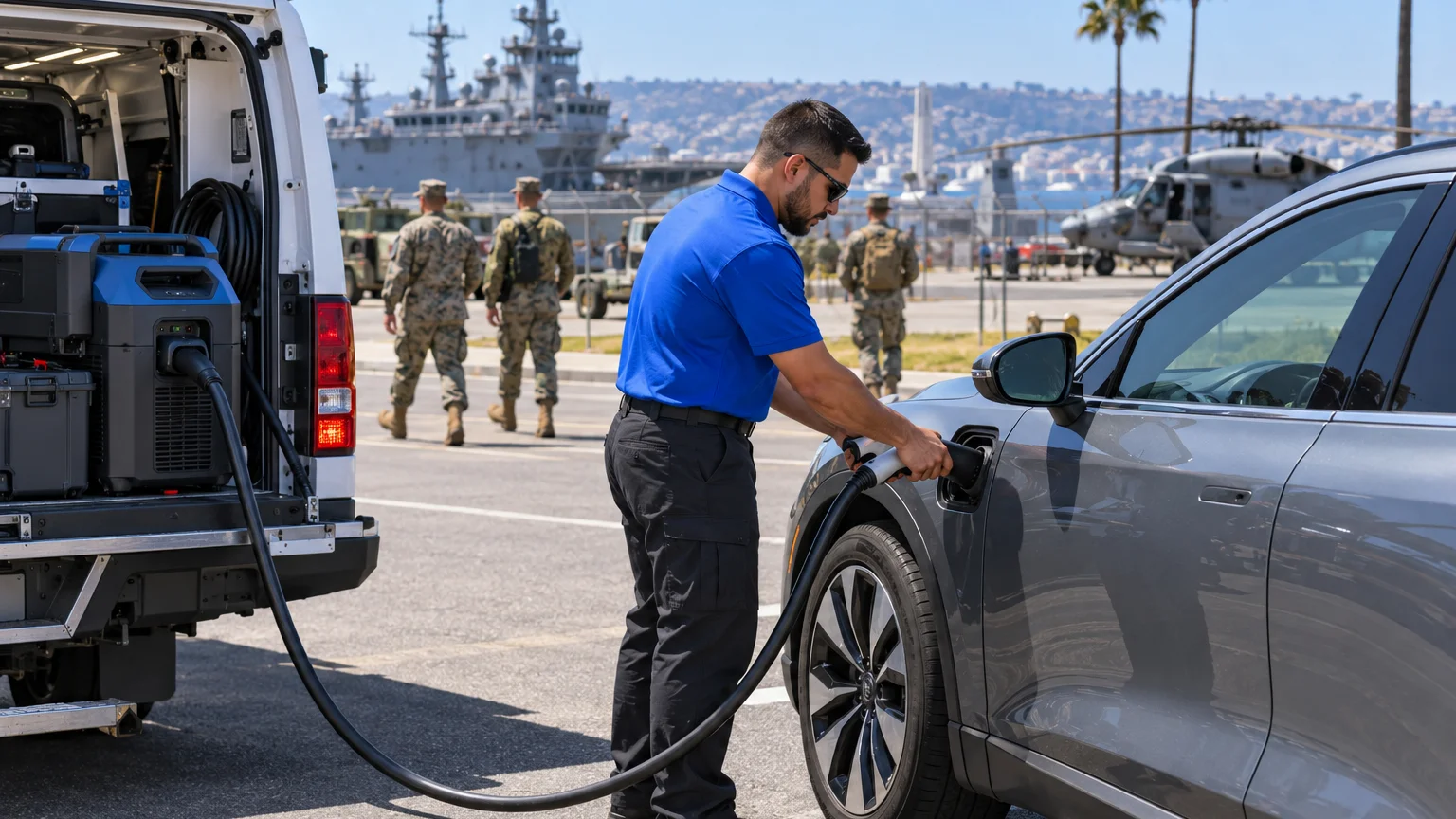
Can a civilian mobile charger enter the base?
There isn’t one confirmed answer for every San Diego military installation. Charge Pro SD couldn’t verify a single current access rule covering Naval Base San Diego, Naval Air Station North Island, Naval Base Point Loma, MCAS Miramar, and Camp Pendleton.
Access may also depend on the operator, vehicle, gate, visit purpose, and current security direction. Don’t assume that a civilian service vehicle can enter because another roadside provider entered before. Don’t send an operator toward a gate until the installation has addressed access for that specific visit.
Start by contacting your command contact, sponsor, or base security. Explain that an EV is disabled on the installation. Say that you’re considering a civilian mobile charging or roadside service vehicle. Ask whether civilian service is permitted and what approval is needed.
Get clear answers to these points:
- Which gate should the operator use?
- Does the driver need a sponsor or escort?
- Must the sponsor meet the operator at the gate?
- Are identification or vehicle documents required?
- Does the operator need commercial vehicle screening?
- Is advance registration required for this visit?
- Are mobile charging vehicles treated differently from tow trucks?
- What should happen if the operator can’t enter?
Current gate hours and visitor procedures weren’t confirmed in the approved facts for this article. Check the installation’s official page and confirm the details with base security that day. A search result, old social post, or remembered procedure isn’t enough.
What to arrange before requesting a referral
Have the access conversation before asking an operator to accept the job. That prevents a civilian vehicle from reaching the wrong entrance without the information needed for screening.
Write down the full installation name. “The Navy base” isn’t specific enough in San Diego. Naval Base San Diego, Naval Air Station North Island, and Naval Base Point Loma are different destinations. The same applies to MCAS Miramar and Camp Pendleton.
Next, record the gate name or gate location given by base security. Include your location inside the installation, but don’t share restricted or sensitive details unnecessarily. A building, parking area, or approved meeting point may help the operator understand the request.
Provide the name and reachable contact information for the sponsor or authorized person handling entry. Ask that person to keep their phone available. If security gave you a case number, visitor instruction, or meeting procedure, relay it exactly.
The operator also needs the vehicle details. Share the make, model, model year, displayed battery level, charge port, approved adapter, warning messages, and symptoms. Say whether the main traction battery appears empty or the vehicle simply won’t power on. Those situations may call for different service.
Charge Pro SD connects drivers with independent local EV rescue operators. It doesn’t control military access or promise that an operator will accept the visit. The independent operator must confirm the proposed service, equipment compatibility, price, timing, and willingness to complete the required entry process.
What to confirm at Navy and Marine Corps installations
For Naval Base San Diego, Naval Air Station North Island, or Naval Base Point Loma, consult the current official Navy Region Southwest or CNIC visitor information. Then contact the installation’s security office through an official channel. Ask specifically about a civilian mobile charging vehicle responding to a disabled privately owned EV.
Charge Pro SD couldn’t confirm current gate hours, sponsor procedures, pass requirements, or commercial vehicle screening rules for those Navy installations from the approved claims ledger. Those details must come from the installation. They can’t be safely inferred from another Navy base’s process.
For MCAS Miramar or Camp Pendleton, use the installation’s current official Marine Corps visitor and commercial vehicle guidance. Confirm the procedure with the installation before arranging the referral. Don’t assume that rules at Miramar match Camp Pendleton.
The same questions matter at either installation. Ask whether a sponsor must submit anything before arrival. Confirm whether the sponsor must meet the service vehicle. Ask which gate handles civilian vendors or roadside operators. State that the proposed vehicle carries mobile EV charging equipment, if that’s the requested service.
No operator credential or standing base access is confirmed here. Ask the independent operator what credentials they actually hold. Then give that information to base security and let the installation decide whether entry is allowed.
Drivers stranded outside Camp Pendleton can also review the separate guide to the Oceanside and Camp Pendleton corridor. That article covers off-base roadside situations, not permission to enter the installation.
Why the operator needs exact vehicle and location details
Gate approval doesn’t establish equipment compatibility. An operator still needs to determine whether the proposed service fits the vehicle and symptoms.
Charging time depends on the battery’s state of charge, battery capacity, the vehicle’s charging capacity, equipment output, and available electrical service. Connector compatibility also depends on the exact vehicle, equipment, and approved adapter. The U.S. Department of Energy charging guide explains the distinctions between AC charging, DC fast charging, and connector types.
Tell the operator whether the EV stopped while driving, won’t shift, won’t unlock, or shows a low-voltage warning. A vehicle that won’t power on may not have a simple out-of-charge problem. Don’t attempt improvised jump-starting, wiring, or adapter combinations.
The operator should receive:
- The full base name and authorized gate
- Your approved meeting or vehicle location
- The sponsor’s name and reachable contact
- The entry steps provided by base security
- The EV’s make, model, and model year
- The charge port and approved adapter available
- The displayed battery level and warning messages
- Whether the vehicle can unlock, power on, or shift
- Any access limits around the vehicle
- The requested service
A mobile EV charging operator can decide whether available equipment may suit the request. For a non-Tesla, the non-Tesla EV rescue page explains the compatibility details worth sharing. Acceptance still depends on confirmed entry, the specific vehicle, and the operator’s assessment.
If the civilian operator can’t enter
Ask base security what alternative is permitted. Don’t direct an operator to wait near a gate without approval. Don’t move the EV unless the installation and vehicle guidance allow it.
Security may direct you to use an installation-approved resource or another recovery process. Charge Pro SD couldn’t confirm which on-base services are currently available at each San Diego installation. Your sponsor, command contact, or base security is the authority for that location.
If an authorized recovery provider can move the vehicle outside the controlled area, ask where the handoff may occur. Confirm that location before requesting a civilian operator. Share the exact public-side meeting point and any instructions affecting access.
A tow may be more appropriate when mobile charging can’t address the symptoms, the vehicle can’t accept a charge, or entry isn’t approved. The independent operator can discuss the proposed service after reviewing the vehicle information. The operator sets the price and timing. Charge Pro SD doesn’t set either one.
If the disabled EV is in a traffic lane or dangerous location, call 911. The California Highway Patrol gives that direction for disabled vehicles in dangerous locations or traffic lanes. Follow on-scene instructions from installation personnel.
Keep your sponsor and operator updated if the approved gate changes. Don’t send sensitive installation details beyond what’s needed to arrange access and reach the vehicle. The goal is a clear handoff between you, base security, the sponsor, and the independent operator.
When to call us
Call after base security has explained the entry process and you have the vehicle details ready. This situation needs a mobile EV rescue operator when entry is permitted and the operator confirms the proposed service fits the vehicle.
Call us at (858) 400-4465 and we’ll connect you with a local EV rescue operator.