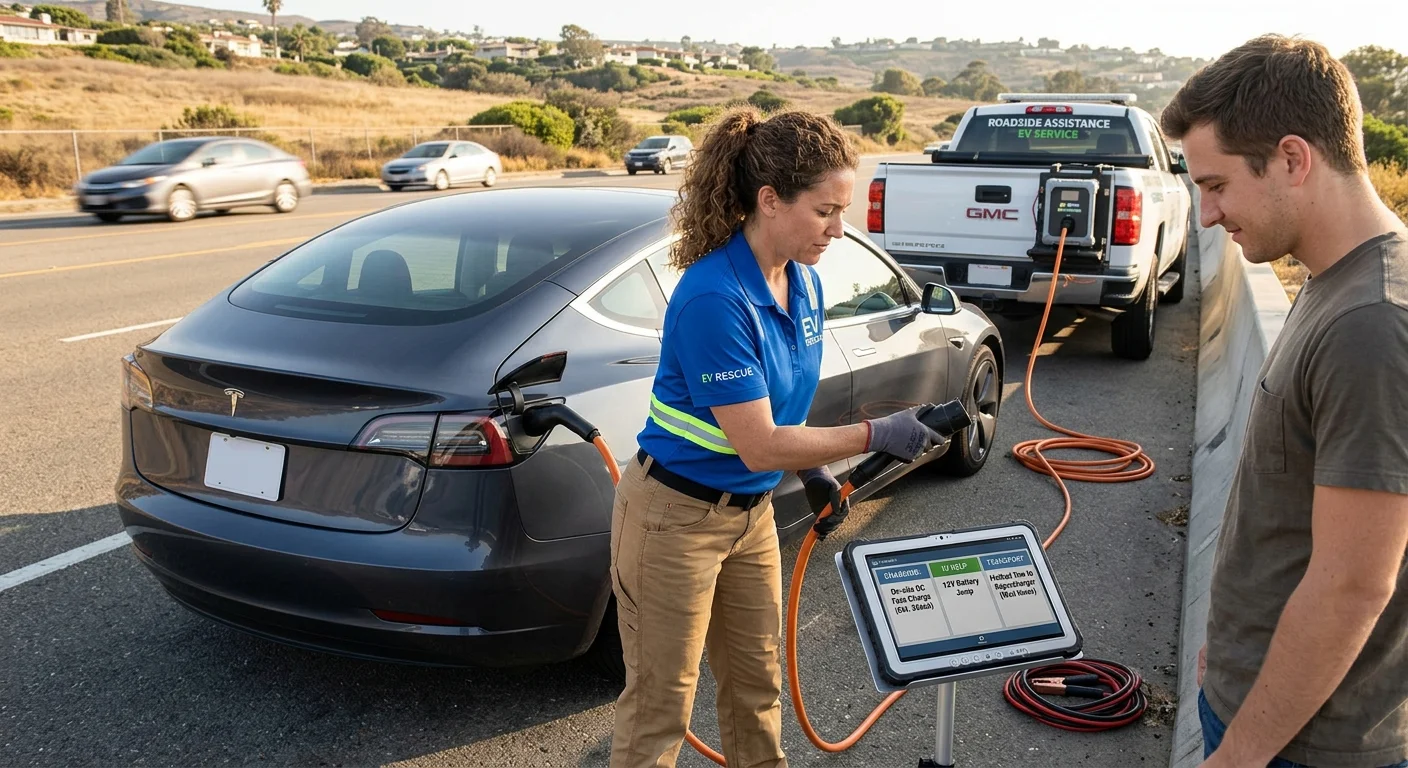
When an electric car dies, use its displayed message to choose the next step. A confirmed empty traction battery points toward charging, a manufacturer-supported low-voltage problem may call for a jump, and an unknown fault or unsuitable location points toward transport. Don’t guess at battery access or procedures before an operator reviews the situation.

A stranded electric car parked safely while its driver compares charging, low-vo

Tell an empty traction battery from lost 12V power

The word “died” doesn’t identify what stopped working. One driver may see an empty driving-battery message. Another may find dark displays and unresponsive controls. Those reports require different questions, but neither confirms the cause by itself.

Start with exactly what the vehicle shows. Report any dashboard message word for word. Note whether the instrument display, interior lights, locks, mobile app, or charge-port controls respond. If a remaining charge level appears, share it without interpreting it. Also tell the operator whether the car shut down while driving or wouldn’t start after parking.

A displayed empty-battery warning supports discussing mobile charging or out-of-charge recovery. Blank screens or unavailable controls may lead the operator to ask about low-voltage power. That still isn’t permission to access a battery or connect equipment. Vehicle designs and approved procedures differ.

Use the current owner’s manual for your exact model and model year. Search its roadside, low-voltage, towing, and charging sections. If the manual isn’t available, tell the operator that before any work begins. Our guide to what happens when an EV 12V battery dies can help you organize the symptoms, but it can’t diagnose your specific car.

The U.S. Department of Energy’s electric-vehicle overview offers general EV background. Your vehicle manual and the independent operator should guide the actual service decision.

Move away from traffic before diagnosing the problem

Traffic exposure comes before roadside diagnosis. If the vehicle presents an immediate danger, contact emergency services and follow their directions. Don’t rely on a general article for instructions about moving a disabled vehicle.

If the car still responds, follow its displayed warnings and manufacturer instructions. Those sources may tell you whether continued movement is permitted. If it won’t move, don’t invent a pushing, rolling, or neutral-release procedure. Tell the responding operator where the vehicle sits and what controls still work.

San Diego location details can change the entire service conversation. “Northbound I-5 near Chula Vista” is more useful than “somewhere in South Bay.” The same applies to I-805 near central San Diego, I-15 near Mira Mesa, SR-78 in North County, and SR-94 in East County. Include the travel direction and nearest visible exit or cross street.

Describe the immediate setting without leaving a protected location. Say whether the car is in a traffic lane, shoulder, surface lot, driveway, curb space, or parking structure. Mention gates, height restrictions, tight turns, or security access when relevant. An operator needs to know whether the service vehicle can legally and physically reach the car.

If emergency personnel are managing the scene, say so. Their directions take priority over troubleshooting by phone. Diagnosis can wait until the vehicle and people involved are in a location where the operator can assess the problem.

Decide whether charging, a jump, or transport fits

The right branch depends on confirmed symptoms, vehicle instructions, and location. “My electric car died” gives an operator a starting point, not a diagnosis.

Discuss charging when the traction battery appears depleted. Share the displayed charge level and warning text. Also provide the make, model, model year, and charge-port status. The operator can then determine whether compatible mobile service is available for that vehicle and setting. Don’t assume the connector, charging method, or required access procedure.

Mobile charging may not fit every stop. The car may be inaccessible, unable to accept a charge, or showing a problem unrelated to stored energy. Our comparison of mobile EV charging and towing explains the questions to raise before selecting either route.

Discuss a jump only after low-voltage trouble is confirmed. The operator should check your symptoms against the manufacturer’s instructions. Don’t choose a jump simply because the displays are dark or the controls don’t respond. Avoid generic battery-access steps, improvised connections, or instructions written for another model.

Discuss transport when roadside service isn’t suitable. That may be the operator’s recommendation when the cause remains unknown, the vehicle can’t accept mobile charging, or the manufacturer requires transport for the displayed condition. Collision damage or an inaccessible location also belongs in the first conversation.

The transport method must follow the current instructions for the exact vehicle. Don’t tell a towing provider how the wheels, parking system, or release controls should be handled unless that direction comes from the manufacturer. Share the manual instead.

The short answer is simple: charge a confirmed empty traction battery, consider manufacturer-approved low-voltage help after confirmation, and use transport when on-site service doesn’t fit.

Share the vehicle and location details

Good information prevents the operator from starting with guesses. Begin with the vehicle’s make, model, model year, and displayed charge level. Read warning messages exactly as written. Don’t replace them with your own diagnosis.

Explain what happened immediately before the car stopped responding. You might report that it was parked, connected to a charger, or traveling on a named road. State only what you observed. If there was an impact, visible damage, smoke, unusual heat, or another immediate hazard, tell emergency services and the operator directly.

Next, describe what still works. Mention the displays, locks, interior lights, mobile app connection, charge-port controls, and gear selection. “Nothing works” is less useful than a short list of tested controls. Don’t keep testing if the manual or emergency personnel tell you to stop.

Provide a precise San Diego County location. Include the road, direction, nearest exit, cross street, business name, parking level, or space marker. A shared location pin can add context. If you’re near San Ysidro, downtown San Diego, East County, or inland North County, name that area too.

Tell the operator about access restrictions. A gated apartment complex, underground garage, paid lot, secured workplace, or narrow residential lane may affect which service is practical. State whether you have the keys and whether someone authorized to approve service is present.

For broader local information after the immediate problem is handled, see our San Diego EV charging guide. It can help with future charging plans, while the independent operator handles the current triage decision.

How Charge Pro SD connects you with an operator

Charge Pro SD is a referral service. We connect stranded drivers with licensed, independent local EV charging professionals. We don’t diagnose the car, perform roadside work, own service vehicles, or transport vehicles.

When you contact us, share the vehicle and location details you’ve gathered. We use that information to make the connection. The independent operator then reviews the symptoms, checks service compatibility, and explains whether charging, low-voltage help, or transport fits.

Our emergency EV roadside assistance page explains the referral service for stranded drivers. It covers situations across San Diego County, including the central city, coastal and inland North County, East County, and South Bay.

The customer contracts with and pays the operator directly. Charge Pro SD doesn’t set the operator’s price or promise an arrival time. Ask the operator to confirm the service scope, current price, payment terms, credentials, and any warranty before authorizing work.

Be clear when the cause hasn’t been confirmed. A responsible referral starts with “unknown problem” when that’s the truth. The operator can decide what equipment and service category fit after reviewing the vehicle, manual, location, and visible symptoms.

If the selected service can’t address the problem, ask the operator what the manufacturer requires next. Don’t authorize a different battery procedure or transport method based only on a generic roadside description.

When to call us

Call when your electric car has stopped, won’t power up, or shows a message you can’t classify. The independent operator determines whether mobile charging, low-voltage help, or transport fits the vehicle and location.

Call us at (858) 400-4465 and we’ll connect you with a local EV rescue operator.