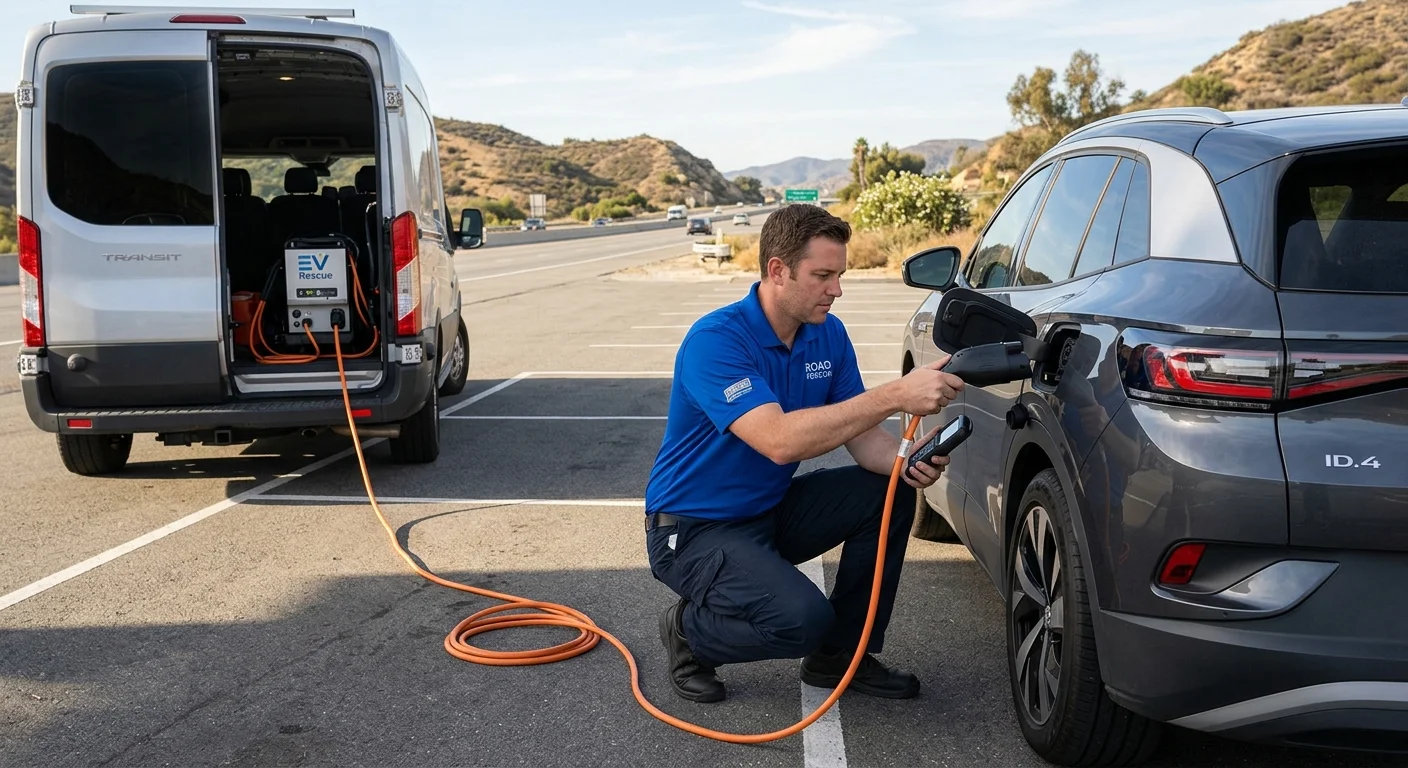
Yes, roadside help may charge a non-Tesla EV where it stops. The matched operator must first confirm that its equipment works with your exact vehicle. When on-site charging won’t fit, transport to a suitable charging location may be the practical next step.
The answer depends on the operator and equipment
Mobile charging isn’t limited to Tesla vehicles. A licensed independent operator may be able to help a Volvo XC40, Rivian, Nissan LEAF, Toyota EV, or another electric model. Compatibility must still be checked for each request.
The vehicle badge alone doesn’t answer the question. The operator needs the model year, exact model, charge-port information, and current condition. The operator also needs to know where the vehicle stopped. Those details help determine whether its available equipment matches the car and setting.
That distinction matters across San Diego County. A Rivian sitting in a Carlsbad motel lot presents a different access situation than an EV stopped near I-5. A Nissan LEAF parked near home may need enough energy to reach a home charger. Another vehicle may need access to a compatible public station. None of those requests should be treated as interchangeable.
Charge Pro SD is a referral service. We connect drivers with licensed independent local professionals. We don’t perform charging, towing, diagnosis, or repair. Our non-Tesla EV rescue service is designed to make that connection without treating every EV like a Tesla.
If you want a broader model-focused overview, read our San Diego non-Tesla EV rescue guide. The main point stays simple: identify the vehicle first, then let the matched operator confirm the service fit.
How mobile charging differs from a standard tow
Mobile charging brings compatible energy equipment to the stopped vehicle. A tow moves the vehicle to another location. Both can be forms of electric car roadside assistance, but they solve the problem differently.
An on-site charge may fit when the vehicle can accept power and the operator has matching equipment. The goal doesn’t have to be a full battery. The driver may only need enough usable charge to reach a known home or public charger. The operator should confirm what its equipment can provide before service begins.
A tow may make more sense when charging compatibility can’t be confirmed. It can also fit when the vehicle won’t accept a charge or its charge port can’t be used. The destination matters too. Tell the operator whether you’re trying to reach home, a public charger, a dealer, or another suitable location.
Charging speed can’t be promised from the vehicle name alone. The US Department of Energy Alternative Fuels Data Center explains that actual charging speeds vary by vehicle battery capacity, state of charge, and ambient temperature. The matched operator must assess its equipment against the actual car.
Our mobile EV charging service helps drivers seek an operator equipped for roadside charging. You can also see how a mobile charging truck works before calling. If you’re weighing both paths, our mobile charging versus towing guide explains the decision in more detail.
Why the connector and vehicle model matter
A charging connector has to match the vehicle’s inlet and charging capability. There isn’t one plug that can be assumed to work with every non-Tesla EV. That’s why the operator should confirm compatibility before heading to the vehicle.
The Department of Energy identifies J1772, CCS, CHAdeMO, and J3400 among EV charging connector formats. That list doesn’t tell you which one your exact vehicle accepts. It also doesn’t establish whether a particular roadside operator carries compatible equipment.
Start with the full vehicle description. “Electric SUV” leaves too much unanswered. “Volvo XC40 Recharge,” “Rivian R1T,” or “Nissan LEAF” gives the operator a useful starting point. Add the model year and trim when you know them. Don’t guess if you’re uncertain.
A clear photo of the charge inlet may help when you’re already parked in a protected location. You can also check the vehicle manual or the charging information shown inside the port area. Share what you find with the operator. The operator can then compare it with the equipment available for that request.
Adapters shouldn’t be assumed either. Having a connector or adapter nearby doesn’t confirm that the complete charging setup will work with the car. Ask the matched professional to verify the connection and equipment before attempting service.
This check protects the purpose of the call. You’re trying to reach a usable charging option, not arrange a visit that can’t serve your vehicle. Exact model details make roadside assistance for an EV much easier to evaluate.
When charging at the stopped vehicle may not fit
On-site charging isn’t the right answer for every depleted EV. The operator may recommend transport when it can’t confirm a compatible setup. Transport may also fit when the charge inlet is inaccessible, the vehicle won’t begin charging, or the location doesn’t allow the operator to position its equipment.
Location details can change the decision. A marked space at a Carlsbad motel offers different access than an I-5 shoulder. A Downtown San Diego parking structure may involve a gate, level number, or posted access instructions. A vehicle near an SR-78 ramp needs a precise direction of travel and nearby landmark.
Tell the operator about those conditions before service is arranged. Don’t describe the vehicle as merely “near Carlsbad” or “somewhere by the freeway.” Share the road, travel direction, closest exit, parking area, and map pin when available.
The vehicle’s condition also matters. Report what the dashboard shows without diagnosing it yourself. A low traction-battery reading is different information from a blank display, locked charge port, visible damage, or an alert message. The matched operator decides whether mobile charging fits the reported condition.
Charge Pro SD can connect you through its emergency EV roadside assistance service. We don’t decide how the physical work will be performed. The independent operator evaluates the stop, vehicle, and available equipment. If charging at the vehicle isn’t suitable, discuss the transport destination and next step directly with that operator.
What to share when requesting local help
A useful request starts with facts the operator can check. Give the year, make, model, and trim when available. Spell out the model name if the phone connection is unclear. Say that it’s a non-Tesla EV and that you’re asking about mobile charging.
Next, describe the vehicle’s current state. Share the displayed battery percentage or remaining range if either appears. Read any dashboard message exactly as shown. Tell the operator whether the screens are active and whether the charge port opens. Don’t reset warnings or guess what they mean.
Then give a precise location. A map pin helps, but include written context too. For a freeway stop, provide the route, direction, closest exit, and whether you’re on a shoulder or off the freeway. For a parking lot, name the business or property and your location within it. For a garage, include the floor and entry instructions.
Explain the result you need. You may want enough charge to reach your home charger. You may prefer transport to a public charging site. If you already chose a destination charger, provide its location so the operator can discuss whether that plan fits.
Finally, ask the independent operator to confirm equipment compatibility and price before service. Charge Pro SD doesn’t own charging equipment, set operator prices, or provide warranties. You’ll contract with and pay the matched professional directly.
Good information won’t guarantee on-site charging. It gives the operator a sound basis for deciding whether non-Tesla EV roadside charging or transport fits the request.
When to call us
Call when a non-Tesla EV has run out of usable charge and you need a local operator to assess mobile charging or transport. Have the vehicle model, charge-port details, dashboard information, and exact San Diego County location ready.
Call us at (858) 400-4465 and we’ll connect you with a local EV rescue operator.