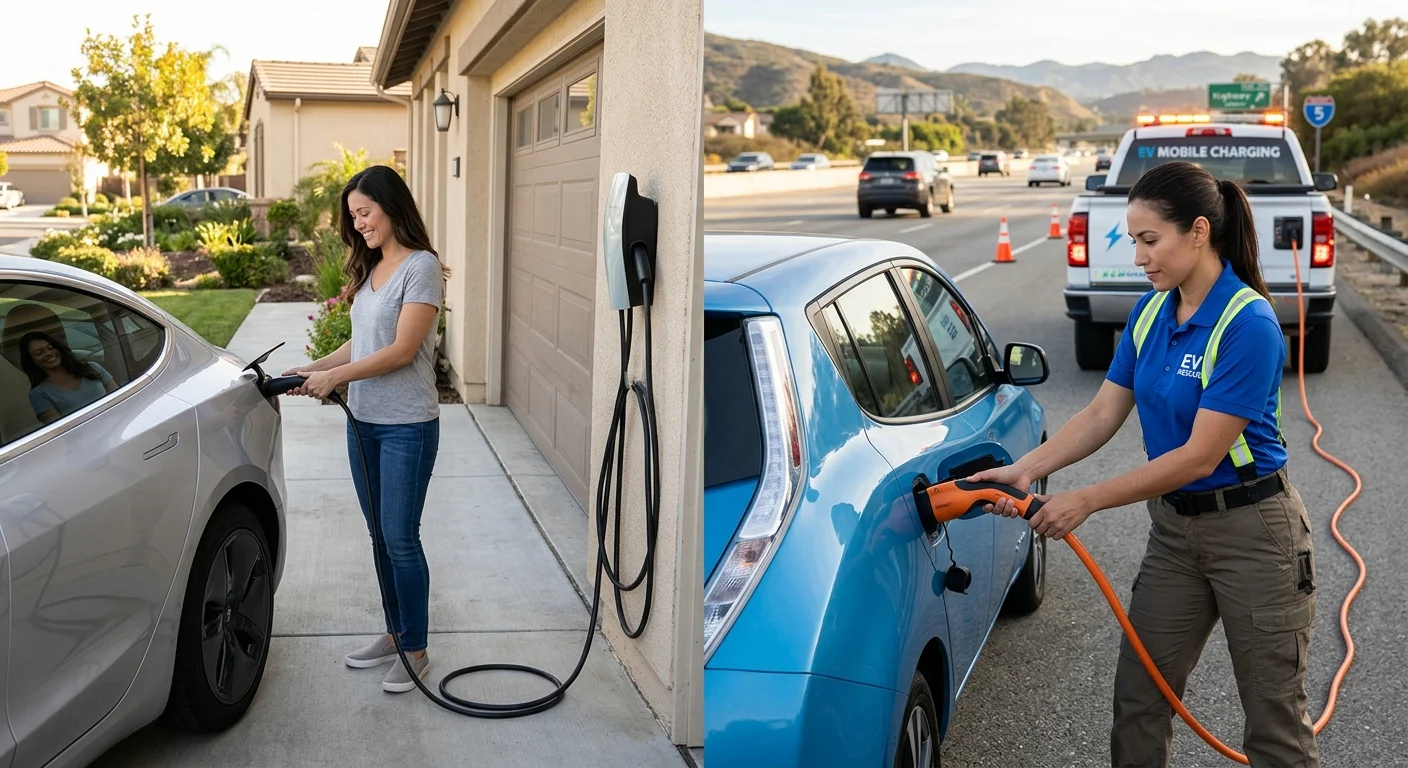
A 240 volt EV charging station usually solves routine charging at home. It doesn’t automatically solve a roadside stop, where the vehicle, connector, location, and available power all affect the next move. San Diego drivers need to separate those two situations before choosing help.
Explain the 240-volt charging question
At home, a 240-volt EV charging station generally means Level 2 charging. The US Department of Energy describes Level 2 as 240-volt service in residential settings. Commercial locations may use 208 volts. Level 2 equipment can operate across a broad power range, so the voltage alone doesn’t tell you the complete charging rate.
The important distinction is purpose. A home station supports planned charging where a suitable electrical connection exists. A roadside service addresses a vehicle that can’t reach usable fixed charging. Both may add energy to an EV, but they don’t use the same setting, equipment, or decision process.
Level 1 uses a standard 120-volt household outlet. It delivers less power than Level 2. See what a Level 1 EV charger is. Level 1 may fit some home routines, but an available outlet still needs to suit the equipment and property.
Level 2 charging can provide about 25 miles of range per charging hour under the DOE specifications in the approved claims ledger. Actual results vary by the vehicle, battery condition, ambient temperature, and the power the vehicle accepts. That figure describes charging performance. It isn’t a roadside arrival promise or a guarantee for any specific EV.
Separate routine home charging from roadside need
Routine home charging starts with the property. You have a regular parking space, time to charge, and a fixed electrical source. A licensed electrician evaluates the home’s electrical demand and panel capacity. That evaluation determines whether the proposed charging equipment fits the existing system or requires other work.
A roadside need starts with mobility. The immediate issue isn’t how to build a home charging setup. It’s whether the EV can receive enough compatible energy to reach a fixed charger, or whether transport is the better option. See EV charging levels for stranded drivers.
Location changes the problem across San Diego County. A car parked in a home driveway in Chula Vista presents a different situation from one stopped near I-805. A vehicle in an Encinitas garage isn’t facing the same access limits as an EV near SR-78. The equipment, traffic exposure, parking rules, and available connections must be considered at the actual location.
Charge Pro SD doesn’t install home charging stations. Charge Pro is a referral to independent operators. If you’re comparing permanent electrical work with immediate vehicle help, see EV charger installation versus roadside service. It keeps those services separate before you contact the right professional.
Confirm the vehicle and available power source
Start with the vehicle’s exact make, model, and model year. Then confirm what the owner’s manual says about compatible charging. Level 2 equipment commonly uses J1772 or J3400 connections, but the vehicle manufacturer remains the authority for your specific EV. Don’t choose a cable or adapter from appearance alone.
Next, identify the actual power source. “There is a 240-volt outlet” isn’t enough information for a home charging decision. A licensed electrician must evaluate the circuit, electrical panel, total household demand, and proposed charging equipment. Charge Pro SD doesn’t make that property assessment or perform electrical installation work.
Inside the City of San Diego, the city’s EV charging bulletin describes a Simple Permit process for qualifying single-family homes, duplexes, and townhouses. It requires an electrical permit and supporting load information. Structural changes can alter the permit path. Requirements and fees can change, so confirm the current process with the City of San Diego Development Services Department before work begins.
Properties elsewhere in San Diego County may fall under another city or county authority. Check the address before relying on City of San Diego instructions. The permitting office serving that property can confirm its current forms and requirements. A California C-10 electrical contractor’s status can also be checked through the Contractors State License Board lookup.
For a roadside request, share the vehicle details, displayed warnings, remaining charge, connector type, and precise location with the operator. Also explain whether the vehicle can shift, steer, or accept charging. The matched operator can then assess whether mobile energy or transport fits the situation.
Know when a fixed outlet can’t solve the stop
A fixed outlet only helps when the vehicle can safely reach it and use compatible equipment. That condition often isn’t present during a roadside stop. A cord at a nearby building doesn’t become a valid charging source simply because the plug appears familiar. The property owner, circuit, charger, and vehicle all matter.
The same limit applies when an EV stops along I-5, I-15, I-805, SR-78, or an East County route. A home charging station remains at the property. It can’t address a vehicle stopped somewhere else. Public charging may also be unsuitable if the car lacks enough remaining energy to reach the site.
A low traction battery isn’t the only possible cause of a stopped EV. The vehicle may reject charging, display a fault, or remain unable to move after receiving power. Those symptoms need to be reported accurately. Don’t assume that adding energy will correct a vehicle fault. Check the owner’s manual or the manufacturer’s support instructions for the displayed message.
A failed charging attempt at home also doesn’t automatically create a roadside case. If the vehicle is parked safely at the property, the charger, circuit, or vehicle may need diagnosis by the appropriate professional. If the car is away from home and can’t reach charging, out-of-charge EV recovery may be the relevant service path.
Immediate hazards come first. Smoke, fire, a collision, or dangerous traffic exposure requires emergency help, not routine charging advice. Once those hazards are addressed, an EV rescue operator can evaluate the mobility problem.
Choose mobile charging or transport
Mobile charging may fit when an out-of-charge EV can accept compatible power at its location. The goal is usually practical mobility, not replacing a full home charging session. The operator must assess the vehicle, access, charging connection, and surrounding conditions before deciding what service is suitable.
The mobile EV charging referral page is a matching start. Charge Pro SD makes the referral. The matched operator performs the physical work, explains the available option, and sets the terms directly with the customer. Charge Pro does not set operator prices or provide warranties.
Transport may be the better path when the vehicle won’t accept power. It may also be recommended when the location doesn’t support mobile charging or a separate vehicle problem prevents movement. The operator can assess whether the EV should go to a compatible charging site, service center, or another destination selected by the driver.
San Diego geography makes destination planning important. A driver near downtown may have different fixed charging choices than someone east of Alpine or north of Escondido. Don’t focus only on the nearest point shown in an app. Confirm that the destination supports the vehicle’s connector and is available through the charging network’s current information.
Before accepting service, ask the operator what equipment will be used, what outcome is expected, and what the service will cost. Charge Pro SD doesn’t set operator prices or provide warranties. Charging rates, towing terms, and operator charges couldn’t be confirmed as one countywide figure because the provider and situation determine them. Confirm those details directly with the matched operator.
When to call
Call when your EV can’t reach a usable charger and you need a referral for possible charging or transport. Charge Pro SD can refer an independent operator. Call (858) 400-4465. Charge Pro does not send a Charge Pro crew.