Your Tesla’s screen goes black on I-15 near Escondido. You’re cruising along SR-56 and a tire pressure warning flashes, quickly followed by a flat. Or perhaps you miscalculated your range heading up the I-8 climb towards Alpine and your battery light is now a stark red. When unexpected trouble strikes your Tesla, getting immediate help is your top priority. Knowing the Tesla roadside assistance number is the first step, but understanding your best options for rapid recovery, especially here in San Diego, can make all the difference.

The official Tesla roadside assistance phone number in the United States is (877) 798-3752. This number connects you directly to Tesla’s support team, who can dispatch assistance based on your vehicle’s warranty and location. While Tesla’s service is a valuable resource, San Diego’s unique EV landscape and traffic patterns often demand a faster, more specialized local solution. This guide covers how to reach Tesla, what their service entails, and when a dedicated local provider like Charge Pro SD offers a quicker path back on the road.

When you need Tesla roadside assistance: official contacts and options

When your Tesla encounters an issue that leaves you stranded, the immediate reaction is often to find the official support line. Tesla provides several ways to request roadside assistance.

How to contact Tesla for roadside help

The primary method is by phone. Dialing (877) 798-3752 connects you with a Tesla representative. They will ask for your vehicle’s VIN, your current location, and a description of the problem. It’s helpful to have this information ready before you call.

Beyond the phone, you can also request assistance directly through your Tesla mobile app. This method can sometimes be faster, as it automatically provides your vehicle’s location and diagnostic data to Tesla.

  1. Via phone: Call (877) 798-3752.
  2. Via Tesla app: Open the app, navigate to “Roadside,” and follow the prompts.

What Tesla roadside assistance typically covers

Tesla’s roadside assistance program covers a range of common issues. The extent of this coverage often depends on your vehicle’s warranty status.

  • Battery out of charge: If your Tesla runs out of charge, Tesla will tow it to the nearest Supercharger, service center, or your home, typically within a 50-mile radius.
  • Flat tire: Tesla can dispatch a service vehicle to repair or replace a flat tire. Keep in mind Teslas do not come with a spare, so a repair kit or a tow is often the solution.
  • Vehicle lockout: If you’re locked out of your Tesla and cannot access it via the app, they can assist.
  • Minor mechanical issues: For issues like a non-functioning 12V battery, Tesla can offer a jump start or tow.
  • Breakdowns: For more serious mechanical failures, Tesla will arrange a tow to the nearest Tesla Service Center.

It’s important to understand the terms of your specific warranty or extended service agreement, as these dictate what services are free and which might incur a charge. You can find detailed information on the official Tesla support website.

Limitations and potential wait times in San Diego

While Tesla’s roadside assistance is valuable, it has limitations, especially in a sprawling region like San Diego County.

  • Response times: Tesla’s service network is centralized. Dispatching a technician or tow truck from a service center (like the one in Miramar) to, say, Julian in East County, or Camp Pendleton along I-5, can involve significant wait times. During peak traffic on I-805 or I-5, these delays can be substantial.
  • Distance limitations: While they offer towing, the “nearest” Supercharger or service center might still be a significant distance, particularly if you’re stranded in areas with fewer charging options, like East County or the mountain roads around Ramona.
  • Direct charging: Tesla’s roadside assistance primarily focuses on towing for out-of-charge situations, not always on-site charging. This means a tow might be your only option, even if you just need a few miles of range.
  • Specific equipment: Their tow trucks may not always be equipped for direct mobile charging, which is often the fastest solution for a stranded EV.

For drivers in San Diego, where EV adoption is among the highest in the nation, these limitations can be frustrating. Getting stuck on the I-8 climb towards Alpine, or experiencing range anxiety on a trip to Anza-Borrego, highlights the need for a rapid and direct solution.

When a local EV rescue service is your faster, smarter choice

While Tesla’s official roadside assistance is a good starting point, for many situations in San Diego, a specialized local EV rescue service like Charge Pro SD can offer a significantly faster and more efficient solution. We understand the specific challenges of EV ownership in this region.

The Charge Pro SD difference: speed and specialized equipment

Charge Pro SD was founded to address the unique needs of electric vehicle owners in San Diego. Our service model is built around rapid response and specialized equipment, specifically designed for EVs.

  • Rapid dispatch: We are locally based and have units strategically positioned to cover all of San Diego County. Whether you’re stuck on I-5 in Carlsbad, I-8 in El Cajon, or a residential street in La Jolla, our goal is to reach you quickly.
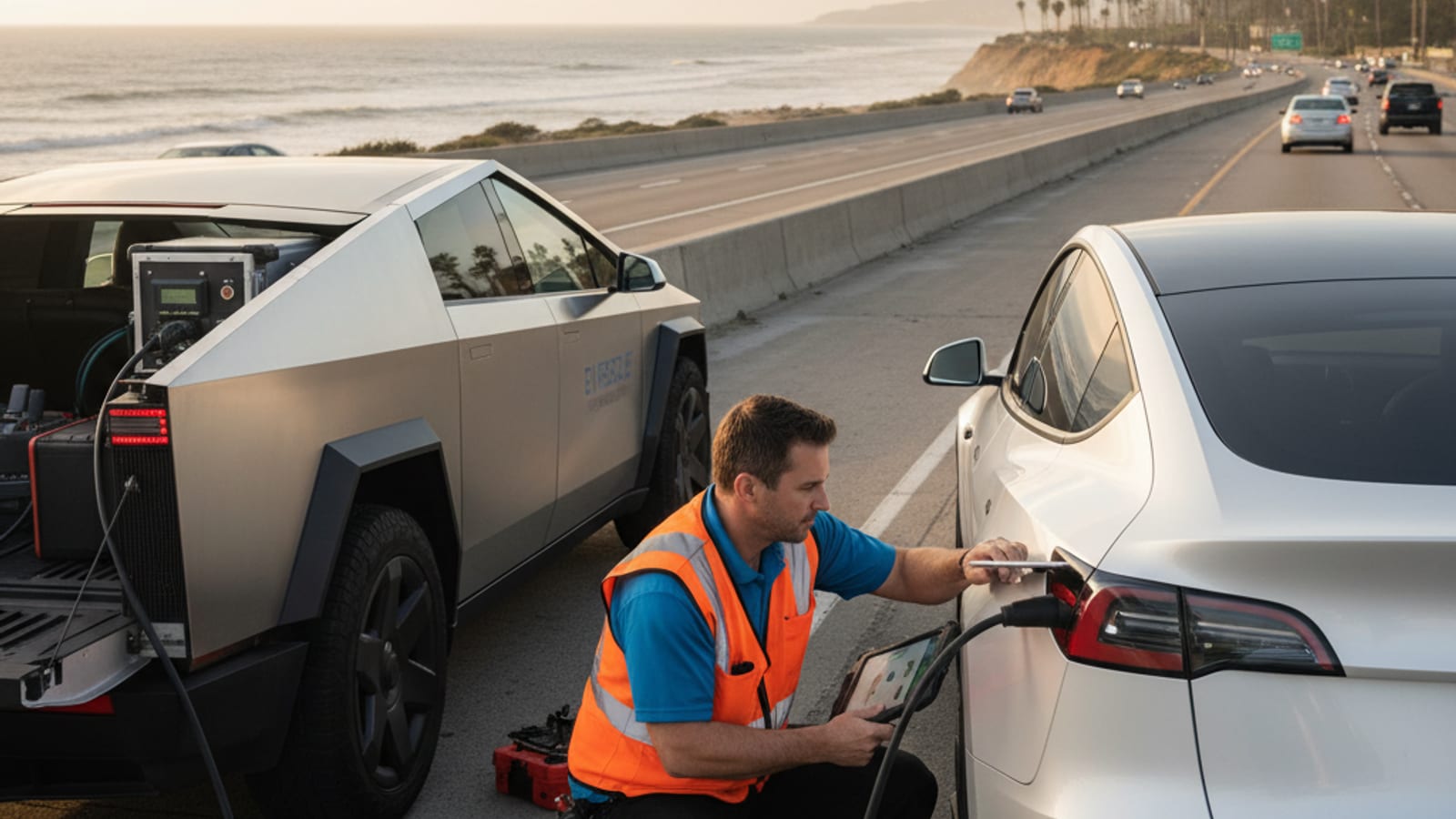
  • Mobile EV charging: This is our core strength. Instead of waiting for a tow, our service vehicles come equipped to provide on-site charging. We dispatch a Tesla Cybertruck outfitted with a powerful 240V / 9.6 kW bed outlet. This allows us to deliver a fast charge directly to your stranded EV.
  • Universal compatibility: Our Cybertruck carries both a NACS plug (native to Tesla vehicles) and a CCS adapter, ensuring we can charge any EV, Tesla or non-Tesla, directly at your location. This eliminates the need for a tow to a charger, saving you time and stress.
  • Expert EV technicians: Our team comprises trained EV specialists who understand the intricacies of electric vehicles. They can often diagnose minor issues on the spot and provide immediate solutions beyond just charging.

Common Tesla issues Charge Pro SD handles directly

We specialize in the most frequent reasons Teslas get stranded in San Diego County.

Out of charge and range anxiety

This is perhaps the most common EV roadside issue. San Diego drivers often push their range, especially when heading to areas with sparse charging.

  • I-8 eastbound climb: The significant elevation gain from El Cajon to Alpine (over 1,500 feet) can deplete a Tesla’s battery faster than anticipated. Many drivers underestimate this consumption.
  • East County and mountain roads: Areas like Julian, Ramona, and Pine Valley have fewer public charging stations, making range anxiety a real concern. If you’re heading for a day trip to the mountains and miscalculate, getting stuck is a serious possibility.
  • Hot inland summer temperatures: In places like Escondido, El Cajon, and Santee, summer temperatures often exceed 100°F. While San Diego’s mild coastal climate generally means EVs rarely face cold-weather range loss, extreme heat can reduce EV range by 10-20% due to battery thermal management and AC usage.
  • Camp Pendleton “charging desert”: The 20-mile stretch of I-5 through Camp Pendleton, between Oceanside and San Clemente, is devoid of public charging. If you’re running low approaching this segment, it can quickly turn into a critical situation.

Our mobile EV charging service directly addresses these scenarios. We bring the power to you, providing enough charge to get you to the nearest Supercharger or your destination. This is far quicker and often safer than waiting for a flatbed tow. For more tips on avoiding this, read our post on /blog/out-of-charge-on-freeway-what-to-do/.

Dead 12V battery

Many Tesla owners are surprised to learn their high-tech EV still relies on a conventional 12V battery for critical functions like unlocking doors, powering the infotainment system, and initiating the main high-voltage battery. A dead 12V battery can render your Tesla completely unresponsive, making it appear as if the main battery is dead.

  • Symptoms: No screen, no power, doors won’t open, car won’t “wake up.”
  • Charge Pro SD solution: We provide Tesla 12V battery jump start services. Our technicians can quickly and safely jump-start your 12V battery, allowing your Tesla to power up and potentially self-charge the 12V from the main battery, or at least be driven to a service center. For more details, check out /blog/tesla-12v-battery-dead-diagnosis/.

Flat tires and tire damage

Teslas do not typically come with a spare tire. If you encounter a flat on one of San Diego’s busy freeways like I-5 or I-805, or even a less-trafficked road in Ramona, you’re left with limited options.

  • Charge Pro SD solution: We can provide roadside tire assistance, including temporary sealant application or arranging a tow if the damage is severe. Our priority is to get you to a safe location or a tire service center.

Lockouts and minor troubleshooting

Sometimes the issue is simpler, like a key fob battery dying or an app glitch preventing access. Our technicians can assist with these minor issues or provide initial troubleshooting when your Tesla won’t start.

Comparing your options: Tesla roadside vs. Charge Pro SD

When you’re stranded, every minute counts. Understanding the differences between calling Tesla’s official line and reaching out to a local specialist like Charge Pro SD can help you make the best decision for your situation in San Diego.

Here’s a comparison:

FeatureTesla Roadside Assistance (Official)Charge Pro SD (Local EV Rescue)
Primary contactPhone: (877) 798-3752, Tesla mobile appPhone: (858) 400-8901, direct local dispatch
Response timeVaries; can be significant in remote areas or high trafficRapid local dispatch; optimized for San Diego County
Mobile chargingPrimarily towing to charger/service center for out-of-chargeOn-site mobile EV charging (240V / 9.6 kW) with Cybertruck
Vehicle compatibilityTesla vehicles onlyTesla (NACS) and non-Tesla (CCS adapter) EVs
12V battery jumpYes, or tow if unableYes, direct jump-start service
Tire serviceRepair/replace or towRepair/temporary fix or tow to tire shop
Local knowledgeGeneral service areaDeep knowledge of San Diego freeways, neighborhoods, charging gaps
EquipmentStandard tow trucks, service vansTesla Cybertruck with specialized EV charging equipment
CostIncluded with warranty/subscription; fees apply out of coverageTransparent pricing, often a faster and more cost-effective solution than long-distance towing

For immediate, specialized EV assistance in San Diego, Charge Pro SD often provides a more direct and efficient solution, especially for out-of-charge or 12V battery issues. Our goal is to get you charged and moving again without the need for a tow.

Preparing for a roadside emergency in San Diego

Being prepared can significantly reduce stress and improve outcomes during a roadside emergency. This is particularly true for EV owners in a large county like San Diego.

Essential items for your Tesla

Even with the best roadside assistance, a few items in your frunk or trunk can be invaluable.

  • Portable tire repair kit: Since Teslas lack a spare, a sealant and compressor kit can temporarily fix minor punctures.
  • Charging cable and adapters: Always carry your mobile connector and any adapters (like a CCS adapter if you use public DCFC stations).
  • Emergency reflective triangle or flares: For visibility, especially if you’re stranded on a busy freeway like I-5 or I-8.
  • First aid kit: Basic medical supplies are always a good idea.
  • Water and snacks: Especially important if you’re stuck in inland areas during summer heat.
  • Fully charged phone and power bank: Your Tesla app is critical, and you’ll need your phone to call for help.

Staying safe while stranded

Safety is paramount when your vehicle breaks down, especially on San Diego’s busy roads.

  1. Pull over safely: If possible, move your Tesla to the shoulder of the road, away from traffic. On freeways like SR-163 or I-805, shoulders can be narrow, so proceed with extreme caution.
  2. Activate hazard lights: Make your vehicle as visible as possible.
  3. Stay inside your vehicle: Unless it’s unsafe to do so, remain in your Tesla with your seatbelt fastened. This protects you from passing traffic. If you must exit, do so on the side away from traffic.
  4. Know your location: Be precise when you call for help. Note the nearest exit, mile marker, or cross street. Apps like Google Maps or your Tesla’s navigation can provide exact coordinates.
  5. Inform passengers: Ensure everyone in the vehicle understands the situation and safety protocols.

Proactive range management in San Diego

San Diego’s diverse geography and climate can impact EV range. Being mindful of these factors helps prevent strandings.

  • Monitor elevation changes: The I-8 climb from El Cajon to Alpine is a prime example of heavy range consumption. Plan for this when heading east.
  • Consider temperature: Hot inland summer days in Escondido or Santee will use more energy for cooling the cabin and battery. Factor this into your range estimates.
  • Utilize navigation: Your Tesla’s navigation system is excellent at predicting range and suggesting charging stops. Trust it, especially on longer trips to places like Julian or Anza-Borrego, where charging infrastructure is sparse.
  • Familiarize yourself with charging infrastructure: While San Diego has over 2,000 public charging ports, coverage is uneven. Know where Superchargers are located (Mission Valley, Carlsbad, Escondido, Chula Vista, National City) and where the gaps are (East County, mountain areas, Camp Pendleton).
  • Home charging habits: Take advantage of SDG&E’s TOU-EV rates by charging your Tesla during off-peak hours (midnight to 6 AM) to ensure a full battery for your daily commute.

By understanding these local nuances and preparing accordingly, you can minimize the chances of needing roadside assistance.

Frequently asked questions

Is Tesla roadside assistance free?

Tesla roadside assistance is often free for new vehicles under warranty, typically for 4 years or 50,000 miles. Coverage for out-of-warranty vehicles or certain situations might incur charges, so it’s always best to confirm your specific coverage when you call.

What if my Tesla is completely dead and won’t respond?

If your Tesla is completely unresponsive, it’s often due to a dead 12V battery, not the main high-voltage battery. You should still contact Tesla roadside assistance or a specialized EV service like Charge Pro SD, who can diagnose and potentially jump-start your 12V battery on-site.

Can Tesla fix a flat tire on the road?

Yes, Tesla roadside assistance can dispatch a service vehicle to address a flat tire. They can often perform a temporary repair or, if the damage is severe, arrange for a tow to a tire shop or service center. Teslas do not carry a spare tire, so a replacement wheel or a tow may be necessary.

How do I know if my 12V battery is dead versus the main battery?

A dead 12V battery will typically result in a completely unresponsive car: no lights, no screen, no ability to unlock or charge. If your main high-voltage battery is simply depleted, you’ll usually still have some low-power functions, and the car might show a “low battery” warning, but won’t be completely dark.

What’s the best way to get help quickly for my Tesla in San Diego?

For the fastest and most specialized EV roadside assistance in San Diego, especially for out-of-charge or 12V battery issues, contact a local service like Charge Pro SD. We offer rapid dispatch and on-site charging with our Cybertruck, often getting you back on the road quicker than traditional towing services.

When your Tesla needs help in San Diego, you have options. While knowing the official Tesla roadside assistance number is important, consider the speed and specialized service a local provider like Charge Pro SD offers. We’re equipped with a Tesla Cybertruck featuring a 240V / 9.6 kW bed outlet and NACS/CCS adapters to provide direct mobile EV charging, 12V battery jumps, and other essential services right where you are. For rapid, expert Tesla roadside rescue anywhere in San Diego County, don’t hesitate to call us at (858) 400-8901, or visit our Tesla roadside rescue service page to learn more.