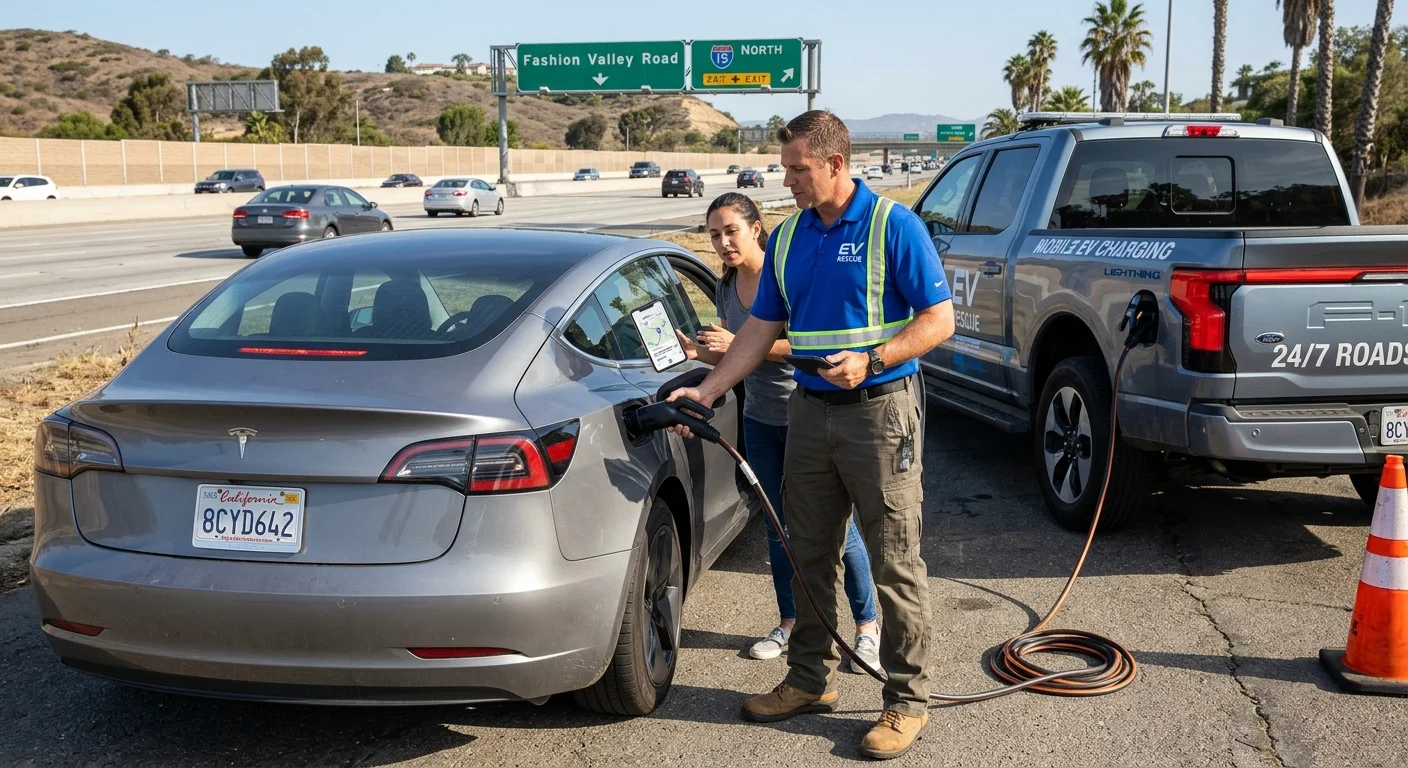
A disabled Model 3 near I-5 can become the wrong tow request when the handoff is vague. Towing a Tesla Model 3 starts by confirming the exact car, its power state, pickup access, destination, and Tesla’s current instructions. Give those details before an operator accepts the job.

A powerless Tesla Model 3 parked safely near a San Diego freeway exit while its

Confirm the Model 3 and model year

Start by telling the operator that the vehicle is a Tesla Model 3. Include the model year if you can confirm it from documents already available. Don’t guess based on body color, wheels, interior trim, or another Tesla nearby.

Send a short vehicle handoff containing:

  • The exact model and confirmed model year
  • The identifying information requested by the operator
  • Any warning message visible inside the car or app
  • Whether the car was involved in a collision
  • The pickup location and intended destination

If you can’t confirm the model year, say that plainly. Share the information you do have and ask the operator what else is needed. A photo of the entire car may help the operator distinguish it from another Tesla, but it doesn’t replace confirmed vehicle information.

Keep observations separate from conclusions. “The display is dark” gives the operator something concrete. “The main battery failed” is an unconfirmed diagnosis. The same rule applies when a vehicle stopped after displaying a low charge. Report the sequence without deciding what caused it.

This first step matters in a San Diego handoff because location alone isn’t enough. “A Tesla on I-15” leaves open the model, direction, nearby exit, condition, and access. A precise description helps the independent operator evaluate the request against current information for that vehicle.

Identify whether low-voltage power is available

Next, describe exactly what responds when you use the controls normally available to you. Tell the operator whether the display is awake, the doors respond, the windows respond, and the app shows a message. Also report whether the charge port is already open or closed. Don’t force any component to test it.

Avoid diagnosing the traction battery or low-voltage system from one symptom. A dark screen, an unresponsive door, and a zero-charge message are observations. Their cause hasn’t been confirmed until the vehicle is evaluated. Our guide to Tesla battery symptoms versus low-voltage symptoms can help you organize those observations without treating them as a final diagnosis.

The approved claims ledger doesn’t contain a Model 3-specific low-voltage access or jump procedure. Because that procedure couldn’t be confirmed here for every model year, this checklist doesn’t provide one. Check Tesla’s current instructions for your exact vehicle and follow the independent operator’s directions.

Location can affect what information the operator needs. A car inside a parking structure may have working doors but limited physical access. A Model 3 beside I-8 presents a different pickup setting. In either case, report the vehicle’s responses without trying an improvised release, jump, or transport step.

If someone already attempted a jump or opened a service area, disclose that before transport. Explain what was touched and what happened afterward. That history gives the operator a clearer handoff without asking you to repeat an unconfirmed procedure.

Check Tesla’s current transport instructions

Open Tesla’s current owner information for the exact Model 3 and model year. Find the section covering roadside transport or vehicle movement. Share the relevant page or screenshot with the operator if requested.

Don’t copy instructions from a Model S, Model X, or Model Y guide. Don’t rely on an old forum post because the pictured car looks similar. General electric vehicle resources, including the U.S. Department of Energy’s EV overview, provide background information. They don’t replace Tesla’s current Model 3 transport directions.

This site’s approved claims don’t confirm a universal procedure for Transport Mode, low-voltage access, neutral release, tow-eye use, wheel lifting, or loading. We therefore can’t tell you that one procedure fits every Model 3. Ask the operator to confirm the proposed transport method against Tesla’s current instructions before the vehicle moves.

Our guide about how to tow a Tesla with no power explains the information a transport provider may request. Use it as a handoff guide, then verify every vehicle-specific step through the current Tesla source.

If you can’t open the manual, tell the operator. Provide the confirmed model year, visible messages, power observations, and photos. The operator can then decide what additional information is needed. Don’t approve a guessed procedure simply because traffic, a garage queue, or another driver creates pressure.

Share parking, access, and destination details

A useful location pin is only the beginning. Tell the operator whether the Model 3 is near I-5, I-8, or I-15. Include the direction of travel, nearest confirmed exit, and the car’s exact position. Say whether it’s on a shoulder, in a lot, beside a curb, or inside a structure.

For a parking structure, send:

  • The structure name or street address
  • The posted entrance clearance
  • The floor, section, and space number
  • Photos of the entrance, ramps, and vehicle position
  • Any gate, ticket, or property-access requirement
  • The direction the car faces within the space

Read the posted clearance instead of estimating it. Mention tight corners, low signs, steep ramps, blocked aisles, or narrow spaces visible at the pickup point. Don’t promise that a particular vehicle can enter. The operator decides whether the site fits the equipment being proposed.

Freeway descriptions also need precision. “Near I-5” can leave an operator searching the wrong side. Share the direction, exit signage you can actually see, and a map pin. If you reached a nearby lot or exit area before the vehicle stopped, provide the business or street name shown there.

Destination details matter too. Give the exact destination selected by you, the vehicle owner, insurer, or other authorized party. Confirm whether that destination has a gate, garage, restricted entrance, or drop-off instructions. Ask the receiving location directly about acceptance and access rather than assuming it can take the vehicle.

Charge Pro SD doesn’t own tow trucks or transport equipment. We connect drivers with licensed, independent local operators. Equipment, access decisions, pricing, and transport arrangements come from the matched operator.

Decide whether charging or transport fits

A Model 3 that can’t continue doesn’t automatically need the same response every time. Start with the confirmed observations. Report the displayed charge, warning messages, visible damage, tire condition, charge-port status, power responses, and parking access. Let the independent operator evaluate those details.

If the vehicle appears out of charge, ask whether out-of-charge EV recovery fits the specific location and vehicle condition. Don’t assume mobile charging will solve an unconfirmed electrical issue. Compatibility and the next step must come from the operator reviewing the request.

For a Tesla-specific handoff, our Tesla roadside rescue connection service can match you with a local independent operator. Charge Pro SD doesn’t perform charging, low-voltage work, loading, or transport. It also doesn’t set the operator’s price or provide the operator’s warranty.

Ask these questions before choosing:

  • Can the operator address the reported condition at this location?
  • Has the exact Model 3 and model year been confirmed?
  • Have Tesla’s current transport instructions been reviewed?
  • Does the operator accept the posted parking access limits?
  • Is the destination ready to receive the vehicle?
  • What price and terms does the operator quote directly?

If charging is proposed, confirm what happens after enough energy is supplied for the next planned step. If transport is proposed, confirm the destination and pickup access. Don’t treat either option as universally correct.

The best handoff stays factual. State what the Model 3 does, where it sits, and what Tesla’s current instructions say. Leave diagnosis, equipment selection, and vehicle movement to the licensed independent operator.

When to call us

Call when your Model 3 can’t continue and you need help finding a local mobile EV rescue operator. Have the model year, power observations, location, access details, and destination ready.

Call us at (858) 400-4465 and we’ll connect you with a local EV rescue operator.