A Tesla that won’t take a charge can create several different service calls. You may need charging-equipment help, mobile energy, low-voltage assistance, or vehicle transport. Identifying the problem first helps you contact the right operator.
Identify what charging service means here
“Tesla charging service” can describe two very different situations. One involves equipment at a home or fixed charging site. The other involves a Tesla that lacks enough energy to move.
Fixed charging service focuses on the charger, its connection, or the electrical supply behind it. Your Tesla may still have usable range. The immediate problem is that one charging location isn’t delivering energy as expected.
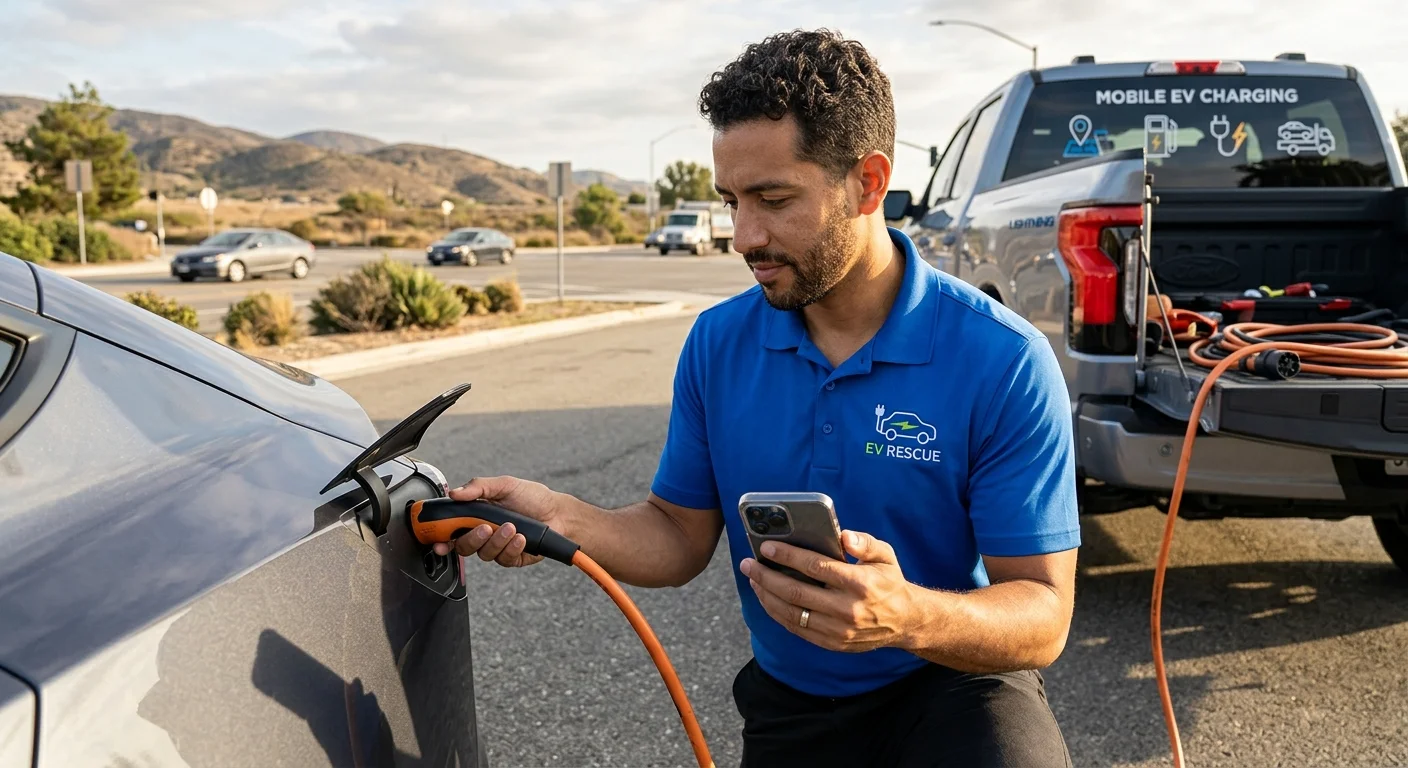
Mobile charging serves a different purpose. A compatible operator brings charging equipment to a reachable vehicle. That may help when the traction battery is depleted and the Tesla can accept a charge. Equipment compatibility and availability must be confirmed with the operator.
The US Department of Energy explains the broader roles of electric vehicles and charging infrastructure. Level 1 uses 120-volt AC charging. Residential Level 2 charging uses 240 volts, while commercial equipment may use 208 volts. Tesla vehicles use the J3400 connector for Level 2 charging.
Those details don’t determine which service you need. Location and symptoms matter more during a roadside call. A Tesla sitting in a North County driveway presents a different problem from one stopped near I-805.
Start by describing where the vehicle is, whether it can move, and what appears on its display. Also tell the operator whether the problem began at home, at a public charger, or while driving. That gives a mobile EV charging operator useful information without guessing at the cause.
Separate charger trouble from an empty battery
A charging problem doesn’t always mean the traction battery is empty. It also doesn’t prove that the charging station or vehicle has failed. Separate the situation into four practical categories before requesting service.
-
Charging-equipment trouble: The vehicle has usable energy, but it isn’t charging at a fixed location. Record the charger location and any message shown by the car or station. If the problem involves home wiring or charging hardware, contact a qualified charging professional.
-
Empty traction battery: The Tesla lacks enough stored energy to continue driving. Ask whether compatible mobile charging is available at the vehicle’s exact location. Don’t assume every roadside operator carries equipment suitable for every Tesla.
-
Missing low-voltage power: The cabin, locks, screens, or controls may not behave normally. Report those observations without diagnosing the traction battery. Ask specifically whether the operator can assess a Tesla low-voltage problem.
-
Transport need: The vehicle may require transport when charging isn’t appropriate, compatible equipment isn’t available, or the Tesla still can’t move. Confirm that the operator can handle the vehicle correctly before accepting service.
Location changes the decision. A car inside a downtown San Diego parking structure may present access limits. A Tesla stopped near SR-78, I-15, or SR-94 presents different roadway concerns. Give the operator the garage level, entrance, travel direction, nearest exit, or visible landmark.
If you’re deciding between roadside help and a repair appointment, read our guide to EV rescue versus repair in San Diego. Roadside service addresses the immediate mobility problem. Diagnosis and lasting repairs may require a separate service provider.
Check Tesla’s current support path
Tesla’s current support channel, coverage terms, prices, and service availability couldn’t be confirmed for this page. Check Tesla’s current official support materials before relying on manufacturer assistance. Follow the contact instructions shown for your vehicle and location.
When reviewing that information, confirm the exact event covered. Ask whether the available path applies to an empty traction battery, low-voltage trouble, charging-equipment failure, or transport. Don’t assume those situations receive identical handling.
Keep the vehicle identification details and exact location ready. Copy any warning text as it appears. Note whether the Tesla is parked safely, blocking traffic, inside a garage, or connected to charging equipment. Avoid replacing the displayed wording with your own diagnosis.
A charging-site problem also needs separate attention. Record the station identifier and any message on the charger. If a Tesla Supercharger isn’t working, our Supercharger troubleshooting guide explains how to separate a station problem from a broader roadside need.
You can also contact an independent operator when Tesla’s current support path doesn’t match the situation. Before accepting service, confirm what the operator plans to provide. Ask about connector compatibility, access requirements, transport method, pricing, insurance, and any operator warranty. The operator sets those terms, not Charge Pro SD.
Choose charging, low-voltage help, or transport
Choose mobile charging when the main issue is depleted driving energy. The Tesla must be accessible, and the operator must confirm suitable equipment. A search for a “Tesla mobile charger near me” should still lead to a direct compatibility conversation.
Choose low-voltage help when the vehicle’s controls aren’t behaving normally and an empty traction battery hasn’t been established. Describe the symptoms instead of requesting a specific repair. Different Tesla vehicles may require different procedures, so the matched operator should assess the vehicle before performing work.
Choose transport when charging won’t address the immediate problem. Examples include collision damage, a blocked charge port, repeated refusal to accept energy, or a location where roadside work isn’t suitable. These observations don’t establish the mechanical cause. They simply help the operator choose an appropriate response.
Choose fixed charging-equipment service when the Tesla can still move but a home charger isn’t working. A licensed electrician can evaluate the home’s electrical capacity and perform the needed load calculation. That assessment determines whether the existing electrical panel can support the charger or needs an upgrade.
San Diego County creates very different access situations. A residential charger problem in Chula Vista may allow the car to remain parked. A depleted Tesla along I-5 through North County creates a roadside mobility problem. A vehicle inside a Mission Valley garage may require clearance and access details before an operator can confirm service.
A mobile Tesla charger service isn’t a universal replacement for transport or repair. It addresses a narrow need: supplying compatible energy to an accessible vehicle that can accept it. Our Tesla roadside rescue service helps drivers connect with operators for the situation they actually have.
How Charge Pro SD connects drivers with operators
Charge Pro SD is a referral service serving San Diego County. We connect drivers with licensed, insured, independent local EV rescue operators. We don’t charge vehicles, perform low-voltage work, transport cars, or repair charging equipment.
When you contact us, describe the vehicle’s location and visible symptoms. Tell us whether the Tesla has remaining range, whether its controls respond, and whether it’s connected to a charger. Include parking restrictions, garage access, or roadside landmarks that may affect the operator.
We’ll use those details to connect you with a relevant local operator. The operator confirms whether compatible charging, low-voltage assistance, or transport is available. That professional also explains pricing, service terms, insurance, and any warranty that applies.
You contract with and pay the independent operator directly. Charge Pro SD doesn’t set the operator’s price or promise a response time. It also doesn’t own the vehicles, charging equipment, or tools used during service.
Before approving work, ask the operator to explain the proposed service. Confirm that the plan matches the problem you described. If the request changes from charging to transport, ask for updated terms before proceeding.
That distinction matters when searching for roadside assistance for Tesla vehicles. A useful connection begins with the right service category, not a guessed diagnosis. Clear details help the operator decide whether the call involves energy, low-voltage power, fixed charging equipment, or transport.
When to call us
Call when your Tesla is stranded or can’t reach a charging location, and you need an independent mobile EV rescue operator. We’ll connect you with a licensed local professional who can confirm the suitable service and terms.
Call us at (858) 400-4465 and we’ll connect you with a local EV rescue operator.