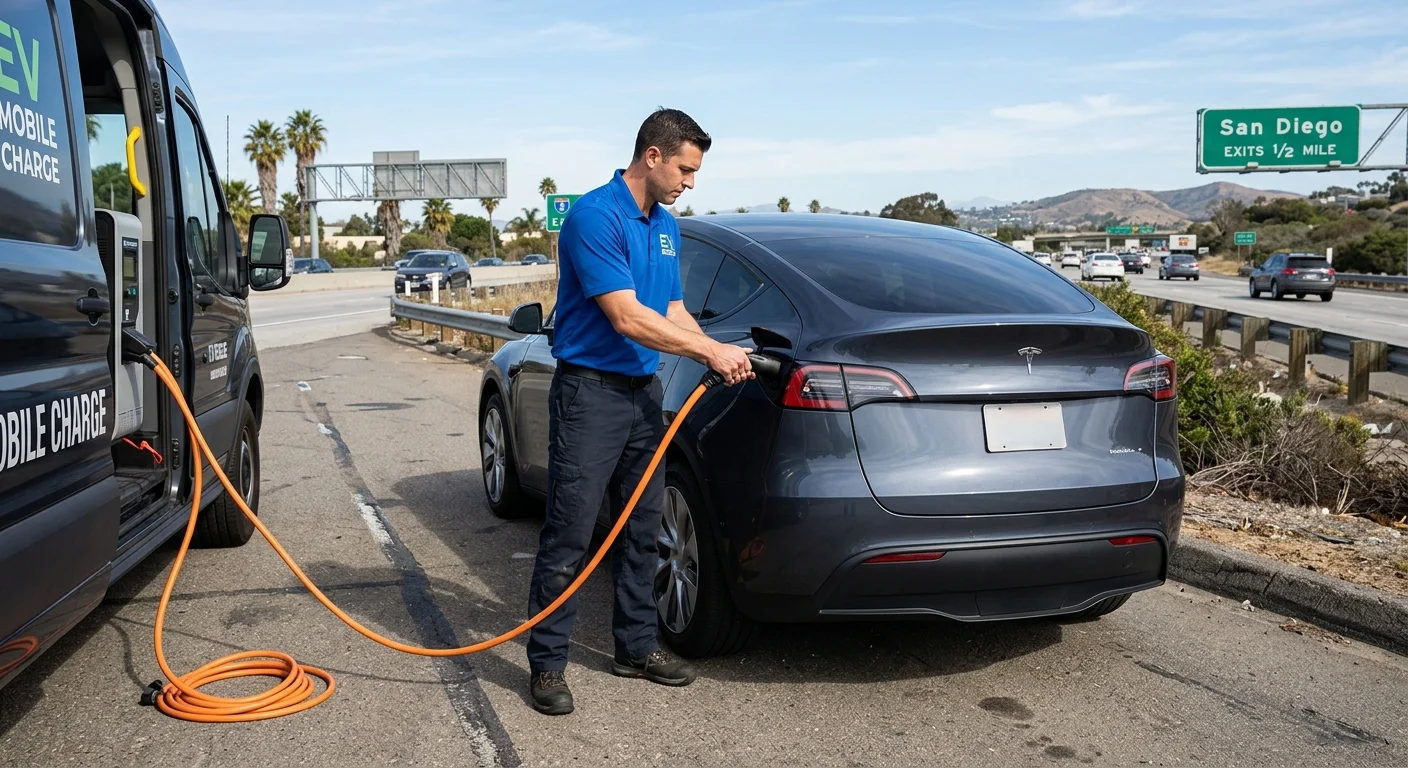
A Tesla that won’t move needs the right kind of roadside help. If you searched “tesla mobile charger near me,” Charge Pro SD can connect you with a licensed, independent local operator serving San Diego County. The operator reviews the Tesla model, battery state, location, and access before confirming what help may be available.

A Tesla parked safely near a San Diego freeway exit while its driver checks local mobile charging options

Identify why the Tesla won’t move

Start with what happened immediately before the Tesla stopped moving. A low displayed battery level points toward one possibility. A low-voltage warning, unavailable screen, charging error, or physical damage may point the operator elsewhere.

Describe what you can see without guessing at the cause. Tell the operator whether the center screen works, whether the doors respond, and whether the vehicle shifts. Report every displayed warning exactly as written. If the Tesla stopped while connected to a charger, mention that too.

Your location also affects the first decision. A Tesla parked in a driveway presents a different access situation from one stopped near I-5, I-805, I-15, or SR-78. If the vehicle is in a traffic lane or another unsafe position, contact emergency services and follow their directions.

Charge Pro SD is the connection service. It doesn’t charge, jump, repair, or transport vehicles. The licensed local operator reviews the situation and explains the available service.

Our Tesla roadside rescue service covers the connection process for Tesla-specific roadside problems. Drivers who aren’t sure which service they need can also read the broader guide to mobile EV charging near you in San Diego.

The clearest request isn’t simply “my Tesla is dead.” Give the operator the last known battery reading, warning text, and current vehicle behavior. Those details help the operator decide whether mobile charging is a reasonable next step.

Tell an empty battery from low-voltage failure

An empty traction battery and a low-voltage problem aren’t the same service request. Mobile charging may fit when the available information points toward an empty traction battery. A low-voltage warning or loss of normal vehicle functions calls for a separate assessment.

Before contacting an operator, gather these details:

  • The last battery percentage you saw
  • The exact warning shown on the screen or app
  • Whether the screen, locks, lights, and app respond
  • Whether the Tesla accepts a charging connection
  • What happened directly before the vehicle stopped
  • Whether there was a collision, tire problem, or visible damage

Don’t label the problem yourself if the evidence is mixed. Tell the operator what you observed and let that professional evaluate it. The operator may need more information before recommending charging, low-voltage service, or transport.

Our guide to Tesla battery symptoms versus low-voltage failure explains how to organize those observations. It doesn’t replace an operator’s assessment of your specific Tesla.

A battery display that was already very low is useful context. So is a warning that appeared while the displayed driving charge remained. Neither detail, by itself, confirms what service will work. The operator still needs the model, current condition, and access details.

Avoid promising yourself that a mobile charge will solve every no-start event. The goal is to match the symptom with an appropriate response. Clear information prevents a charging request from hiding a different roadside problem.

Share the model, location, and access details

A nearby operator needs more than “Tesla in San Diego.” Share the exact model, model year, last displayed battery level, and any warning text. Connector compatibility and available equipment must be confirmed for the specific request.

Send a precise location when possible. In Downtown San Diego, include the garage name, floor, and stall. Near Mission Valley or Mira Mesa, share the road direction and closest exit. In Chula Vista, National City, or Eastlake, mention gates, parking structures, or security access. North County drivers should specify whether they’re near I-5, SR-78, or a local street.

A map pin helps, but access details still matter. Tell the operator whether the Tesla is:

  • In a driveway, garage, or assigned parking stall
  • Behind a gate or inside a controlled building
  • On a street, shoulder, ramp, or parking lot
  • Blocked closely by another vehicle
  • Connected to charging equipment
  • Locked with normal access unavailable

Photos can help the operator review the parking position and visible warnings. Don’t share sensitive access codes in a public message. Provide them directly through the communication method arranged for the service.

Mention anything that may change the service decision. That includes visible collision damage, a damaged charge port, standing water near the vehicle, or a cable that won’t release. Report what you see without attempting a technical diagnosis.

Charge Pro SD doesn’t promise operator availability, equipment, connector compatibility, or a delivered amount of charge. The matched operator confirms those details after reviewing your request. You contract with and pay that independent professional directly.

Know when mobile charging may fit

Mobile charging may fit when the operator’s review points toward an empty traction battery and the Tesla can be reached safely. The operator must also confirm that the available equipment and connector work for the vehicle.

The US Department of Energy identifies J3400, also called NACS, as a connector used by Tesla vehicles for Level 2 charging. That general standard doesn’t guarantee compatibility with every roadside setup. The operator still confirms the specific vehicle and equipment.

A mobile charging request should include the practical goal. Tell the operator whether you’re trying to reach a nearby charging location, move the vehicle from its present spot, or address another immediate problem. The operator determines whether charging is suitable and what can be provided.

Our mobile EV charging service connects San Diego County drivers with licensed, independent local operators. It doesn’t mean Charge Pro SD owns charging equipment or performs the roadside work.

Ask the matched operator to confirm the scope and price before agreeing to service. Charge Pro SD doesn’t set the operator’s prices, warranties, or service terms. No price for Tesla mobile charging could be confirmed from the approved claims ledger for this page.

Mobile charging isn’t the automatic answer whenever a Tesla won’t move. It fits only when charging addresses the problem and the operator can safely provide a compatible service. If those points aren’t confirmed, another roadside option may make more sense.

Know when transport may fit instead

Transport may fit when charging won’t address the reported condition. That could include visible damage, an inaccessible charging connection, an unresolved low-voltage warning, or a vehicle that still can’t accept charge. The local operator makes that recommendation after reviewing the Tesla and its location.

A roadside charging request can also change after the first assessment. New warning text, access restrictions, or damage may lead the operator to recommend transport instead. That’s a service decision, not a failure of the referral process.

If transport is recommended, confirm the destination and handling plan with the provider. Share the exact Tesla model and describe its current condition. Tell the provider whether the vehicle shifts, steers, rolls, unlocks, or displays warnings. Don’t assume the provider already received every detail from an earlier conversation.

Location remains important. A Tesla stopped near the San Ysidro border, inside a La Jolla garage, or along an East County route presents different access details. Give the provider a precise pin, travel direction, nearby exit, parking level, and entry restrictions.

Charge Pro SD doesn’t transport the Tesla or warrant another company’s work. We connect drivers with licensed, independent local operators. The matched professional explains what service is available and whether another provider is needed.

Choosing transport can be more appropriate than repeatedly requesting charge when the underlying problem hasn’t been confirmed. The useful decision is the one based on the vehicle’s symptoms, safe access, and the operator’s assessment.

When to call us

Call when your Tesla appears depleted or won’t move and you need a local operator to assess whether mobile charging may fit. Have the model, location, battery reading, warning text, and access details ready.

Call us at (858) 400-4465 and we’ll connect you with a local EV rescue operator.