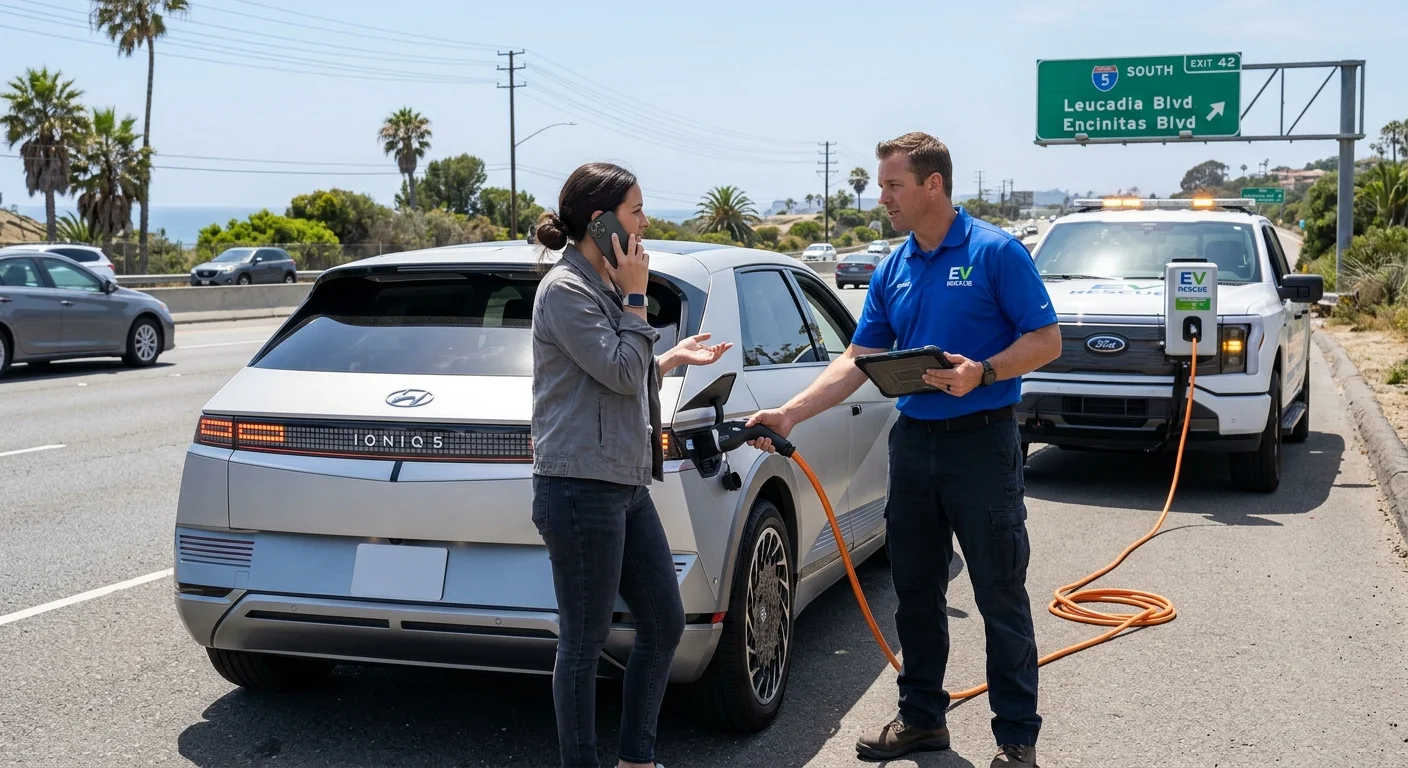
For mobile EV charging in Encinitas after a stall, start with precise location and vehicle details. A matched operator reviews the battery state, connector, and access before recommending charging or transport. Availability, equipment, delivered charge, and price must be confirmed directly with that operator.
Share your I-5 direction and nearest exit
“On I-5 in Encinitas” doesn’t give an operator enough location detail. Start with your direction of travel when the vehicle stopped. Then name the nearest signed exit, even if you’ve already passed it.
If Encinitas Boulevard is the closest exit, say that plainly. Explain whether you’re on the main freeway, an on-ramp, an off-ramp, or a nearby surface street. These are different access situations. Don’t use your planned destination as your direction of travel.
A map pin can help, but pair it with written details. Phone location services sometimes place a pin on the wrong side of a divided roadway. Include a visible sign, intersection, business, or parking entrance when possible. Tell the operator whether your EV is fully outside a travel lane or remains where traffic affects access.
A useful I-5 location message might include:
- Northbound or southbound direction
- Nearest signed exit
- Main lanes, ramp, shoulder, lot, or surface street
- A map pin and visible landmark
- Your vehicle’s color, make, and model
If the vehicle stopped away from I-5, name the street and nearest intersection. Our broader guide to EV roadside assistance in Encinitas covers other breakdown situations. Drivers moving between Encinitas and Cardiff can also review the Encinitas and Cardiff corridor guide.
Follow instructions from emergency personnel or roadway authorities when they’re present. Location details help the matched operator evaluate the request, but they don’t confirm availability or access.
Tell empty charge from low-voltage failure
Don’t describe every nonmoving EV as having a dead battery. Report what the vehicle showed before and after it stopped. The operator can then assess whether the request points toward depleted driving charge, a low-voltage problem, or another fault.
Start with the last battery percentage you saw. If the display showed a specific warning, copy its wording exactly. A photo is better than a summary. Terms such as “battery,” “power,” and “charging” can refer to different systems, so the original message matters.
Tell the operator whether:
- The center display or instrument panel turns on
- The doors respond to the key, phone, or handle
- The vehicle shifts from Park
- The charging screen shows a battery percentage
- The charge port opens
- The manufacturer’s app shows a current reading
- A low-voltage warning appeared
- The vehicle stopped while driving or wouldn’t start while parked
Don’t guess that the traction battery reached zero when the screens are dark. Likewise, don’t label the issue as low voltage unless the vehicle displayed that warning or an operator confirmed it. These observations aren’t a remote diagnosis.
Mobile charging may be considered when the information points toward an empty traction battery. A low-voltage warning, charging error, or unresponsive vehicle may call for another form of assistance or transport. The matched operator makes that decision after reviewing the vehicle and the reported symptoms.
Keep the vehicle powered down if the manufacturer’s instructions or an operator direct you to do so. Don’t repeatedly change settings just to produce a different warning. Save the clearest information for the person assessing the request.
Account for Coast Highway 101 access
A stall near Coast Highway 101 needs a different description than an I-5 stop. Give the visible address, nearest cross street, or business name. Add the side of the street and the direction the vehicle faces.
In Leucadia, “near the coast” remains too broad. State whether the EV is in a marked parking space, driveway, lot, curbside position, or travel lane. If you’re near Encinitas Boulevard, name the closest intersection or parking entrance. Don’t make the operator search several blocks for the correct access point.
Access details can affect whether mobile charging is suitable. Tell the operator about low-clearance entrances, narrow parking areas, locked gates, parking structures, or traffic blocking the charging side of the vehicle. Share private gate instructions directly with the matched operator.
Also report the charge-port side and the space around it. A photo showing the EV and nearby access can provide more context than several text messages. Include enough background to show the parking position without exposing personal documents or unrelated people.
Confirm whether the car can shift, steer, or release its parking brake. Simply report what happens when you try the normal controls. Don’t force anything. The operator will use those details when comparing mobile charging with transport.
Coast Highway 101, Encinitas Boulevard, I-5, and Leucadia each require precise location language. The city name alone can’t describe the working area. Clear access notes help an independent operator determine whether the request fits the service they can provide.
Prepare the details an operator needs
Gather the facts before requesting emergency EV charging in Encinitas. A short, complete message reduces unnecessary back-and-forth. It also helps the operator avoid treating a connector issue, low-voltage warning, and empty traction battery as the same request.
Send these details:
- Vehicle year, make, and model
- Last displayed battery percentage
- Exact warning text
- Photos of the display and charge port
- Connector type, if confirmed
- Any adapters already with the vehicle
- Exact map pin and written location
- I-5 direction or nearest Encinitas intersection
- Parking and access description
- Whether the vehicle responds to normal controls
If you aren’t certain about the connector, send a clear port photo. Don’t choose one from memory. The U.S. Department of Energy’s EV overview provides general charging background, but the operator still needs your exact vehicle information.
Charge Pro SD is a referral service. We match stranded drivers with licensed, independent local EV charging professionals. Charge Pro SD doesn’t perform the physical work, employ the operator, own charging equipment, set prices, or provide warranties. You contract with and pay the independent professional directly.
Ask the matched operator to confirm the proposed service, equipment compatibility, price, and payment terms before authorizing work. If a detail can’t be confirmed, say so. A clear unknown is more useful than a confident guess.
Keep your phone available after making the request. If your location or vehicle status changes, give the updated facts to the operator. Don’t assume an earlier assessment still applies after the car moves or displays a new warning.
Choose mobile charging or transport
The final choice depends on the vehicle, battery state, connector, and access. Mobile EV charging may fit when the operator confirms that the vehicle and location match the service they can provide. That confirmation must come from the operator handling the request.
Transport may fit when charging isn’t appropriate for the reported condition. Examples include an unresolved low-voltage warning, a vehicle that won’t accept charge, inaccessible charging hardware, or a location that doesn’t support the proposed service. These examples aren’t diagnoses. They’re reasons to let the operator compare the available options.
For an EV reported at empty charge, review out-of-charge EV recovery before deciding. That service path explains the broader recovery request without assuming mobile charging will solve every stall.
Ask the operator these questions before choosing:
- What vehicle details support the recommendation?
- Is the connector and proposed equipment compatible?
- Can the operator work from the described position?
- What does the quoted service include?
- If transport is recommended, what destination information is needed?
- What payment and warranty terms does the operator provide?
Charge Pro SD can make the connection, but it doesn’t decide the technical outcome. The independent operator evaluates the request and explains the proposed work. Don’t treat a referral as confirmation that mobile charging will restore movement.
Price and availability can’t be confirmed from this page. They depend on the operator and the specific request. Get those terms directly before you contract for charging or transport.
When to call us
Call when a stranded EV in Encinitas may need mobile charging, out-of-charge recovery, or transport assessment. Have your location, vehicle, battery display, connector, and access details ready. Call us at (858) 400-4465 and we’ll connect you with a local EV rescue operator.