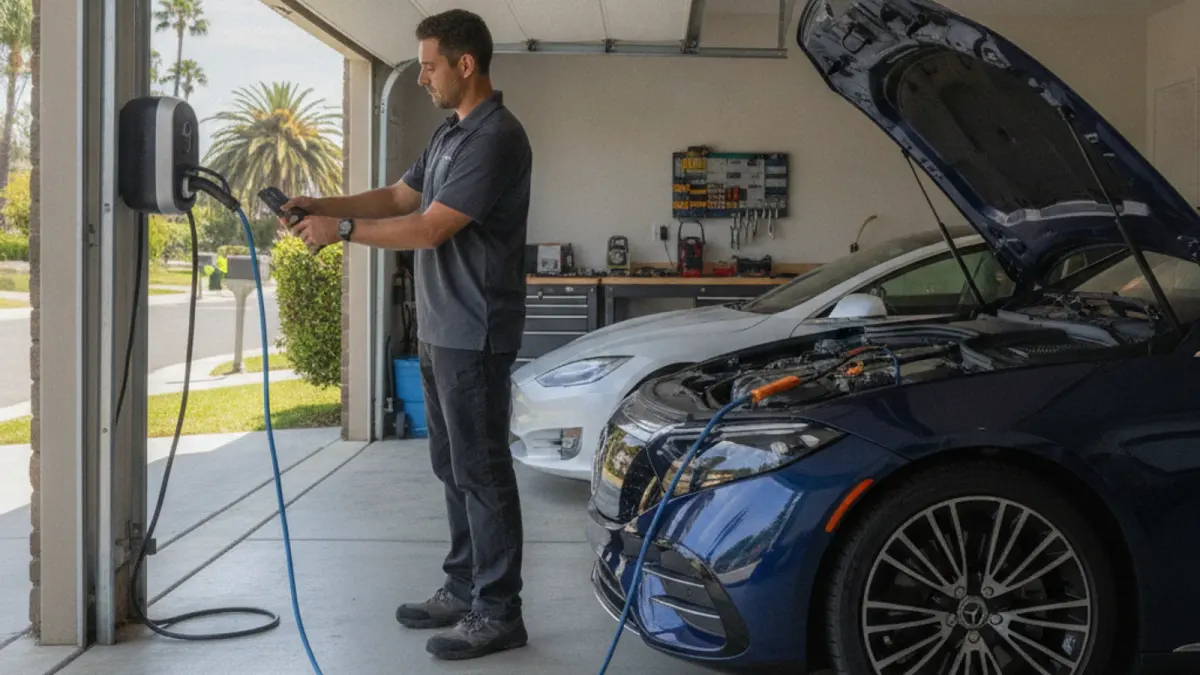
A Mercedes EQE that won’t start is almost always a dead 12V battery, not a problem with the main high-voltage pack. The screen stays dark, the door handles won’t power out, and you get no “Ready” mode even though the drive battery may read 80% or more. Jump the dedicated terminals under the hood (positive under the red cap on the fuse box, negative to a chassis ground), let the 12V recover for two minutes, and the car reboots normally. If you’re stranded anywhere in San Diego County, call Charge Pro SD at (858) 400-4465.
The EQE shares the EVA2 platform and low-voltage architecture with the EQS, so it fails the same way and gets rescued the same way. This guide covers why the 12V dies, where the battery and jump points actually are, the exact dash symptoms, the San Diego conditions that make it worse, and what to do the moment it happens.
Why the Mercedes EQE won’t start
The EQE runs an AGM lead-acid 12V battery, separate from the big drive battery, and that 12V is what actually wakes the car up. It powers the flush door handles, the MBUX display, the ambient lighting, the driver-assistance sensors, and, most importantly, the control units that connect the high-voltage pack to the motors. When the 12V drops too low, none of that can complete its startup handshake, so the car sits there dead while the main pack stays full and untouched.
The usual cause is parasitic drain. The EQE keeps a long list of modules partly awake, the connectivity gateway, the radar and camera units, the OTA update system, and the MBUX ambient electronics. Mercedes flagged an elevated self-discharge rate on early EVA2 cars and pushed software updates to quiet the background modules. Even on updated cars, leaving an EQE parked for two weeks or more without driving can pull the 12V below the level it needs to start.
San Diego’s mild coast works against you here more than it looks. The EQE is happiest in climate-controlled conditions, and a car sitting in coastal heat in La Jolla or Del Mar with standby electronics cycling puts steady load on the 12V. A battery that’s three or more years old and has never been load-tested is the one that strands you first, usually on the hottest week of summer.
Dash symptoms: what a dead 12V looks like
The EQE gives a few different warning signs depending on how far the 12V has dropped. They all point to the same fix.
| What you see | What it means |
|---|---|
| Completely dark, no lights, handles won’t extend, fob won’t open the car | 12V is fully flat; needs a jump |
| Screen boots part way, then freezes or shuts off before “Ready” | 12V has just enough to start but not finish the handshake |
| ”12V vehicle electrical system” or battery warning, then the display dies | 12V voltage is under the control-unit threshold |
| Car unlocks but won’t shift out of park or enter drive mode | Low-voltage modules can’t bridge to the high-voltage pack |
None of these mean your expensive drive battery has failed. They all mean the small 12V battery can’t deliver enough voltage to bring the car online.
Where the EQE 12V battery and jump terminals are
This is where the EQE surprises people. The actual 12V battery is not under the hood, it sits in the rear of the car under a trunk floor panel. Replacing it is a workshop job that means pulling the cargo liner and load floor, not something you do in a parking lot.
For a jump start you don’t touch the rear battery at all. Mercedes builds dedicated jump terminals under the hood for exactly this situation. Here’s the sequence:
- Pull the interior hood release near the driver’s door sill. It’s a mechanical cable, so it still works with the 12V dead. If the doors won’t open electronically, slide out the mechanical key blade hidden in the fob and unlock the driver’s door by hand.
- Open the hood. On the driver’s side you’ll see a black plastic fuse and relay box.
- Lift the fuse box cover. There’s a clearly marked positive (+) terminal stud under a red protective cap. That’s your jump positive.
- For the negative (-), use an unpainted metal bolt or bracket on the chassis or a strut-tower ground point. Don’t run negative to the rear battery, use chassis ground near the engine bay.
Connect in the standard order: positive to the EQE jump stud, positive to the donor, negative to the donor, negative to the EQE chassis ground. Wait two full minutes so the low-voltage side recovers, then start. The display should wake, run its boot sequence, and the car should enter Ready mode normally.
| Battery detail | Mercedes EQE |
|---|---|
| 12V battery location | Rear cargo area, under the trunk floor panel |
| Jump terminal location | Engine bay, fuse box cover (driver’s side) |
| Battery type (typical) | 12V AGM lead-acid |
| Common failure pattern | Parasitic draw from MBUX, radar, and OTA modules |
| Screen goes dark | 12V system, not the high-voltage pack |
| Replacement | Workshop job (rear disassembly, battery registration) |
The EQE SUV shares this same layout. The EQB and EQA are built on a different, more conventional platform, so their 12V placement differs, but the symptom of a no-start from a dead 12V and the fix of a proper jump are the same. Our non-Tesla EV rescue service carries the equipment for the full Mercedes EQ lineup. If you’ve already read up on the EQS, the Mercedes EQS 12V battery guide walks the same fix on the sedan’s larger sibling.
San Diego scenarios: where this happens most
EQE density in San Diego County tracks the same map as the rest of the Mercedes EQ line. La Jolla, Del Mar, Rancho Santa Fe, Carmel Valley, and Coronado see the most of them, and those are also the driveways where the car sits for a week or two between drives.
A common Charge Pro SD call goes like this: an EQE parked at SAN or McClellan-Palomar for five-plus days, and the owner comes back to a dead, silent car. Another: a Rancho Santa Fe home where the EQE lives in a detached garage with no Level 2 charger, so the onboard charger isn’t topping up the 12V, and a two-week gap without driving kills it. The I-5 and SR-56 stretch through Carmel Valley produces its share too, a driver stops for coffee and the car won’t wake back up.
Almost none of these need a tow. A jump on the underhood terminals, two minutes of recovery, and the EQE is moving again. For coverage details in the two zip codes we see this most, see our EV roadside assistance in La Jolla and EV roadside assistance in Rancho Santa Fe pages.
What to do when you’re stranded
Here’s the short version if you’re reading this from a parking lot:
- Check whether the doors respond. If not, use the mechanical key blade in the fob to open the driver’s door by hand.
- Look for any sign of 12V power, dome light, hazards, a flicker on the screen. If there’s nothing, you need a jump.
- Pop the hood, the interior release cable is mechanical and works with no 12V.
- Find the red-capped positive stud on the fuse box, driver’s side of the engine bay.
- Use a jump pack or a donor vehicle, and wait two full minutes after connecting before you try to start.
- If the EQE throws a 12V fault after jumping and won’t clear it, the battery is failing internally and needs replacement, a workshop job.
If you don’t have a jump pack and you’re in San Diego County, call us at (858) 400-4465. Typical dispatch runs 25 to 60 minutes depending on where you are, and we carry the gear to jump the EQE’s dedicated terminals safely. For the general procedure on any EV, read how to jump start an EV safely, and to understand why a full drive battery still can’t move the car, see what happens when an EV 12V battery dies.
Once you’re driving, the 12V recharges from the main pack through the DC-DC converter. But if the battery is old or failed inside, it won’t hold that charge and you’ll be dead again within days. Our EV 12V battery replacement guide covers replacement cost and options so the next parked stretch doesn’t strand you again.
Frequently asked questions
How do you jump start a Mercedes EQE?
Jump the EQE at the dedicated positive terminal stud under the hood, inside the fuse box cover on the driver’s side. Connect the positive cable there, connect the negative to a chassis ground point (not the rear battery’s negative terminal), wait two full minutes, then start the car. The real 12V battery is in the rear cargo area and is not accessible for a parking-lot jump.
Where is the 12V battery in a Mercedes EQE?
The EQE 12V battery sits in the rear of the car, under a panel in the trunk floor, not under the hood. You wake the car through the underhood jump terminals instead: a red-capped positive stud in the engine bay and a chassis ground point nearby. That lets you start the car without pulling apart the trunk, which matters when the dead 12V has already disabled the powered tailgate.
Why won’t my Mercedes EQE turn on even though the battery is charged?
Because the “battery that starts the car” and the “battery that drives the car” are two different batteries. The high-voltage pack can read 80% or more, but the small 12V battery is what powers the door handles, the screen, and the control units that bring the car online. If the 12V is dead, the EQE won’t start no matter how full the drive battery is. Jump the 12V and it wakes up.
Does Charge Pro SD respond to Mercedes EQE calls in San Diego?
Yes. We cover all of San Diego County for non-Tesla EV rescue, including the full Mercedes EQ lineup: EQE, EQS, EQB, EQA, and AMG EQ variants. Typical dispatch is 25 to 60 minutes. Call (858) 400-4465 and give us your location.
Why does the screen go dark when the EQE 12V battery dies?
The MBUX display runs off the 12V system, not the high-voltage pack. When 12V voltage falls below what the control units need, the whole low-voltage network shuts down, the screen, the powered handles, the exterior lights, and the startup sequence. The drive battery is untouched, but the car can’t function until the 12V is back up.
How long does a Mercedes EQE 12V battery last?
Most EQE owners get 3 to 5 years out of the 12V AGM battery, though cars with high parasitic draw and long idle periods can see shorter life. San Diego’s warm coastal heat adds stress from standby electronics running in ambient temperature. Have it load-tested at your service interval, especially once the car passes three years.
Can I replace the EQE 12V battery myself?
It’s not a roadside job. The battery is in the rear under the trunk floor, and the replacement usually needs to be registered to the car’s battery management system with a compatible diagnostic tool. Get the jump done first to get the car mobile, then book a proper replacement with a Mercedes dealer or an independent EV specialist.
Stranded with a Mercedes EQE that won’t start somewhere in San Diego County? Call Charge Pro SD at (858) 400-4465. We dispatch to La Jolla, Del Mar, Rancho Santa Fe, Carmel Valley, Coronado, and every other part of the county, no tow needed for a 12V failure.