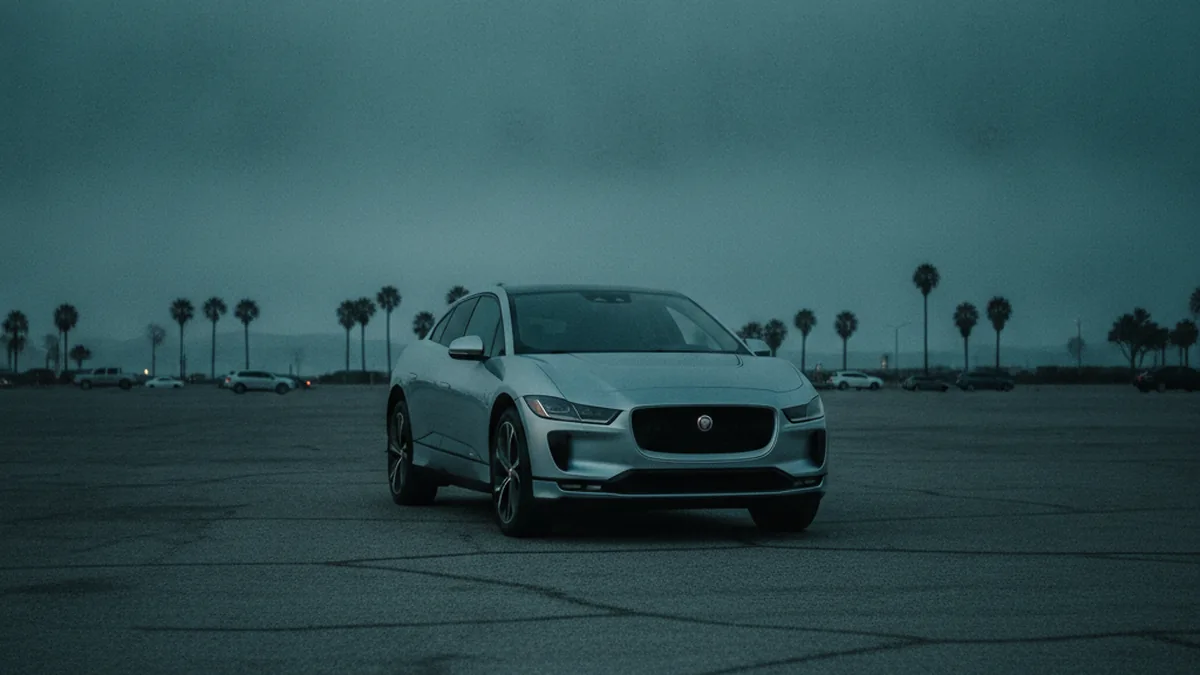
A Jaguar I-Pace that won’t start almost always has a dead 12V battery, not a drained traction pack. When that small battery fails, the flush door handles won’t present, the fob stops working, and the dash stays black. The tricky part is that the 12V lives in the frunk, and a dead 12V is exactly what locks you out of the frunk. Once you know the two manual overrides, you can get in and jump it in a few minutes.
The I-Pace is one of the older luxury EVs on San Diego roads now, and the 2018 to 2020 cars are right in the window where 12V batteries give out. If yours went dark in a driveway in La Jolla or on a garage level downtown, this is the guide for you.
Why an I-Pace goes completely dead
The I-Pace runs on two power systems. A high-voltage traction pack moves the car, and a conventional 12V battery runs the low-voltage electronics, including the computers that wake the high-voltage system up. If the 12V is dead, the traction pack stays locked out no matter how full it is.
So an I-Pace showing plenty of range can still refuse to do anything. The screens stay dark, the handles don’t pop out, and there’s no chime when you approach. Owners assume the big battery died. It almost never has. The 12V just can’t boot the car.
Watch for the signs that point straight at the 12V:
- The flush door handles stay retracted and won’t present when you approach
- The key fob won’t unlock the car, so the mechanical key blade is your only way in
- Dash, touchscreens, and interior lights all stay dark
- No welcome chime, no lock clunk as you walk up
If the dash instead lights up, throws a warning, and then quits, that’s a different fault that needs a dealer scan. For the plain “nothing happens at all” version, start with the 12V. For the bigger picture on why this hits every EV brand, read what happens when an EV 12V battery dies.
The I-Pace’s known 12V weakness
Here’s the part that makes the I-Pace stand out. The early cars have a documented history of 12V trouble. Owners of pre-2021 models report the 12V running down while parked, and many have replaced batteries at around three years old, sooner than they expected. Jaguar revised the setup for the 2021 model year, so pre-MY21 cars are the ones that fail most often.
The pre-2021 I-Pace also uses a dual 12V setup, with two batteries under the frunk panel rather than one. That means a weak battery can drag the whole low-voltage system down, and a jump has to reach the right post. San Diego heat speeds the decline, since a lead battery left at a low charge starts to sulfate, which is permanent capacity loss. If your I-Pace is a 2018 to 2020 car and it’s never had the 12V replaced, treat a slow or glitchy startup as a warning, not a fluke. A quick load test settles it, and our 12V battery replacement guide walks through what to expect.
How to get into a locked I-Pace when the 12V is dead
A dead 12V leaves the flush handles retracted, so you can’t grab a door the normal way. The fix is the mechanical key hidden inside the fob. Slide the release and pull the metal key blade out of the fob body.
Now find the hidden lock on the driver’s door. Push the front of the door handle inward, near the small button, so the back edge pivots outward. Pull the handle out as far as it comes to expose the lock cylinder behind it. Insert the key blade and turn it clockwise to unlock the door. That gets you into the cabin even with zero power in the car.
This lockout trap is common across EVs with power door handles, and the recovery is similar on other models. If you want the parallel, see how it plays out on a Tesla in dead battery, locked out of your Tesla.
Where the 12V is and how to jump it
The I-Pace 12V lives in the frunk, under a removable center panel, and a dead 12V is what keeps the frunk latched. To open it manually, get into the cabin first, then find the frunk release cable behind a black plug in the right side footwell. Pull it, and the frunk pops so you can reach the batteries.
Lift the center panel in the frunk. On pre-2021 cars you’ll see two batteries, and the positive posts are marked with red caps. Here’s the safe way to jump it:
- Connect the red clamp to the exposed positive post with the red cap
- Connect the black clamp to bare, unpainted metal on the chassis, not the battery’s negative terminal
- Let the donor source feed the battery for two to three minutes
- Then try to power the car up and bring it to READY
Grounding to the body instead of the negative post keeps any spark away from the battery. Always confirm the exact post and panel against your own model-year manual before you touch anything, since the pre-MY21 and MY21 layouts differ. For the full walk-through that applies to any EV, read how to jump start an EV safely.
Common I-Pace no-start scenarios
| What you see | Most likely cause | What to do |
|---|---|---|
| Handles won’t present, dash dark, no chime | Dead 12V battery | Manual key entry, then jump the 12V in the frunk |
| Car wakes, warns, then shuts off | High-voltage or DC-DC fault | Don’t keep jumping, get a dealer scan |
| Starts fine but 12V dies again in days | Failing 12V near end of life | Load test and replace the 12V |
| Won’t wake after a clean jump | Deeper electrical fault | Call for a road diagnosis or tow |
| Dead in a garage with no donor car nearby | No power source on hand | Call mobile rescue with a jump pack |
When to stop and call for rescue
If the manual key won’t turn, if the frunk release won’t pop the hood, or if the car won’t wake after a clean jump, stop there. Forcing a flush handle or the wrong terminal can cost more than a service call. The same goes for a car dead in a tight parking structure downtown or on the shoulder of I-5 or I-805, where jumping it yourself isn’t safe.
That’s when we come to you. Charge Pro SD runs mobile non-Tesla EV rescue across San Diego County, from the coastal early-adopter neighborhoods in La Jolla, Del Mar, and Rancho Santa Fe to the inland heat in El Cajon and Escondido where 12V batteries age fastest. We carry the gear to open a locked I-Pace, jump the correct post, load test the battery on the spot, and top up your charge if range is also low. For the wider view of what roadside help covers, see our EV roadside assistance guide.
Frequently asked questions
Why won’t my Jaguar I-Pace start or turn on?
The most common reason is a dead 12V battery, not the high-voltage traction pack. The I-Pace needs the 12V to power its computers before the main system can engage, so a dead 12V leaves the car unresponsive even with plenty of range. The flush handles stay retracted, the fob won’t work, and the dash stays dark. Jump the 12V first, and if the car still won’t wake after a clean jump, it likely has a deeper fault that needs a dealer scan.
How do I get into my I-Pace if the battery is dead and the handles won’t open?
Use the mechanical key hidden in the fob. Slide the release and pull out the metal key blade. On the driver’s door, push the front of the handle inward so the back edge pivots out, then pull the handle out to expose the lock cylinder behind it. Insert the key blade and turn it clockwise to unlock the door. That gets you into the cabin with no power in the car.
Where is the 12V battery on a Jaguar I-Pace?
It’s in the frunk, under a removable center panel, with the positive posts capped in red. Pre-2021 cars have two 12V batteries under that panel, while 2021 and newer cars were revised. Because a dead 12V keeps the frunk latched, you open it by pulling the manual frunk release cable behind a black plug in the right side footwell after you’ve unlocked the cabin.
How do you jump start a Jaguar I-Pace?
Open the frunk with the manual release, lift the center panel, and connect the red clamp to the red-capped positive post. Connect the black clamp to bare metal on the chassis, not the battery’s negative terminal, so any spark stays away from the battery. Give it two to three minutes, then power the car up and bring it to READY. Confirm the exact post against your model-year manual, since the pre-MY21 and MY21 layouts differ.
Do I-Pace 12V batteries really fail early?
They can on the early cars. Pre-2021 I-Pace models have a documented habit of running the 12V down while parked, and many owners have replaced the battery around three years old. Jaguar revised the system for 2021, so a 2018 to 2020 car that’s never had the 12V changed is the one to watch. San Diego heat speeds the decline, so a load test is worth it once the car is a couple of years old.
Does Charge Pro SD come out to a Jaguar I-Pace?
Yes. We cover all non-Tesla EVs across San Diego County, including the I-Pace. Our truck carries the gear to open a locked car, jump the correct 12V post, assess whether the battery needs replacing, and add a charge if you’re low on range. Typical arrival is 25 to 60 minutes from your call.
If your Jaguar I-Pace is sitting dark in a garage downtown, on the shoulder of I-805 in Sorrento Valley, or in your driveway in La Jolla, we can help. Call Charge Pro SD at (858) 400-4465 and we’ll be on our way.