Your Tesla is stranded, the screen’s black, and the thought of towing it fills you with dread. It’s not like towing a gas car, and getting it wrong can lead to major damage. When your Tesla has no power, understanding the right towing procedure is critical for its safety and your wallet.
Why you can’t tow a Tesla like a regular car
Teslas, like other electric vehicles, have a fundamentally different drivetrain than gasoline cars. This difference means towing them incorrectly can cause severe and costly damage. In a traditional car, the engine connects to the wheels through a transmission. When you tow it with the drive wheels on the ground, the transmission can still disengage, allowing the wheels to spin freely without damaging the engine.
EVs don’t work that way. Their electric motors are directly connected to the wheels, often through a single-speed gearbox. If the drive wheels spin while the car is off or inoperable, these motors generate electricity. This electricity has nowhere to go. It can cause the motors to overheat, damage internal components, or even send uncontrolled power back to the battery system. This isn’t just a risk; it’s a certainty if the car isn’t properly prepared for towing. The regenerative braking system, always active in a Tesla, adds another layer of complexity. It can engage unexpectedly when wheels spin without power, stressing the entire system. Ignoring these unique needs means risking thousands of dollars in repairs to your Tesla’s powertrain.
Transport mode: how to enable it with a dead 12V
Transport Mode is a critical feature for any Tesla being moved or towed. It disengages the parking brake and neutralizes the drivetrain, allowing the wheels to spin freely without engaging the motors or causing damage. Normally, you’d activate Transport Mode through the touchscreen under the “Controls” > “Service” menu. But what happens if your Tesla has no power and the screen is completely dead? This is usually due to a depleted 12V auxiliary battery, which powers all the car’s low-voltage systems, including the main computer and touchscreen.
If your 12V battery is dead, you can’t access the touchscreen to enable Transport Mode. The solution is to jump-start the 12V battery. You’ll find the access points for the 12V battery terminals by removing the front tow eye cover, typically on the passenger side of the front bumper. Connecting a 12V jump starter to these terminals provides just enough power to wake up the car’s systems. This allows you to then access the touchscreen and engage Transport Mode. Remember, this isn’t meant to start the car or charge the main battery; it’s only to power the low-voltage electronics temporarily. If you’re locked out because of a dead 12V, you can find more help in our guide on what to do if your Tesla battery dead locked out. For expert assistance with a dead 12V battery in San Diego, our Tesla 12V Battery Jump service can get your Tesla ready for safe transport.
Flatbed only — and why dolly tows damage Teslas
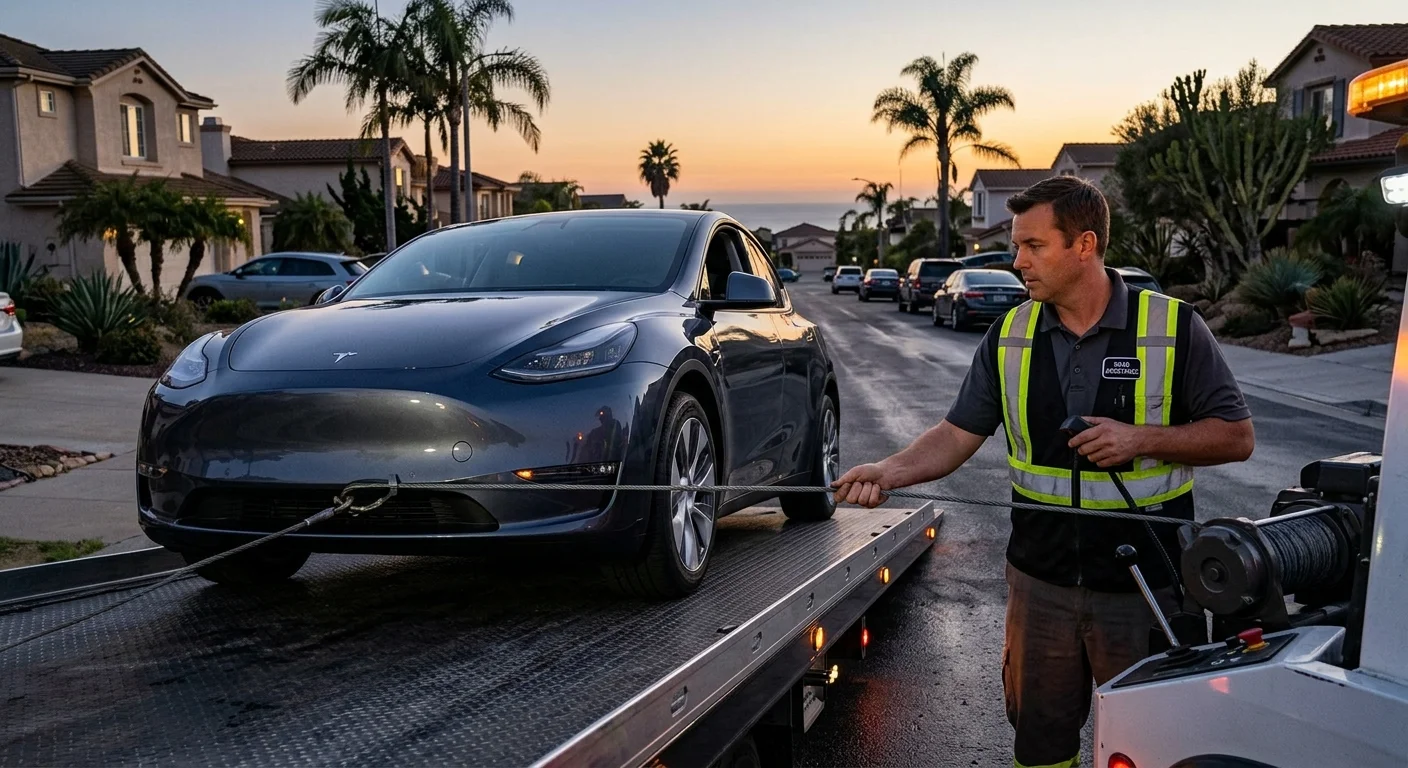
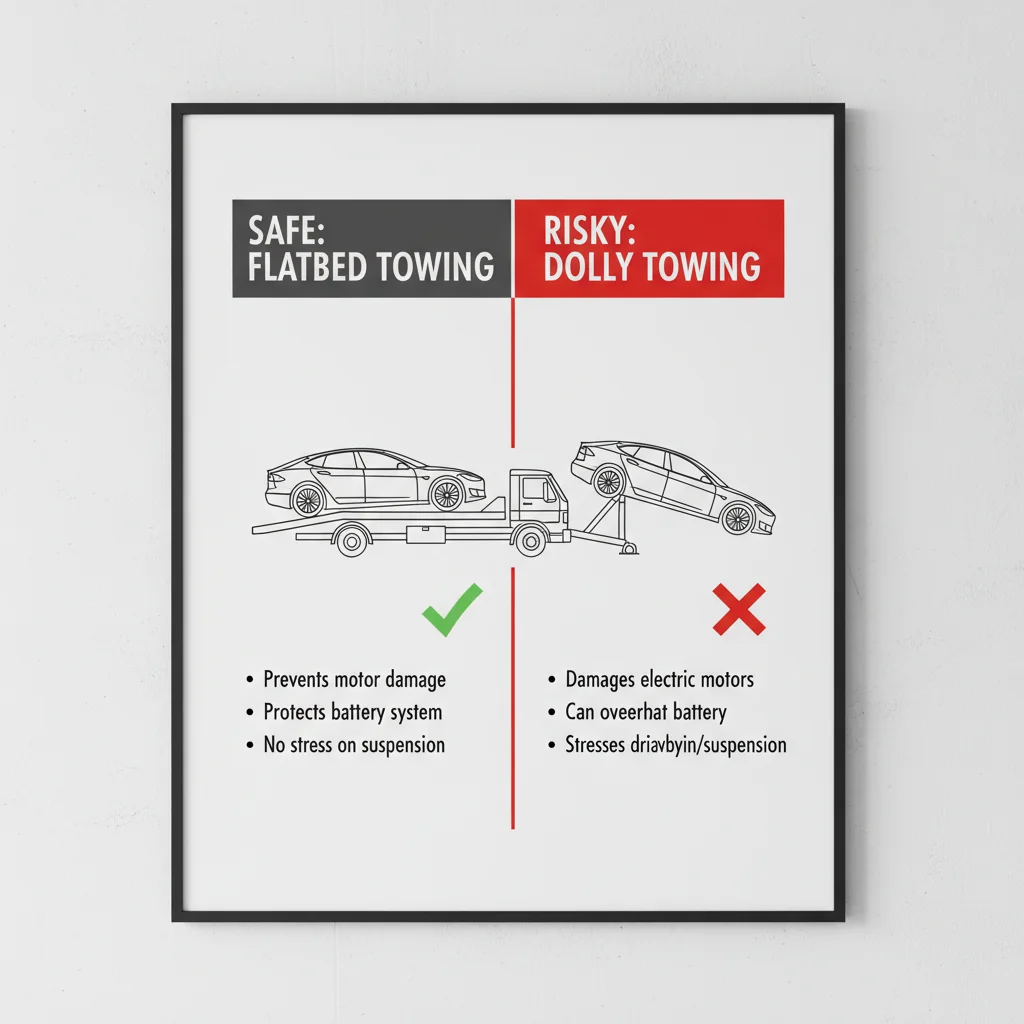
Let’s be absolutely clear: if your Tesla needs towing, a flatbed truck is the only safe method. Any other towing approach, especially using a dolly tow or a “hook and chain” method, guarantees severe damage to your vehicle. This isn’t an exaggeration; it’s a technical fact rooted in how Teslas are designed.
A dolly tow involves lifting either the front or rear wheels of the vehicle while the other pair of wheels remains on the ground. If the drive wheels (which is usually all four wheels in a Tesla AWD system) are allowed to spin while the car is off, the electric motors will generate electrical current. Without the main battery management system active, this current can’t be safely dissipated. The result is rapid overheating and irreversible damage to the electric motors and potentially other sensitive electronic components. Even for a short distance, a dolly tow can cause thousands of dollars in repairs. It also stresses the suspension and steering components in ways they aren’t designed for during towing. Always insist on a flatbed tow, where all four wheels of your Tesla are lifted completely off the ground. It’s the only way to ensure its safety and prevent expensive damage.
What to tell the tow operator before they hook up
Effective communication with the tow operator is crucial for a safe Tesla tow. Before they even think about hooking up, make sure they understand these non-negotiable points. First, state unequivocally: “It’s a Tesla, and it must be transported on a flatbed truck. No dolly towing.” This is the most important point to emphasize. Second, explain the power situation: “The 12V battery is dead, so we’ll need to jump it temporarily to enable Transport Mode.” Be ready to guide them to the 12V jump points if they’re unfamiliar.
Once Transport Mode is enabled and the parking brake is released, confirm the proper winching procedure. The wheels must be pointed straight ahead, and the winch should pull the car smoothly onto the flatbed. Ensure they use Tesla’s designated tow points. These are specific reinforced areas designed to handle the vehicle’s weight. Avoid any operator attempting to attach chains or hooks to suspension components or the underbody, as this can cause structural damage. A professional tow operator in San Diego County, experienced with EVs, will already know these steps. If you’re unsure, or if the operator seems hesitant, don’t proceed. We specialize in Tesla Roadside Rescue and ensure these exact procedures are followed to protect your vehicle.
When mobile charging beats towing entirely
Sometimes, a dead Tesla doesn’t need a tow at all. It just needs power. It’s important to distinguish between a dead 12V auxiliary battery and a depleted high-voltage drive battery. If your Tesla’s screen is black and it won’t respond, it’s highly likely the 12V battery is the culprit. As we discussed, a quick 12V jump start can bring the systems back online, allowing you to drive your Tesla to a Supercharger or home charging station. Our Tesla 12V Battery Jump service provides this quick, non-towing solution right where you are in San Diego.
However, if your Tesla’s main drive battery is truly depleted – meaning you’ve run completely out of charge – towing to a charger might seem like the only option. But often, mobile EV charging is a much faster, safer, and more convenient alternative. Instead of waiting for a flatbed tow truck and then waiting again at a charging station, a mobile charging service comes directly to you. We can provide enough charge to get your Tesla moving again, allowing you to drive to the nearest Supercharger or your destination. This avoids the complexities, potential damage risks, and extra costs associated with towing. For situations where you’re out of charge anywhere in San Diego County, consider our comprehensive Tesla Roadside Rescue to get you back on the road without a tow.
When to call us
Dealing with a dead Tesla can be stressful, but you don’t have to navigate towing requirements alone. Our team specializes in Tesla Roadside Rescue and understands the unique needs of your vehicle, from Tesla 12V battery jumps to safe flatbed transport. If your Tesla needs expert care in San Diego County, we’re ready to help. Call us at (858) 925-5546 for a same-day estimate.