The honest answer depends entirely on which charger you’re using, and the gap between the fastest and slowest option is enormous. A Tesla goes from near empty to about 80% in roughly 25 to 40 minutes on a Supercharger, takes 6 to 10 hours overnight on a home Level 2 charger, and can take two to three full days on a standard wall outlet. San Diego’s mix of coastal marine layer mornings and inland summer heat also changes the math slightly, more on that below.

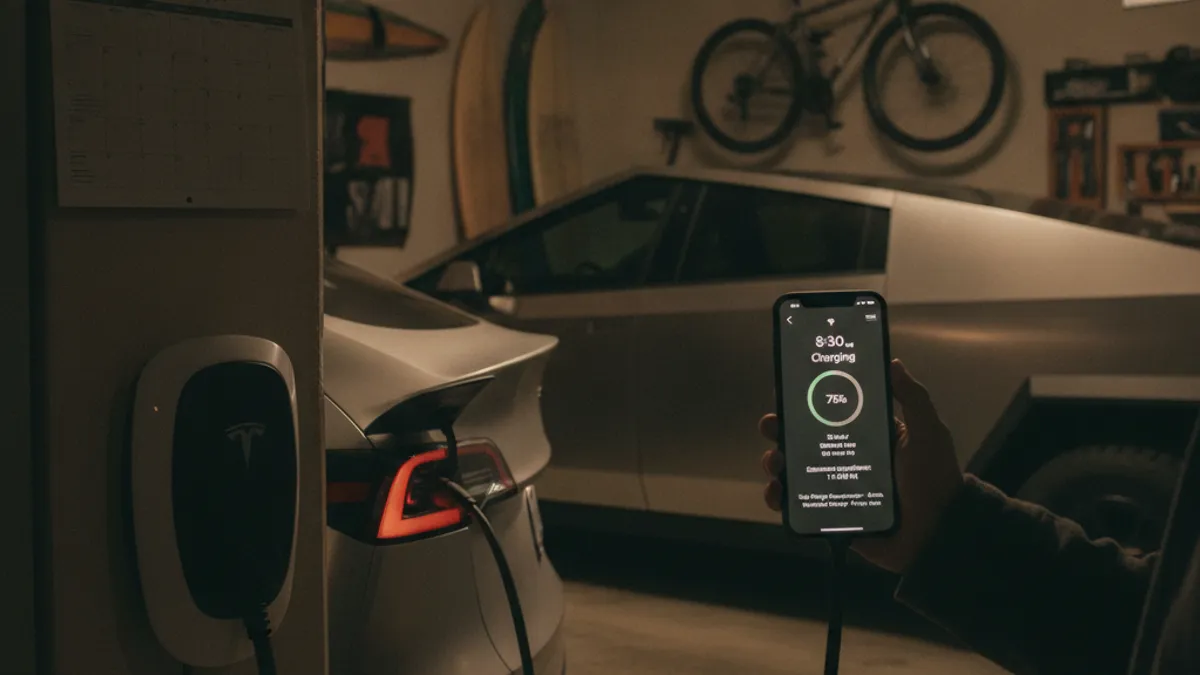
A Tesla Model Y plugged into a home Level 2 wall charger in a San Diego garage at night, with a phone showing the Tesla app charging screen.

Charging speed by charger type

Tesla, like every EV maker, splits charging into three levels. The jump between them is the single biggest factor in how long you’ll wait.

Level 1: the wall outlet you already have

Plugging into a standard 120V household outlet is the slowest option by far, adding roughly 3 to 5 miles of range per hour. For a Model 3 or Model Y with 250 to 330 miles of range, filling from near empty this way takes two to three days of continuous charging. It works fine if you drive under 30 miles a day and always have overnight hours to spare, but it can’t keep up with a longer commute across the county.

Level 2: the home and public standard

A 240V Level 2 charger, whether it’s a home wall connector or a public Level 2 station at a mall or office, adds 20 to 44 miles of range per hour, depending on your car’s onboard charger and the circuit’s amperage. Most Tesla owners plug in overnight and wake up to a full battery regardless of how depleted it was the day before. A full charge from near empty typically runs 6 to 10 hours, which is why Level 2 is built around overnight charging rather than a quick top-off.

DC fast charging: Superchargers and third-party networks

Tesla’s Supercharger network, along with CCS fast chargers from Electrify America and EVgo, delivers direct current straight to the battery, skipping the onboard charger entirely. On a newer Supercharger, a Model 3 or Model Y can go from around 10% to 80% in roughly 25 to 35 minutes. Older Model S and Model X vehicles, and older Supercharger stalls, run slower. Charging past 80% slows down significantly on any fast charger, which is why most drivers stop there rather than waiting for a full 100%.

Why the last 20% takes so long

Lithium-ion batteries accept charge fastest in the middle of their range and slow down sharply as they approach full, to protect the cells from damage. Going from 10% to 80% might take half an hour, but pushing from 80% to 100% on the same charger can take nearly as long again. For road trips, most drivers plan around the 80% stopping point and skip the slow tail end entirely.

What actually changes charging time in San Diego

Two local factors move these numbers more than people expect.

Cold-soaked mornings on the coast. A marine-layer morning in La Jolla or Del Mar can leave a battery cooler than it would be inland, and a cold battery accepts DC fast charging more slowly until it warms up. Tesla’s navigation system preconditions the battery automatically when you route to a Supercharger, so plugging the Supercharger into your nav before you leave home is worth the extra 30 seconds.

Inland summer heat. East County and North County Inland regularly hit 100°F or higher in summer. Extreme heat can also slow fast charging as the car’s thermal management system works to keep the pack in a safe temperature range. It’s a smaller effect than cold-soaking, but it’s part of why the exact same charger can behave differently in July versus January.

A quick reference for planning your day

If you’re deciding whether you have time for a charge before you need to leave, the rule of thumb is simple: a Supercharger stop fits into a coffee break, a home Level 2 charge fits into a normal night’s sleep, and a Level 1 wall outlet only makes sense if the car is going to sit for a day or more. Anything in between those windows is where drivers tend to misjudge and end up short on range.

What to do if you can’t wait for a charge

If your Tesla runs critically low before you can reach a charger, whether that’s a stalled trip on the I-15 or a dead 12V battery that won’t let the car power on at all, Charge Pro SD brings a mobile Level 2 charger directly to you anywhere in San Diego County. We add enough range on-site to reach the nearest Supercharger or get you home, without waiting on a tow truck. Our out-of-charge recovery service handles exactly this scenario, and our breakdown of what mobile EV charging costs covers the pricing in full.

Frequently asked questions

How long does it take to charge a Tesla from empty on a Supercharger?

Roughly 25 to 40 minutes to reach about 80%, depending on the model and the Supercharger’s max output. Charging past 80% slows down significantly, so most drivers stop there for road trips.

How long does a home Tesla charger take overnight?

A 240V Level 2 home charger typically takes 6 to 10 hours to go from near empty to full, which fits comfortably into a normal overnight window.

Can I charge a Tesla with a regular wall outlet?

Yes, but it’s slow. A standard 120V outlet adds only 3 to 5 miles of range per hour, meaning a full charge from empty can take two to three days.

Does San Diego weather affect Tesla charging speed?

Yes, modestly. Cold marine-layer mornings can slow DC fast charging until the battery warms up, and extreme inland summer heat can do the same. Preconditioning the battery by navigating to a Supercharger ahead of time helps in both cases.

If you’re stranded before you can reach a charger anywhere in San Diego County, call (858) 400-4465 for same-day mobile charging.