A disabled EV near University City needs the right kind of help. Your location, battery symptoms, and parking access shape what an independent operator can safely offer.
Share your I-5 or SR-52 location
“University City” isn’t precise enough for an EV roadside request. Start with the road, direction of travel, and your nearest safe reference point. On I-5 or SR-52, share the direction, nearest exit, and whether you’re on a shoulder, ramp, or connecting road.
Genesee Avenue crosses busy retail and employment areas. A street address may still point to several entrances or separate parking areas. Add the property name, driveway, parking row, and nearest cross street. If you’re inside a structure, include the garage entrance and level.
Send a location pin when possible. Then describe what an operator will encounter. Note gates, ticket arms, security desks, loading areas, or restricted entrances. Don’t assume a landmark identifies the correct access point.
If the EV is stopped in a traffic lane or another dangerous position, call 911 first. The California Highway Patrol also says metropolitan-area drivers can use 511 and request roadside assistance for other situations. Follow emergency instructions for the actual scene.
A breakdown near the I-5 and SR-52 corridor differs from one inside a Genesee Avenue garage. The freeway request may involve traffic exposure. The garage request may involve height, turning, and entry limits. Give those details before an operator accepts the referral.
Our guide to an EV running out of charge on SR-52 covers that corridor in more detail. Drivers west of University City can also compare the local considerations in our La Jolla EV roadside guide.
Tell empty charge from low-voltage failure
Don’t diagnose the EV from one warning or a dark screen. Instead, report exactly what happened before the vehicle stopped. Those observations help an operator decide whether charging, a low-voltage service, or transport needs discussion.
Start with the make, model, and model year. Share the displayed charge percentage if you saw it. Say whether the EV lost driving power, refused to shift, stopped charging, or wouldn’t unlock. Mention any warning text exactly as shown.
A depleted traction battery and a low-voltage failure aren’t the same request. Mobile charging addresses an out-of-charge situation when the vehicle, location, connector, and available equipment fit. A low-voltage problem may require a vehicle-specific jump procedure. A jump doesn’t add usable energy to an empty traction battery.
Don’t improvise with charging cables, adapters, or jump points. The approved procedure can differ by model year. The owner’s manual controls the vehicle-specific steps. Ask the independent operator to confirm the exact vehicle, charge port, approved adapter, symptoms, and proposed service.
Charging time also varies. The U.S. Department of Energy explains EV charging and vehicle systems, while its charging guidance identifies several relevant factors. These include battery state, battery capacity, vehicle limits, equipment output, and electrical service.
If you’re unsure what failed, that’s fine. Describe what you can see without opening panels or entering traffic. Clear symptoms are more useful than a confident guess.
Explain garage and parking access
University City roadside calls often start in a parking area rather than beside a freeway. The vehicle may be near offices, stores, housing, or a secured property. The operator still needs a workable route to the EV.
Give the full address, but don’t stop there. Name the entrance from Genesee Avenue or the closest cross street. Share the garage level, space number, row marker, and nearby elevator or stairwell. If several buildings share a driveway, identify the correct building.
Ask the property manager or security desk about current entry rules. Charge Pro SD couldn’t confirm one access policy for University City properties. Each owner or manager sets the rules for that location.
Tell the operator about height signs, steep ramps, tight turns, locked gates, and ticket controls. Don’t estimate a clearance if you can safely read the posted figure. Share a photo of the sign instead. Also mention whether another vehicle blocks direct access to the charge port or approved low-voltage connection area.
Avoid promising that roadside work is allowed inside the garage. Permission, equipment fit, and safe access need confirmation for the actual request. If the property won’t permit the proposed work, ask the operator about another recovery plan.
A location pin may land on the roof or street beside a structure. Written directions close that gap. “Level three, north side, entered from the driveway nearest Genesee” gives an operator more useful context than a map pin alone.
Choose charging, a jump, or transport
The right recovery path depends on the vehicle and symptoms. It also depends on where the EV stopped. Charging, a low-voltage jump, and transport solve different problems.
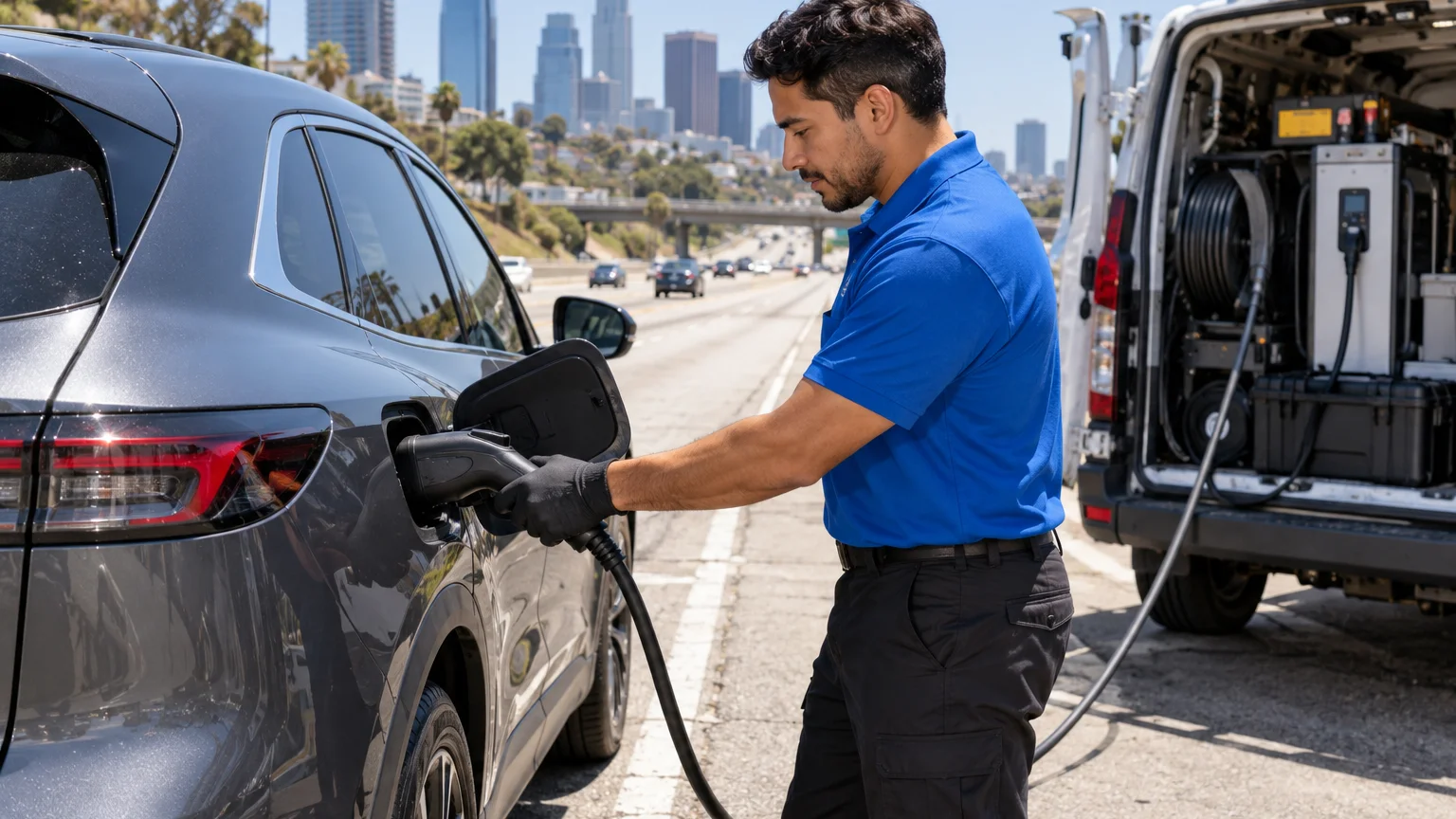
Mobile EV charging may be considered when the traction battery is depleted. The operator must confirm the vehicle, connector, approved adapter, available equipment, and safe access. Connector shape alone doesn’t prove that equipment will work with your EV.
A low-voltage jump may be considered when the symptoms and vehicle procedure support it. Share the model year because procedures can change between versions. Don’t copy instructions from another EV or an earlier model. Don’t use an EV to jump another vehicle unless its manufacturer expressly permits that use.
Transport may be the better discussion when charging isn’t suitable, the car has damage, the location is unsafe, or access prevents roadside work. The destination also matters. Give the operator the intended repair or charging destination, then confirm whether that destination can receive the vehicle.
Ask what the completed service established and what remains uncertain. A roadside step may restore access or power without diagnosing the underlying fault.
Our emergency EV roadside assistance service connects drivers with licensed, independent local operators. Charge Pro SD doesn’t perform charging, jumping, or transport. The customer contracts with and pays the operator directly. Confirm the proposed service, price, timing, equipment, and destination before accepting the referral.
How local operator matching works
Charge Pro SD serves San Diego County as a referral service. We connect stranded drivers with licensed, independent local operators. We don’t own rescue vehicles, employ roadside crews, set prices, or perform physical work.
The matching process starts with accurate information. Share your callback details, exact location, make, model, model year, displayed charge level, warnings, and recent events. Include the charge port and any approved adapter you have. Add photos when they clarify the vehicle or access point.
Next, describe the scene. Tell us whether you’re on I-5, SR-52, Genesee Avenue, or private property. Identify the travel direction, entrance, garage level, gate, security contact, and visible clearance limits. Mention collision damage, tire damage, smoke, leaking material, or a vehicle blocking traffic.
An independent operator must review the requested work. Ask that operator to confirm the proposed service, vehicle compatibility, equipment, price, timing, access needs, and destination. Availability isn’t guaranteed, and a listed service doesn’t mean every operator can perform it for every EV.
The operator performs the work and provides any applicable terms. Charge Pro SD doesn’t issue a roadside warranty. Keep the operator’s name and agreed details before service begins.
Good matching isn’t about choosing “charging” from a menu. It’s about sending the right facts to someone who can assess the request. In University City, precise parking directions can matter as much as the vehicle symptoms.
When to call us
Call when your EV is stranded near University City and you need an operator to review charging, a low-voltage jump, or transport. Have the vehicle, symptoms, I-5 or SR-52 direction, Genesee Avenue entrance, and parking access details ready. Call us at (858) 400-4465 and we’ll connect you with a local EV rescue operator.