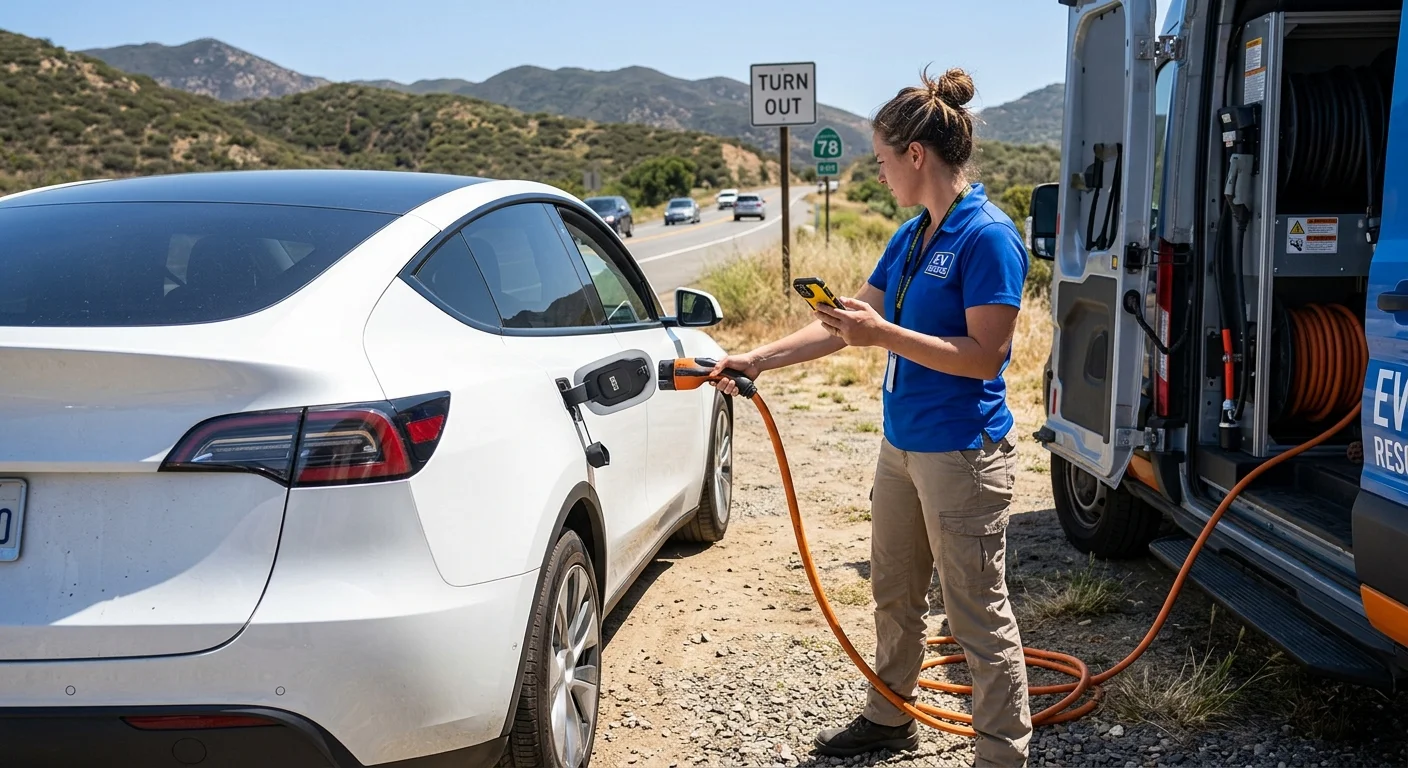
A zero-range warning near Ramona makes your exact location the first priority. On SR-67 or SR-78, report where the EV stopped and what its display shows. Those details help an operator assess mobile charging or transport.

An electric vehicle parked safely in a turnout near SR-67 or SR-78 while its dri

Identify your position on SR-67 or SR-78

Start with the route shown on the nearest sign or map. Saying “near Ramona” leaves too much ground to search. An operator needs a location that points to one specific stopping place.

Share every detail you can confirm:

  • SR-67 or SR-78
  • Your direction of travel
  • The nearest visible road or intersection
  • A map pin from your phone
  • A nearby sign, entrance, or business name
  • Whether you’re on the roadway, a turnout, or private property

Read labels exactly as they appear. Don’t guess at a road name, mile marker, or direction. If your navigation app and a visible sign disagree, share both. The operator can ask follow-up questions before arranging service.

A screenshot can help when the map pin moves or lacks context. Include enough of the map to show the route and nearby roads. Keep the original pin available so you can resend it if needed.

Also explain which side of the road you’re on. A pin can appear close while still directing someone toward the opposite side. Mention barriers, medians, closed gates, or separate driveways when you can see them.

Our broader Ramona and Valley Center roadside guide covers the surrounding service area. This page focuses on the narrower SR-67 and SR-78 out-of-charge decision. Precise location details should come before any discussion of charging or transport.

Move away from traffic when it’s safe

Your first decision concerns the immediate scene, not the battery. If the EV is already away from moving traffic, tell the operator where it’s positioned. If it isn’t, describe the situation before attempting another maneuver.

The approved claims ledger doesn’t contain route-specific shoulder or evacuation instructions for SR-67 or SR-78. Because every stopping place differs, this article can’t tell you whether to stay inside, exit, cross traffic, or move the vehicle. If there’s immediate danger, call 911 and follow directions from the responding authority.

Don’t assume a nearby turnout, driveway, or side road is reachable. An EV showing no usable range may not complete another move. Report whether the car can select drive, roll, steer, or release its parking brake. Don’t test those functions if doing so would place anyone in danger.

If an officer, firefighter, or road worker is already present, tell the operator. Share any instructions you’ve received about moving or removing the vehicle. That information can change whether roadside charging remains an option.

Keep your location message factual. “Stopped in traffic” communicates something different from “parked off the roadway.” The operator needs that distinction before recommending the next step.

For a broader checklist, read the out-of-charge freeway guide. It can help organize the information you share without replacing instructions from authorities at the scene.

Tell empty charge from low-voltage failure

A car that won’t move hasn’t diagnosed itself for you. Don’t label every no-start condition as an empty drive battery. Instead, copy the vehicle’s messages exactly and describe what happened before it stopped.

Useful observations include:

  • The displayed battery percentage or estimated range
  • Any out-of-energy message
  • Any low-voltage warning
  • Whether the main screen remains on
  • Whether the doors and charge port respond
  • Any charging, electrical, or system-fault message

Use the vehicle app if it still connects, but don’t treat missing app data as a diagnosis. Report what the app shows and when it last updated. A screenshot of the warning can preserve wording that later disappears.

If the vehicle reports a low-voltage problem, say that clearly. Don’t call it an empty traction battery unless the vehicle also reports depleted charge. Likewise, a displayed zero-charge message shouldn’t be rewritten as a low-voltage failure.

Avoid opening panels, connecting another vehicle, or attempting an improvised jump based on a guess. The matched operator should confirm the vehicle, symptoms, and suitable response. Charge Pro SD doesn’t diagnose the car or perform roadside work.

Our EV roadside assistance service connects drivers with licensed, independent local operators. Share the exact make, model, model year, dashboard wording, and current vehicle state. Those details help the operator decide what equipment and service may fit.

Share access details before help is arranged

A correct map pin still doesn’t explain how equipment can reach the EV. Describe the final approach before an operator accepts the job. Access details matter on either route and throughout the Ramona area.

Tell the operator whether the vehicle is:

  • Beside an active travel lane
  • Inside a marked turnout or parking area
  • Behind a gate or within private property
  • In a garage or under a height restriction
  • Facing toward or away from the access point
  • Blocked by another vehicle or fixed object

Report whether there’s room near the charge port. Include the port’s location on the vehicle if you know it. Don’t move the EV merely to create working space unless the scene is safe and the operator or responding authority directs you.

Mention locked doors, a missing key, collision damage, flat tires, or wheels that won’t roll. These details may affect the available recovery method. If someone else owns the property, explain whether you have permission to admit the operator.

Send the make, model, model year, connector information, and warning screenshots directly. Don’t assume every mobile charger fits every EV. Ask the operator to confirm connector compatibility and available charging output before service is arranged. The U.S. Department of Energy charging guide provides background on charging levels and connector types.

Charge Pro SD can pass your information to an independent operator. It doesn’t control operator availability, arrival time, equipment, pricing, or access decisions. Confirm those details directly with the operator before accepting service.

Choose mobile charging or transport

Mobile charging is one possible recovery path, not the automatic answer. The operator first needs to determine whether the EV can accept energy where it stopped. Location, access, vehicle condition, and connector compatibility all affect that decision.

Ask the operator to confirm:

  • Whether mobile charging fits the reported symptoms
  • Whether the available connector matches your EV
  • Where the equipment would need to be positioned
  • What charging output the operator can provide
  • Whether transport is the better recovery method

Don’t assume a mobile charge will deliver a specific range or take a specific amount of time. Output depends on the operator’s equipment and the vehicle’s charging capability. Confirm what the proposed service is intended to accomplish before agreeing.

Transport may be considered when the EV can’t accept a charge, has another unresolved fault, or can’t be serviced at its location. The transport provider should confirm the loading method, destination, access requirements, and price. Charge Pro SD doesn’t set those terms.

If charging is proposed, identify the next intended destination. That could be a charging location, home, or another place selected with the operator. Don’t rely on an unconfirmed charging location or assume access will be available. Check current information before setting that plan.

Our out-of-charge EV recovery service connects stranded drivers with licensed, independent local operators. For mobile EV charging near Ramona, give the operator your exact SR-67 or SR-78 position first. A clear location and symptom report makes the charging-versus-transport decision easier to evaluate.

When to call us

Call when your EV has stopped near Ramona and you need an operator to assess mobile charging or transport. Charge Pro SD is a referral service and doesn’t perform the physical recovery work.

Call us at (858) 400-4465 and we’ll connect you with a local EV rescue operator.