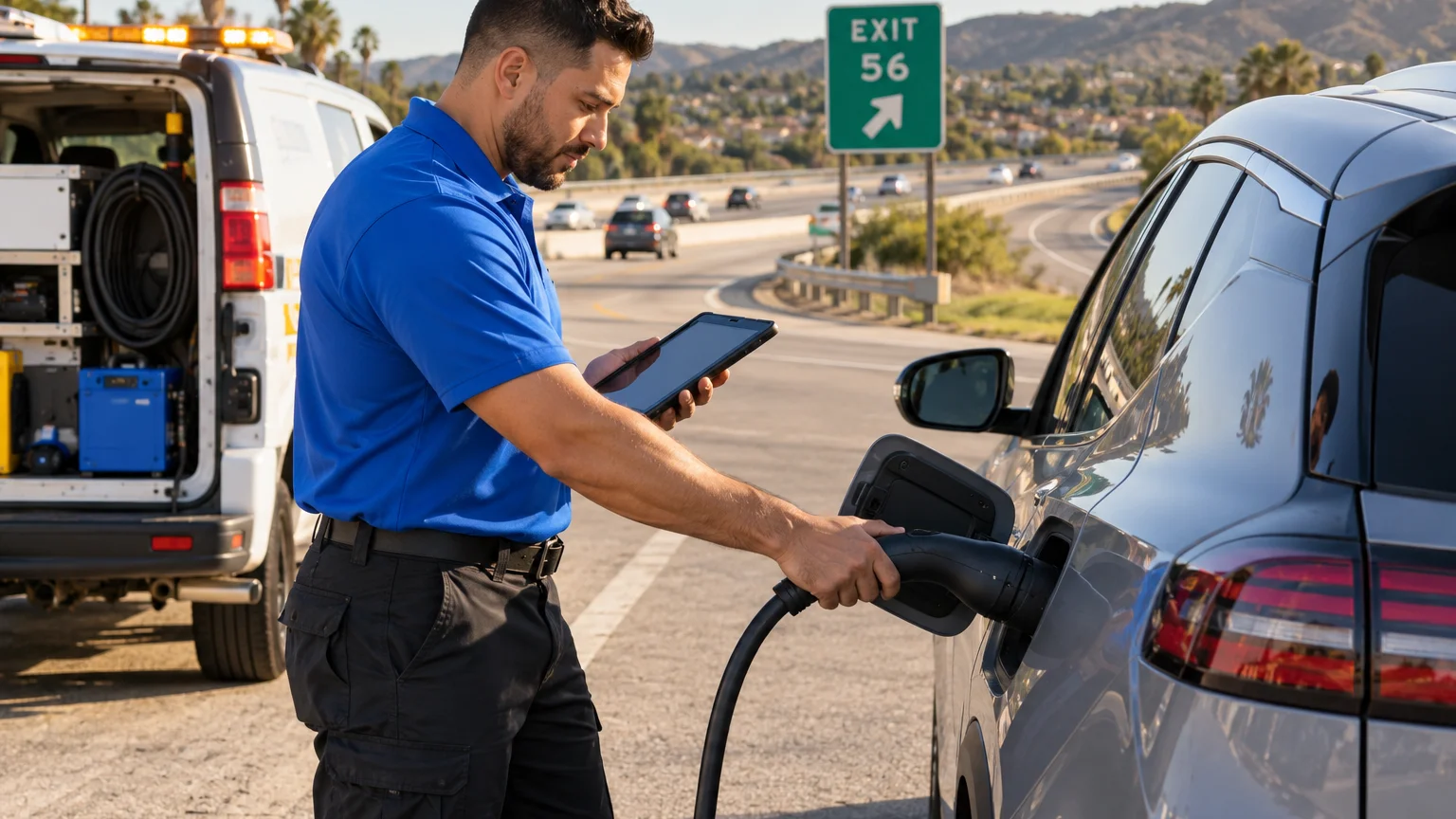
An empty battery on SR-56 creates an immediate location problem. The operator needs to know which side of Carmel Valley you’re on and how the vehicle can be reached. Clear details help the operator assess mobile charging or transport without guessing.
Identify your direction and nearest exit
Start with your direction of travel. Say whether you were heading east toward I-15 or west toward I-5. Don’t rely on “near Carmel Valley,” since that can describe a large area around SR-56.
Next, check the nearest exit shown on a road sign, navigation screen, or map. Carmel Valley Road may help identify the western part of the corridor. Rancho Peñasquitos and I-15 point the operator toward the eastern side. If you passed an exit before stopping, include that detail too.
Share the location pin from your phone when possible. Then write the same location in plain words. A pin can identify the vehicle, while your written description explains the approach.
A useful location report includes:
- Eastbound or westbound SR-56
- The nearest named exit
- The last exit you passed
- Whether you’re before or after the exit
- Whether the vehicle is in a traffic lane or another location
- Any barrier, gate, ramp, or access restriction
Don’t describe the vehicle as simply “between I-5 and I-15.” That leaves too much corridor for an operator to interpret. The nearest visible sign is more useful.
Drivers near the western side can also review our guide to EV roadside assistance in Carmel Valley. For incidents closer to I-15, the Scripps Ranch and Rancho Peñasquitos guide covers that local service area.
Follow current roadside safety guidance
Location safety comes before charging decisions. The California Highway Patrol says to call 911 when a disabled vehicle is in a traffic lane or another dangerous location. Tell the call taker that the vehicle is an EV, where it stopped, and which direction it was traveling.
For other roadside-assistance requests in metropolitan areas, CHP says drivers can call 511 and say “Roadside Assistance.” That guidance doesn’t confirm mobile EV charging, a particular operator, or service availability on SR-56. It provides a public-authority contact path for roadside help.
There isn’t one verified instruction that tells every stranded driver to stay inside or exit the vehicle. The correct choice depends on the vehicle’s position, traffic, barriers, and instructions from public-safety personnel. Follow directions from 911, CHP, or responders who can assess the scene.
Don’t place yourself near moving traffic to inspect a charge port or take photos. If public-safety personnel direct you to another location, follow their instructions. A roadside operator may also determine that the vehicle’s position doesn’t allow charging work there.
Charge Pro SD can help with an EV roadside assistance referral, but it isn’t an emergency agency. We connect drivers with independent local operators. We don’t control traffic, move vehicles, or determine whether a freeway location is safe for roadside work.
Share safety-related details before discussing equipment. Mention whether the vehicle blocks a lane, whether authorities are present, and whether access has been restricted. Don’t assume that an operator can enter every shoulder, ramp, or controlled scene.
Tell empty charge from low-voltage failure
Describe what happened without diagnosing the vehicle yourself. “The traction battery displayed zero” and “the vehicle won’t power on” are different reports. A blank display alone doesn’t prove which battery or vehicle system caused the shutdown.
Tell the operator what you observed before the vehicle stopped:
- The last traction-battery percentage or range shown
- Any warning text displayed
- Whether the vehicle gradually lost driving power
- Whether the screens, locks, or charge-port controls still respond
- Whether the vehicle accepts a charging connector
- Whether the vehicle is already connected to equipment
- The exact make, model, and model year
Don’t remove panels, connect improvised equipment, or try a model-specific jump procedure from memory. Low-voltage procedures vary by vehicle and year. The exact owner’s manual should control any instructions.
For example, Hyundai’s verified 2026 IONIQ 5 guidance addresses its 12-volt system and limits that procedure to a 12-volt power supply. That information shouldn’t be copied onto an earlier IONIQ 5, an IONIQ 5 N, or another EV. Tesla and Rivian, for example, publish model-specific low-voltage instructions in their owner’s guides.
If the traction battery showed remaining charge but the vehicle became unresponsive, say that plainly. If the display reached zero and the vehicle stopped, report that instead. The matched operator can then confirm whether the request fits charging, low-voltage help, or transport.
Our out-of-charge recovery service focuses on matching the situation with an independent operator. The operator must confirm the proposed service before you accept it.
Share shoulder and access details
An accurate pin still doesn’t explain whether equipment can reach the vehicle. Add a short description of the stopping area and the route into it. This matters along SR-56, where “near an exit” could mean the main roadway, a ramp, or a nearby surface street.
Tell the operator which side of the vehicle faces traffic. Also identify the charge-port location if you know it. Don’t guess about an adapter or connector. Share a clear photo of the port and any approved adapter available with the vehicle.
Access details should cover:
- The vehicle’s exact position
- Available space around the charge port
- A barrier or narrow edge beside the vehicle
- Whether an exit ramp separates the operator from the car
- Any direction given by CHP or another responder
- The vehicle’s color and license plate
- Your current callback number
If you reached Carmel Valley Road or another surface street before stopping, update the pin. Don’t keep describing the location as SR-56 if the vehicle is now somewhere else. If you’re closer to Rancho Peñasquitos, include the nearest visible street or business name without assuming it allows roadside work.
Cellular coverage and operator access can’t be promised. Save the important details in a message before beginning a referral request. If the call disconnects, the written location, vehicle information, and symptoms remain available to share again.
These details don’t guarantee that charging can happen at that spot. They help the independent operator decide whether the proposed equipment and approach fit the actual location.
Choose mobile charging or transport
Mobile charging and transport solve different problems. Mobile charging may be considered when an operator confirms the vehicle, connector, approved adapter, location, and available equipment. Transport may be considered when charging isn’t suitable, can’t be confirmed, or won’t address the reported symptoms.
Ask the operator several direct questions before accepting service:
- Does the equipment match this make, model, and model year?
- Is an approved adapter required?
- Can the operator legally and safely access this location?
- What charging service is proposed?
- How much energy does the operator expect to provide?
- What price and timing apply to this specific request?
- What happens if the vehicle doesn’t accept a charge?
Charge Pro SD doesn’t set prices or promise timing. The customer contracts with and pays the independent operator directly. Confirm those terms before accepting the referral.
The U.S. Department of Energy’s charging overview explains that charging time depends on the vehicle’s state of charge, battery capacity, onboard charging capacity, equipment output, and electrical service. A connector that physically fits doesn’t establish the charging result.
If transport is proposed, give the provider the exact vehicle details. Ask the provider to follow that model year’s owner’s manual and manufacturer instructions. Don’t assume one transport method fits every EV.
Mobile service also shouldn’t be treated as a promised full recharge. The operator must explain the proposed service and expected result. Our mobile EV charging service connects drivers with independent local professionals, but each operator must confirm the equipment, location, price, and timing for the request.
When to call us
Call when your EV is out of charge near SR-56 and a mobile operator needs to assess charging or transport options. Share your direction, nearest exit, vehicle details, symptoms, and access conditions first.
Call us at (858) 400-4465 and we’ll look for an independent local EV rescue operator who can take the request.