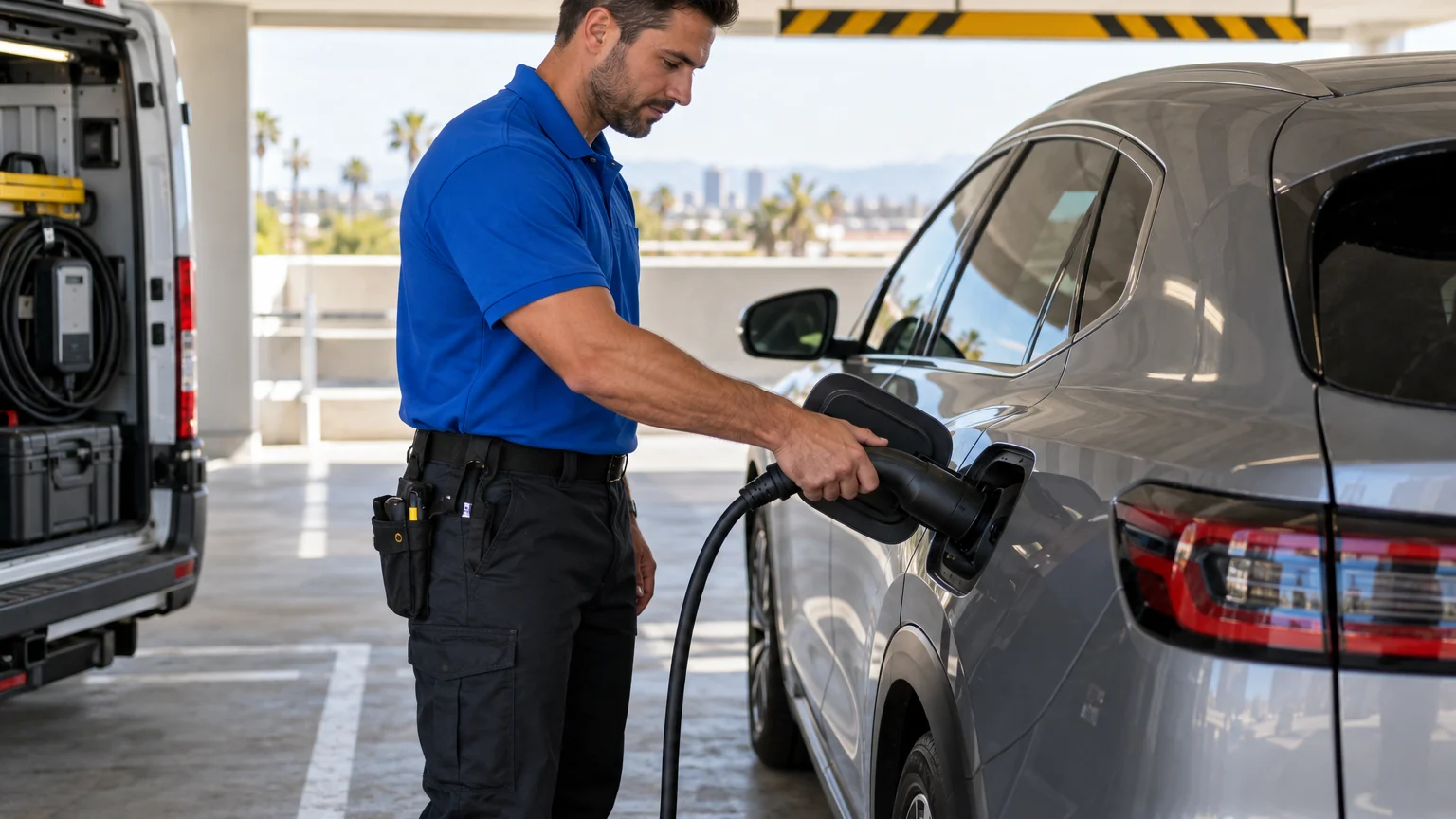
A dead EV inside a downtown San Diego garage needs careful coordination. Before anyone heads over, confirm the clearance, access rules, vehicle details, and exact parking location.
Identify garage level, stall and posted clearance
Start with the information visible around your vehicle. Record the garage name, street address, entrance location, level, section, and stall number. If the garage uses colors, letters, or zones, include those too.
Photograph the posted clearance at the entrance. Don’t estimate it from memory. An operator needs the number shown on the sign before deciding whether available equipment might fit. Clearance can also change inside a structure. Note any lower pipes, signs, ramps, or hanging barriers along the route to your EV.
Describe the path from the entrance to the stall. Tell the operator about tight turns, steep ramps, gate arms, speed bumps, narrow lanes, and low overhead fixtures. Say whether the vehicle is nose-in, backed-in, or parked against a wall. Nearby columns or parked cars may affect access.
Share the exact entrance rather than only the garage address. A downtown structure may have multiple gates, and one could lead somewhere different from another. If the entrance closes at certain times, ask management for the current access procedure. Don’t guess at garage hours or assume every gate works the same way.
Send photos when the operator accepts them. Useful images show the clearance sign, entrance, ramp, vehicle position, and open space around the EV. This gives the independent operator a better basis for confirming compatibility before accepting the request.
Ask building management about access, power and safety rules
Contact the garage attendant, security desk, property manager, or building management. Explain that the EV can’t move and that you’re arranging outside roadside help. Ask who can authorize entry for an independent operator.
Confirm whether the operator must check in, show identification, receive an access code, or use a particular entrance. Ask whether staff need the operator’s business information before opening a gate. Charge Pro SD can connect you with an independent local operator, but it can’t promise that a private garage will grant entry.
Don’t assume an outlet near the stall may be used. Ask management whether any electrical connection is authorized for roadside recovery. The building controls its power and safety rules. An available outlet doesn’t establish permission, compatibility, or suitability for charging your vehicle.
Tell management what you know about the vehicle’s condition. Mention smoke, unusual heat, leaking fluid, collision damage, or a burning odor if any is present. Don’t attempt charging, towing, or low-voltage work when the vehicle manual warns against it. If the disabled vehicle is in a dangerous location or traffic lane, the California Highway Patrol says to call 911.
Ask whether staff can temporarily control nearby traffic or keep the access path clear. Don’t promise that an operator will enter, charge, or remove the vehicle. Management approval and operator compatibility both need confirmation before service begins.
Tell the independent operator the vehicle, charge port and alerts
Give the operator the exact make, model, and model year. Similar-looking EVs can have different ports, approved adapters, low-voltage systems, and recovery instructions. Don’t report only “Tesla” or “electric SUV.”
Describe what happened before the vehicle stopped. Say whether the main battery reached zero, the screens went dark, the doors stopped responding, or a warning appeared. Copy alert text exactly when possible. A photo of the display is more useful than a paraphrase.
Tell the operator which charge port the vehicle has and which approved adapters are inside the car. Don’t assume a connector will work because it looks familiar. Connector compatibility also depends on the vehicle, charging equipment, and proposed service.
Share whether the charge port opens and whether the vehicle can enter its manufacturer-approved transport or tow setting. Don’t try to push or drag an immobile EV unless its manual permits that handling. Vehicle-specific instructions control safe recovery.
Tesla owners should consult the manual for their exact model and year. For example, the official Tesla Model Y owner’s manual contains procedures for low-voltage power and hood access. Other EV owners should use the corresponding manufacturer manual.
Our out-of-charge EV recovery service explains the referral process. The matched operator still must confirm the vehicle, equipment, garage access, and proposed service before accepting the job.
Compare available mobile help and a tow without assuming either fits
A low ceiling changes the decision. Mobile charging equipment may fit where a conventional tow vehicle doesn’t, but that isn’t guaranteed. A smaller service vehicle may still exceed the posted clearance or lack enough working space near your stall.
Ask a prospective mobile operator to confirm the height and access needs of the actual vehicle being sent. Also ask whether the proposed equipment matches your EV and approved adapter. Don’t treat a general mobile-charging description as proof that a specific operator can serve this garage.
Mobile power may help when the high-voltage battery is simply depleted. It may not address a low-voltage fault, damaged charge port, collision issue, locked wheels, or another vehicle fault. Describe the symptoms and let the operator determine whether the requested service matches them.
A tow creates separate questions. Confirm whether the towing equipment can enter the structure, reach the stall, position safely, and handle that exact EV according to its manual. If a full-size tow vehicle can’t enter, ask what recovery method the towing company proposes. Don’t authorize dragging, rolling, or improvised movement that conflicts with manufacturer instructions.
Garage management may have its own removal procedure or approved vendor requirements. Ask before arranging movement. The practical choice isn’t automatically mobile charging or towing. It’s the option that both the property and qualified operator confirm can be performed at that exact location.
Confirm the price and actual access before dispatch
Before an independent operator starts toward the garage, repeat the critical details. Confirm the posted clearance, selected entrance, level, stall, vehicle model year, symptoms, charge port, adapters, and management contact.
Ask the operator to state the proposed service. It might involve charging support, low-voltage assistance, diagnostics, or coordination for vehicle recovery. Don’t assume the initial description will remain correct after the operator reviews the vehicle alerts and garage restrictions.
Get the price directly from the operator before accepting service. Charge Pro SD doesn’t set prices, collect the operator’s payment, or provide a warranty. The customer contracts with and pays the independent professional directly. Ask what the quoted amount covers and what could change it, including parking charges or access complications.
Confirm timing directly with the operator. Don’t rely on an unverified arrival estimate. Garage entry, operator availability, equipment compatibility, and property approval can affect whether the request is accepted.
Finally, exchange a working callback method and the management contact. Tell the operator where you’ll meet them if phone reception near the stall becomes unreliable. If access hasn’t been approved, say so plainly. An operator shouldn’t be represented as garage-compatible until both the equipment and property access have been confirmed.
When to call us
Call when your EV can’t move inside a San Diego garage and you need help finding a mobile EV rescue operator who can review the access details. Call us at (858) 400-4465 and we’ll look for an independent local EV rescue operator who can take the request.