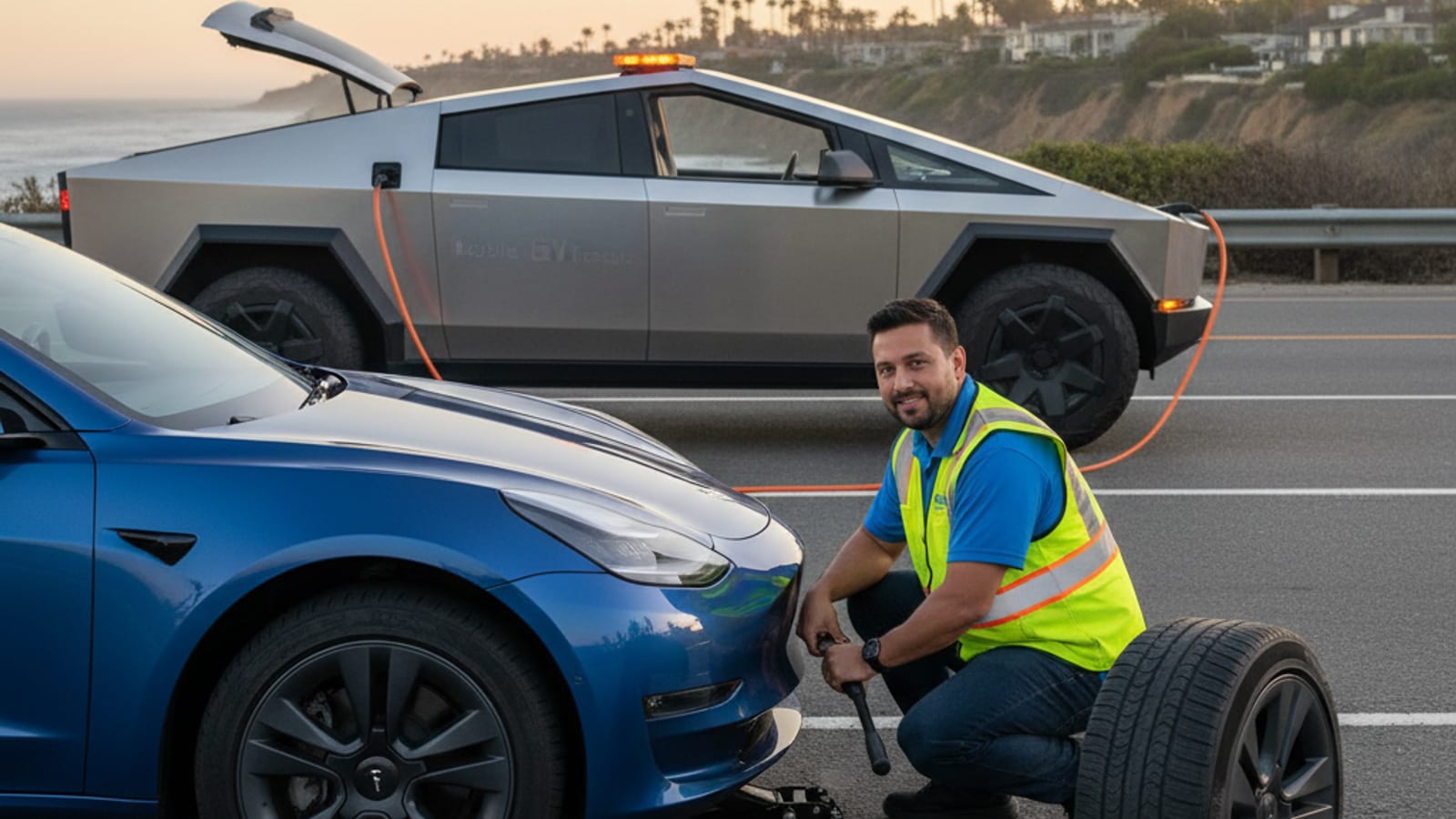
Discovering a flat tire on your Tesla can quickly turn a normal San Diego drive into a stressful roadside stop. Whether you are cruising down I-5 near La Jolla, navigating I-15 through Escondido, or heading east on I-8 towards Alpine, a flat tire requires immediate and specialized attention. Teslas, unlike many traditional cars, do not carry a spare tire, making a roadside incident more complicated. Understanding your options for Tesla roadside assistance for flat tires is essential for any EV owner in San Diego County, a region with one of the highest EV adoption rates in the US.
This guide explains what Tesla’s official roadside assistance offers, the costs involved, and why a local, specialized EV rescue service like Charge Pro SD often provides a quicker, more tailored solution when you face a flat tire in America’s Finest City.
Understanding Tesla’s official flat tire roadside assistance
Tesla provides roadside assistance for its vehicles, including services for flat tires. This assistance is accessible through your car’s touchscreen or the Tesla mobile app. When you request help, Tesla’s system tries to locate your vehicle and dispatch a service provider.
What Tesla roadside assistance covers
Tesla’s roadside assistance generally covers incidents like flat tires, out-of-charge events, and minor mechanical issues. For flat tires, the service typically involves towing your vehicle to the nearest Tesla Service Center, a third-party tire shop, or a location of your choice within a specified distance.
Important details about coverage:
- New Vehicle Limited Warranty: If your Tesla is under its New Vehicle Limited Warranty, certain roadside services, including towing for a flat tire, are often covered without charge. This coverage usually extends for four years or 50,000 miles, whichever comes first.
- Out-of-Warranty: Once your Tesla is outside of its warranty period, roadside assistance for a flat tire will likely incur a service fee. This fee covers the dispatch and towing service. The cost of tire repair or replacement is always separate and your responsibility.
- Temporary Tire Repair: Tesla’s roadside assistance rarely performs on-the-spot tire repairs. Their primary method is to tow the vehicle. This means you won’t typically get a patch or a new tire installed directly at the roadside.
For more information on Tesla’s broader roadside offerings, you can review our detailed post on Tesla roadside assistance coverage.
Limitations and potential delays
While Tesla’s service is available, it comes with certain limitations, especially in a geographically diverse area like San Diego County.
- Response Times: Tesla relies on a network of third-party tow companies. Response times can vary significantly based on your location, time of day, and tow truck availability. Getting stuck on SR-52 or I-805 during rush hour, or in a more remote area like Ramona or Julian in East County, can mean extended waits.
- Towing Only: As mentioned, on-site tire repair is uncommon. This means your Tesla will be towed, potentially adding time and inconvenience to the process. You then need to arrange for the tire repair or replacement at another facility.
- Service Center Availability: San Diego County has a few Tesla Service Centers, but they can be busy. Being towed to a service center does not guarantee immediate tire service.
- Specialized EV Knowledge: Not all tow truck operators are equally familiar with the specific requirements of towing a Tesla, such as proper jacking points and transport methods to avoid battery damage.
Understanding these factors helps set realistic expectations when relying solely on official Tesla roadside assistance for a flat tire. For official Tesla support information, you can always visit Tesla support.
The reality of a Tesla flat tire in San Diego County
San Diego’s unique landscape and high EV population present specific challenges for Tesla owners experiencing a flat tire. Our freeways, coastal routes, and mountain roads all contribute to the complexity of a roadside incident.
Common scenarios and local challenges
Imagine you’re driving your Model 3 down I-5, perhaps on your way to Carlsbad or Encinitas, and suddenly your tire pressure warning lights up. Or you’re making the scenic, but often isolated, drive up the I-8 climb from El Cajon to Alpine, which gains over 1,500 feet of elevation, and hit road debris. A flat tire in these situations isn’t just an inconvenience; it can be a safety concern.
- Busy Freeways: Getting a flat on I-5, I-15, I-8, or SR-163 during peak hours means dealing with fast-moving traffic and limited shoulder space. Waiting for a tow truck can be nerve-wracking and dangerous.
- Coastal Tesla Density: Cities like La Jolla, Del Mar, and Encinitas have a very high density of Teslas. While this means more EVs, it also means potentially higher demand for roadside services, which can strain resources.
- East County Isolation: In areas like Ramona, Julian, or Alpine, public charging infrastructure is sparser. A flat tire here, especially combined with lower range from mountain driving or hot inland summer temps (which can hit 100°F+ in places like Escondido or El Cajon), can quickly become a full-blown range anxiety event.
- The Camp Pendleton Gap: The 20-mile stretch of I-5 through Camp Pendleton between Oceanside and San Clemente is a known “charging desert.” A flat tire here not only strands you but can also induce significant range anxiety for other EVs that might be cutting it close on charge.
These local factors underscore the need for a prompt, reliable roadside solution that understands the intricacies of EV ownership in San Diego.
Why Teslas need specialized flat tire service
Teslas are not like gasoline cars when it comes to tire service. Their unique design requires specific handling.
- No Spare Tire: Teslas do not come with a spare tire or a jack from the factory. This means you cannot simply change a flat yourself.
- Jacking Points: Teslas have specific jacking points to protect the battery pack, which runs along the entire underside of the vehicle. Incorrect jacking can cause severe and costly damage to the battery.
- Heavy Weight: EVs, particularly Teslas, are significantly heavier than comparable gasoline cars due to their large battery packs. This weight means tires wear differently and require specific load ratings. It also impacts how the vehicle needs to be lifted and towed.
- Tire Pressure Monitoring System (TPMS): Teslas rely on advanced TPMS. Any tire service needs to ensure this system is correctly recalibrated or handled.
A standard tow truck driver or general mechanic might not have the specialized tools or knowledge for safe and effective Tesla tire service.
Cost of Tesla flat tire service
Understanding the potential costs associated with a Tesla flat tire is important for budgeting and making informed decisions.
When is it free, and when is it not?
As mentioned, if your Tesla is under its New Vehicle Limited Warranty, the towing service for a flat tire is typically covered. This means Tesla will arrange for your vehicle to be towed to a service center or tire shop without an upfront charge for the tow itself.
However, the cost of the tire repair or replacement is always your responsibility, regardless of warranty status. Even if the tow is free, you will pay for the actual tire work.
Once your Tesla is out of warranty, you will be responsible for:
- Roadside dispatch and towing fee: This can vary depending on distance and time of day, often ranging from $100 to $300+ for a standard tow.
- Tire repair/replacement cost:
- Puncture repair: A simple plug or patch for a small puncture can cost $25 to $75. This is only possible if the damage is minor and within the tire’s tread area.
- New tire: Tesla tires are specialized, often low-rolling-resistance or performance-oriented, and can be expensive. A single new tire can range from $250 to $500 or more, plus mounting, balancing, and disposal fees.
Comparing service options and their costs
| Service Option | Towing Cost (Out-of-Warranty) | Tire Repair/Replacement Cost | Overall Wait Time (Estimate) | Notes It’s an excellent idea to research your specific tire model and size directly on the manufacturer’s website to confirm whether it has specific run-flat capabilities or specific care requirements. You can also consult the California Energy Commission for broader EV policies and resources.