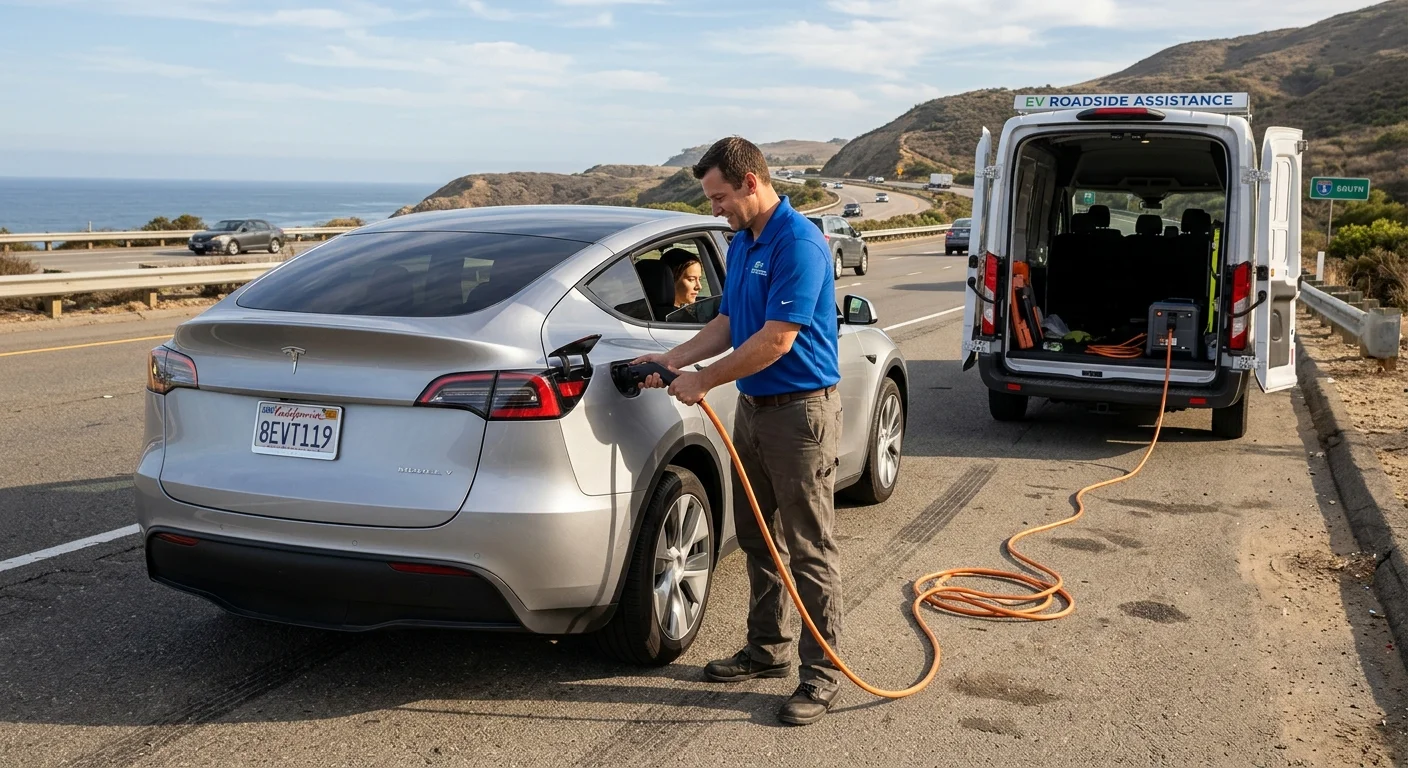
A low traction-battery warning calls for the current on-screen direction, a check of reachable charging, and an early decision about roadside help. It isn’t automatically a low-voltage battery failure. Read and save the exact message before choosing what to do.
Distinguish low charge from a low-voltage alert
Start with the literal words on the screen. Drivers often shorten several different messages to “low battery.” That shorthand can send roadside help toward the wrong problem.
A warning about low traction charge isn’t automatically evidence of low-voltage battery failure. Likewise, a message that explicitly mentions low voltage shouldn’t be translated into “the main battery is almost empty.” Treat those as separate possibilities until the vehicle or a qualified operator confirms more.
Don’t infer the cause from the battery icon alone. The approved source record doesn’t contain a universal Tesla warning threshold, remaining-range formula, or hidden reserve figure. Those details couldn’t be confirmed for every current model and vehicle state. Follow the guidance displayed by your Tesla and check its current owner materials.
If you’re safely parked, photograph the complete message. Include any heading, supporting text, and visible symbols. Don’t crop away details that may change the operator’s assessment.
Share the model, model year, charge level shown, and exact location. Also explain whether the Tesla can move, shift, or communicate with the display. Report only what you observe. Don’t label the problem as a failed battery unless it has been diagnosed.
Our guide to Tesla battery symptoms versus a low-voltage problem can help you organize those observations. The key is simple: describe the message, not your guess.
Follow the current on-screen guidance
The vehicle’s active message is the first instruction to read. If the screen offers more detail, review it while safely parked. Follow the action it gives instead of relying on an old forum post or another driver’s experience.
If the message says to stop or restricts driving, don’t continue merely to test the remaining distance. If it directs you toward charging, compare that direction with a charger you can safely reach. A map pin isn’t permission to ignore a more restrictive warning.
Don’t clear alerts before recording them. Avoid improvising with resets, disconnected batteries, or jump procedures because the word “battery” appeared. A low traction charge and a low-voltage alert may call for different equipment and handling.
Your surroundings also shape the next decision. A Tesla in a downtown San Diego garage presents different access details than one beside I-15. A driver near I-5 in South Bay may have direction-of-travel constraints. Someone along SR-94 or SR-125 may need to describe a shoulder, ramp, or nearby exit.
Give the operator the travel direction, nearest exit, parking level, gate access, and any clearance limits. Mention whether you’re in an active traffic area. If the location isn’t safe, contact emergency services and follow their instructions.
Keep the display message available while arranging help. The matched operator can use that wording to discuss whether charging, low-voltage support, or transport should be considered.
Check whether a reachable charger remains
“Nearby” and “reachable” don’t always mean the same thing. Don’t rely on a fixed mileage cushion. Charge Pro SD couldn’t confirm a universal Tesla reserve or warning threshold in the approved source record. Check the current in-car guidance and Tesla’s current owner materials for your vehicle.
Review the entire route before moving. Confirm that the charging location is accessible from your travel direction. Check the charging provider’s current status information. Also confirm that the location and equipment fit your Tesla.
Access matters around San Diego County. A charging pin across I-805 may require a longer approach than the map suggests. A station inside a garage may involve a gate, parking rules, or clearance limits. Coastal North County, central San Diego, East County, and South Bay routes also present different access choices.
Don’t select a charger solely because its straight-line distance looks short. Compare the actual route with the vehicle’s on-screen direction. If those two don’t support a safe attempt, stop planning around that charger and explain the situation to an operator.
Share the proposed charging location when you call. The operator can discuss whether reaching it appears practical based on the vehicle state you report. That isn’t a guarantee that the Tesla will complete the route.
If the car has already stopped, don’t try to create distance by repeatedly moving it. Read what to do when a Tesla runs out of battery before choosing between mobile help and transport.
Know when roadside charging may fit
Roadside charging may fit when the Tesla is safely located and a local operator confirms that compatible service can be provided there. It isn’t the answer for every low battery warning. The vehicle state, site access, equipment, and operator’s assessment all matter.
Tell the operator exactly where the car sits. Include its model, model year, displayed charge, complete warning text, and whether it can be moved. For a parking structure, share the level, entrance, gate instructions, and clearance limits. For a highway location, provide the route, direction, nearest exit, and visible landmark.
Ask what outcome the operator proposes. That may involve on-site charging, moving the vehicle toward charging, or arranging transport. Confirm the equipment and connector the operator plans to use. You should also confirm pricing, payment terms, and any warranty directly with that independent operator.
Charge Pro SD doesn’t perform the physical work, set operator prices, or provide warranties. We connect drivers with licensed, independent local EV rescue operators. Our out-of-charge recovery service and Tesla roadside rescue service explain that referral process.
Emergency Tesla charging shouldn’t be treated as a promise of a particular amount of energy or driving distance. No such figure is approved in the source record. Ask the operator what service is available for the vehicle and location you described.
Don’t move the car into a hazardous spot to make mobile charging easier. If the present location is unsafe, emergency direction comes before charging plans.
Know when the Tesla may need transport
Transport may be the better path when the screen restricts driving, no safe working area exists, or an operator can’t provide compatible charging at the location. It may also be considered when the Tesla won’t accept a charge or can’t be moved safely.
That decision doesn’t diagnose the main battery. A car that won’t continue could present more than one issue. If you see both low-charge information and a separate low-voltage message, share both. Don’t discard one because the other seems more familiar.
The correct transport method can depend on the Tesla model and its current condition. Charge Pro SD couldn’t confirm one transport procedure that applies to every current Tesla. Follow the vehicle’s active guidance, Tesla’s current owner materials, and the qualified operator’s instructions.
Location details become especially important here. Tell the operator if the Tesla is in a narrow garage, behind a gate, on a steep driveway, or near moving traffic. Describe its orientation and whether access is blocked. Don’t attempt an unverified release or towing method just to make the car easier to reach.
Our guide for a Tesla that has run out of battery explains how to preserve the message and location details for help. Keep your description factual. “The screen shows this message” is more useful than “the main battery failed.”
A matched operator can review the reported vehicle state and site access. That operator, not Charge Pro SD, performs any roadside charging or transport work.
When to call us
Call when your Tesla’s on-screen guidance leaves no safely reachable charging option, or when you need a mobile EV rescue operator to assess roadside charging versus transport. Call us at (858) 400-4465 and we’ll connect you with a local EV rescue operator.