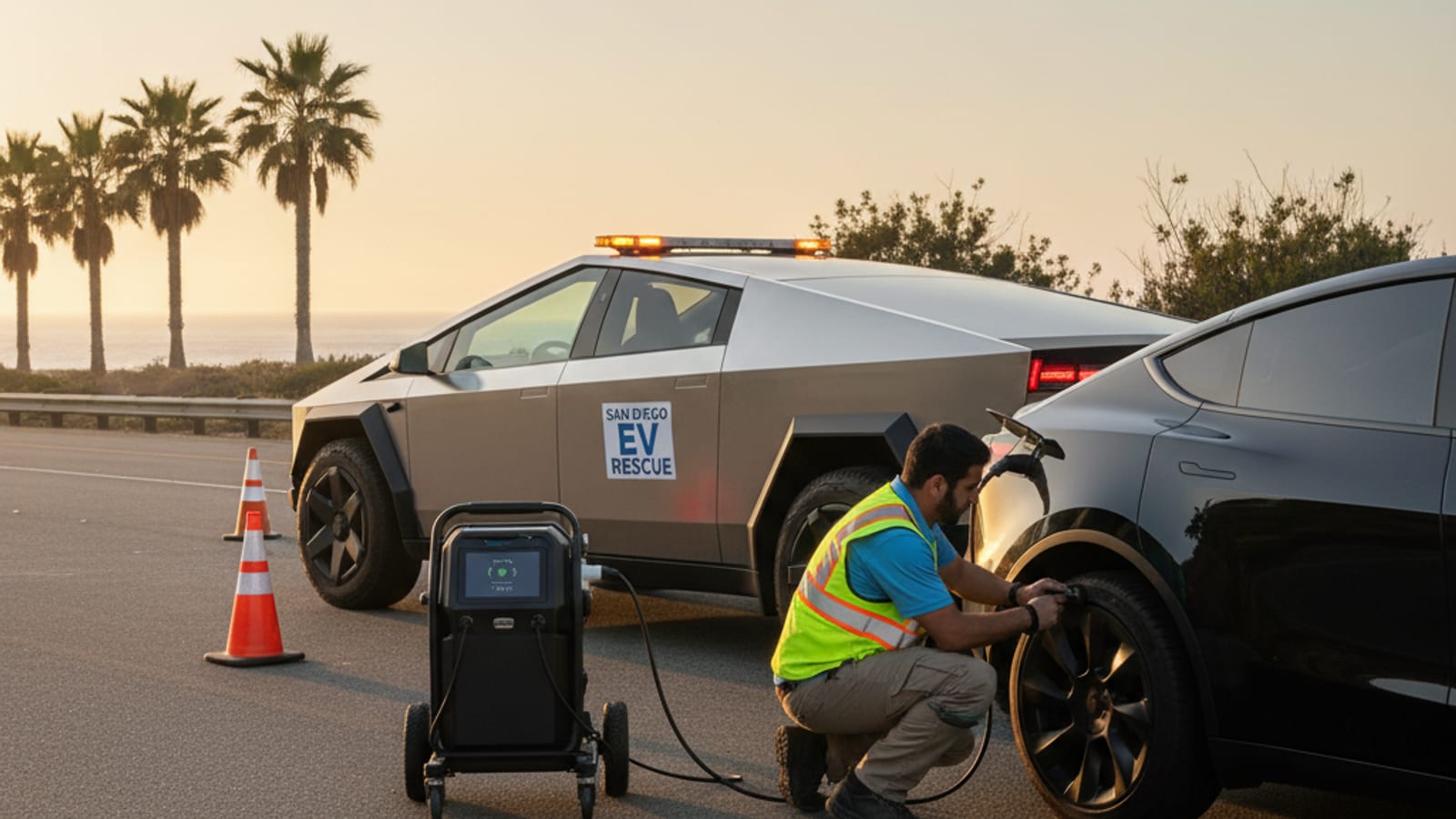
Getting stranded with a depleted EV battery on a busy San Diego freeway like I-5 or I-15 presents a unique challenge. Unlike a gasoline car that can get a quick fuel delivery, an electric vehicle needs a charge. As EV adoption continues to soar in San Diego County, the demand for reliable, on-the-spot charging solutions grows. This guide explores the landscape of mobile EV chargers for roadside use in 2026, helping you understand your options and what to expect from a professional service.
Why mobile EV charging is essential in 2026
The number of EVs on San Diego roads is higher than ever. With more than 100,000 registered EVs, our county leads the nation in adoption rates. This growth, while positive, also highlights gaps in charging infrastructure. While San Diego boasts over 2,000 public charging ports, their distribution is uneven. Areas like East County, including Alpine and Julian, have significantly fewer chargers. Mountain roads, such as the I-8 climb from El Cajon to Alpine, consume battery range quickly. This can leave drivers vulnerable to running out of charge far from a charging station.
Range anxiety remains a real concern for many EV owners. It refers to the fear of running out of charge before reaching a destination or charger. This anxiety is amplified when planning road trips to places like Anza-Borrego Desert or Julian, where charging options are sparse. Even within metro San Diego, unexpected detours or traffic jams can deplete a battery faster than anticipated. The 20-mile stretch of I-5 through Camp Pendleton, for instance, is a charging desert between Oceanside and San Clemente. This makes a mobile EV charger for roadside use not just a convenience, but a necessity for peace of mind.
Understanding personal portable EV chargers
Before discussing dedicated roadside services, it’s helpful to understand personal portable EV chargers. These are typically smaller, lighter units designed for emergency top-offs or for charging in places without dedicated EV infrastructure.
Types of personal portable chargers
Most personal portable chargers fall into two main categories:
- Level 1 portable chargers: These plug into a standard 120V household outlet. They offer very slow charging, typically adding only 2-5 miles of range per hour. While they can provide a trickle charge overnight at a friend’s house, they’re not practical for roadside emergencies. You’d need many hours to get enough range to reach a station.
- Level 2 portable chargers: These require a 240V outlet, similar to what a clothes dryer or electric stove uses. They can deliver 7-10 kW, adding 20-40 miles of range per hour. Some come with adapters for different NEMA outlets. If you happen to be near a suitable industrial or RV park outlet, this type could offer a faster emergency charge. However, finding such an outlet on the side of I-805 or SR-163 is unlikely.
Limitations of personal portable chargers for roadside use
While compact and convenient for specific situations, personal portable chargers have significant limitations for roadside emergencies:
- Power source dependency: They still need an external power source. You can’t just plug them into thin air on the side of the road.
- Slow charging speeds: Even Level 2 portable units are much slower than DC fast charging. Getting enough range to safely drive to a Supercharger or public station could still take an hour or more.
- Safety concerns: Charging on a busy shoulder carries risks. You need to be visible and ensure your charging setup is secure. The National Highway Traffic Safety Administration (NHTSA) offers general roadside safety tips for all motorists.
- Not a full rescue solution: These chargers are for topping off, not for a dead-battery scenario far from any power.
For these reasons, relying solely on a personal portable charger for a roadside emergency isn’t a realistic strategy for most San Diego EV owners.
Dedicated mobile EV roadside charging services
This is where professional mobile EV chargers for roadside use come in. Companies like Charge Pro SD specialize in bringing the charging station directly to your stranded EV. This service bridges the gap between running out of charge and reaching a fixed charging station.
How professional mobile EV charging works
When you call for mobile EV charging, a specialized rescue vehicle is dispatched to your location. For Charge Pro SD, this means our Tesla Cybertruck arrives. It’s equipped with a powerful 240V / 9.6 kW bed outlet. This setup allows us to deliver a significant Level 2 charge directly to your vehicle.
Here’s a typical service process:
- Dispatch: You call us, providing your location and EV model.
- Arrival: Our Cybertruck reaches you, often much faster than waiting for a tow truck.
- Connection: We use the appropriate charging plug – NACS for Teslas or a CCS adapter for most other EVs – to connect to your vehicle.
- Charge: We initiate a charge, typically providing enough range (10-20 miles) in 15-30 minutes for you to comfortably reach the nearest public charging station or your home.
- Safety: Our technicians prioritize your safety and position the rescue vehicle to provide a visible buffer from traffic. This is especially important on high-speed freeways like I-5 or I-805.
Benefits of professional mobile EV charging
- Convenience: No need for a tow. You get charged on the spot.
- Speed: While not DC fast charging, our 9.6 kW output is significantly faster than any Level 1 or most personal Level 2 setups. It’s enough to get you moving quickly.
- Safety: Our trained technicians handle the roadside environment and charging equipment safely.
- Reduced stress: Avoid the hassle and potential damage of towing your EV.
- Cost-effective: Often less expensive and time-consuming than a tow to a distant charging station. You can learn more about this on our blog post comparing mobile EV charging vs. tow.
- Coverage: We serve all of San Diego County, addressing those charging deserts in East County or along Camp Pendleton.
Key factors in choosing a mobile EV charging service
When you need a mobile EV charger for roadside use, choosing the right service matters. Here’s what to consider:
Power output and charging speed
- What to look for: A service offering at least 7-10 kW (Level 2) charging is ideal for getting enough range quickly. Some advanced services might offer limited DC fast charging capabilities, but these are rarer and often more expensive for roadside deployment.
- Charge Pro SD’s output: We provide a reliable 9.6 kW Level 2 charge. This means you can expect to gain approximately 30-40 miles of range in about 30 minutes, depending on your EV’s efficiency. This is usually more than enough to get to a nearby Supercharger in Mission Valley or a public Level 2 station.
EV compatibility
- What to look for: The service should support the common charging standards. In North America, this means NACS (North American Charging Standard) for Teslas and CCS (Combined Charging System) for most other manufacturers like Ford, GM, Hyundai, Kia, BMW, and Mercedes. J1772 is the common Level 2 plug, often used with a CCS adapter.
- Charge Pro SD’s compatibility: Our Cybertruck is equipped with a NACS plug and we carry a CCS adapter. This allows us to charge virtually any EV model currently on the road in San Diego County. We handle everything from Tesla roadside rescue to non-Tesla EV rescue.
Response time and service area
- What to look for: A local service with a reputation for quick response times. For San Diego, this means a company familiar with our traffic patterns and freeway system.
- Charge Pro SD’s coverage: We operate entirely within San Diego County. Our technicians know the local roads, from the coastal cities like La Jolla and Del Mar to the inland communities of Escondido and El Cajon. We aim for rapid dispatch to reduce your wait time.
Safety protocols
- What to look for: Technicians should be trained in roadside safety and high-voltage EV charging procedures. The rescue vehicle should have appropriate lighting and markings.
- Charge Pro SD’s safety: Our team follows strict safety protocols for roadside assistance. We ensure the area around your vehicle is secure before beginning the charge.
Pricing and transparency
- What to look for: Clear pricing without hidden fees. Some services might charge per kWh, others a flat rate for a roadside boost.
- Charge Pro SD’s pricing: We offer transparent pricing for our mobile EV charging service. We’ll provide an estimate upfront so you know what to expect.
San Diego’s unique EV landscape and mobile charging needs
San Diego’s environment presents specific challenges and opportunities for EV owners. Understanding these factors highlights the value of a mobile EV charger for roadside use.
Climate and terrain impact on range
- Hot inland summers: Areas like Escondido, El Cajon, and Santee frequently experience temperatures over 100°F during summer. High heat can reduce an EV’s range by 10-20% as the battery management system works harder to cool the battery. This means a planned trip might consume more energy than expected, increasing the risk of running out of charge.
- Mountain elevation changes: The I-8 climb from El Cajon to Alpine gains over 1,500 feet of elevation. Driving eastbound on this stretch consumes significant range. While regenerative braking helps on the downhill, the net effect can be a much shorter effective range for mountain excursions to Julian or other East County destinations.
- Mild coastal climate: San Diego’s mild coastal temperatures mean EVs rarely face the cold-weather range loss common in other parts of the country. This is a benefit, but doesn’t negate the impact of heat or elevation.
Charging infrastructure gaps
Despite a growing number of chargers, significant gaps remain:
- East County: Rural areas like Ramona, Julian, and Alpine have far fewer public charging options compared to coastal or central San Diego. Range anxiety is particularly pronounced here.
- Camp Pendleton: The stretch of I-5 between Oceanside and San Clemente lacks any public charging infrastructure. This 20-mile “charging desert” can be a trap for drivers pushing their range limits.
- Popular road trip destinations: While Temecula wine country has some chargers, routes to places like Anza-Borrego Desert State Park are notoriously sparse. Planning these trips requires careful attention to charging stops. You can read more about what to do if you’re out of charge on the freeway on our blog.
San Diego EV owner demographics
Coastal cities such as La Jolla, Del Mar, Encinitas, and Carlsbad boast some of the highest Tesla densities in the nation. These drivers often appreciate convenience and premium services, making mobile charging an attractive option. Many San Diegans are also accustomed to SDG&E’s Time-of-Use (TOU-EV) rates, which encourage off-peak home charging (midnight to 6 AM). However, this also means they might be less familiar with public charging etiquette or planning.
Mobile charging vs. towing: a comparison
When your EV battery is critically low, your primary options are a mobile charge or a tow. Here’s a look at why a mobile EV charger for roadside use often wins out:
| Feature | Mobile EV Charging Service (e.g., Charge Pro SD) | Traditional EV Tow Service |
|---|---|---|
| Response Time | Often faster, direct to your location | Can be slow, especially during peak hours or remote areas |
| Service Provided | On-site charge to get you moving | Transport to a charging station or repair shop |
| Vehicle Handling | No physical movement, less risk of damage | Requires flatbed tow (for EVs), potential for missteps if not trained |
| Convenience | High, you stay with your vehicle, quick return to road | Low, involves waiting, transfer, and additional travel to charge |
| Cost | Generally a flat fee for the charge | Towing fees can be distance-based, potentially higher |
| Time to Resolution | 15-30 minutes for enough range | Can be hours including tow, drop-off, and charging time |
| Peace of Mind | High, immediate solution | Lower, more steps involved, potential for further delays |
Choosing a mobile EV charging service like Charge Pro SD means avoiding the complexities and potential damage associated with towing an EV, especially one with a completely dead 12V battery. For issues like a dead Tesla 12V battery, we can even provide a Tesla 12V battery jump.
Preparing for an EV road trip in San Diego
While professional mobile EV charging is a lifesaver, prevention is always better. Here are tips for San Diego EV owners:
- Plan your route carefully: Use apps like PlugShare or the in-car navigation to identify charging stations along your route, especially for trips to areas like Anza-Borrego or Julian. Factor in elevation changes and potential hot weather. The Department of Energy’s Alternative Fuels Data Center (AFDC) provides a comprehensive station locator.
- Monitor your range: Pay attention to your EV’s estimated range, especially when driving on freeways like I-8 East towards the mountains or I-15 North to Temecula. Remember that hot weather in inland areas can reduce range.
- Charge proactively: Don’t wait until your battery is low to look for a charger. Top off when you have the opportunity. SDG&E’s TOU-EV rates make home charging overnight very economical.
- Know your options: Keep Charge Pro SD’s number (858) 400-8901 saved in your phone. Understand what our EV roadside assistance covers.
The Charge Pro SD difference
At Charge Pro SD, we understand the specific needs of San Diego EV owners. Our service is designed for speed, safety, and compatibility. When you’re stranded on I-5 near La Jolla, I-15 in Escondido, or I-8 in East County, you need a solution that works.
Our Tesla Cybertruck is purpose-built for this mission. Its 240V / 9.6 kW bed outlet provides a powerful Level 2 charge, getting you back on the road without delay. We carry both NACS and CCS adapters to serve all major EV brands. We’re not just a tow service; we’re a mobile charging station that comes to you. Our goal is to minimize your downtime and eliminate range anxiety. Whether you need an out-of-charge recovery or assistance for a specific issue like a Tesla that won’t start, we’re here to help.
Frequently asked questions
What is a mobile EV charger for roadside use?
A mobile EV charger for roadside use is a specialized service that brings charging capabilities directly to a stranded electric vehicle. Instead of towing the EV to a charging station, a rescue vehicle equipped with a portable charger delivers enough power on-site to get the car moving again. This is typically a Level 2 charge, sufficient to reach the nearest permanent charging station.
How fast can a mobile EV charger charge my car?
The charging speed depends on the power output of the mobile unit. Professional services like Charge Pro SD offer 9.6 kW Level 2 charging. This can add approximately 30-40 miles of range in about 30 minutes, which is usually enough for a safe drive to a nearby public charger or home. It’s much faster than a standard 120V household outlet.
Can any EV use a mobile EV charging service?
Most professional mobile EV charging services are equipped to handle all popular EV models. Charge Pro SD, for example, uses a NACS plug for Teslas and carries a CCS adapter for non-Tesla EVs. This ensures broad compatibility, regardless of your vehicle’s make or model. Always confirm compatibility when contacting a service.
Is mobile EV charging safer than towing my EV?
In many cases, yes. Mobile EV charging eliminates the need to tow your vehicle, which reduces the risk of damage during transport. Experienced technicians handle the charging process safely on the roadside. It also means you avoid the complexities of securing a flatbed tow and then waiting for your EV to be charged at another location.
How much does mobile EV charging cost in San Diego?
The cost of mobile EV charging varies by service and location. Generally, it involves a flat service fee for the roadside charge. This can often be more cost-effective than a tow, especially if the nearest charging station is far away. Charge Pro SD provides transparent pricing, and we encourage you to call for an estimate specific to your situation.
When you’re facing a low battery warning on a San Diego freeway or a remote road, knowing your options for a mobile EV charger for roadside use can make all the difference. Charge Pro SD is here to provide that reliable, on-the-spot solution. Don’t let range anxiety dictate your plans. For immediate assistance across San Diego County, call us at (858) 400-8901 or visit our mobile EV charging service page to learn more.