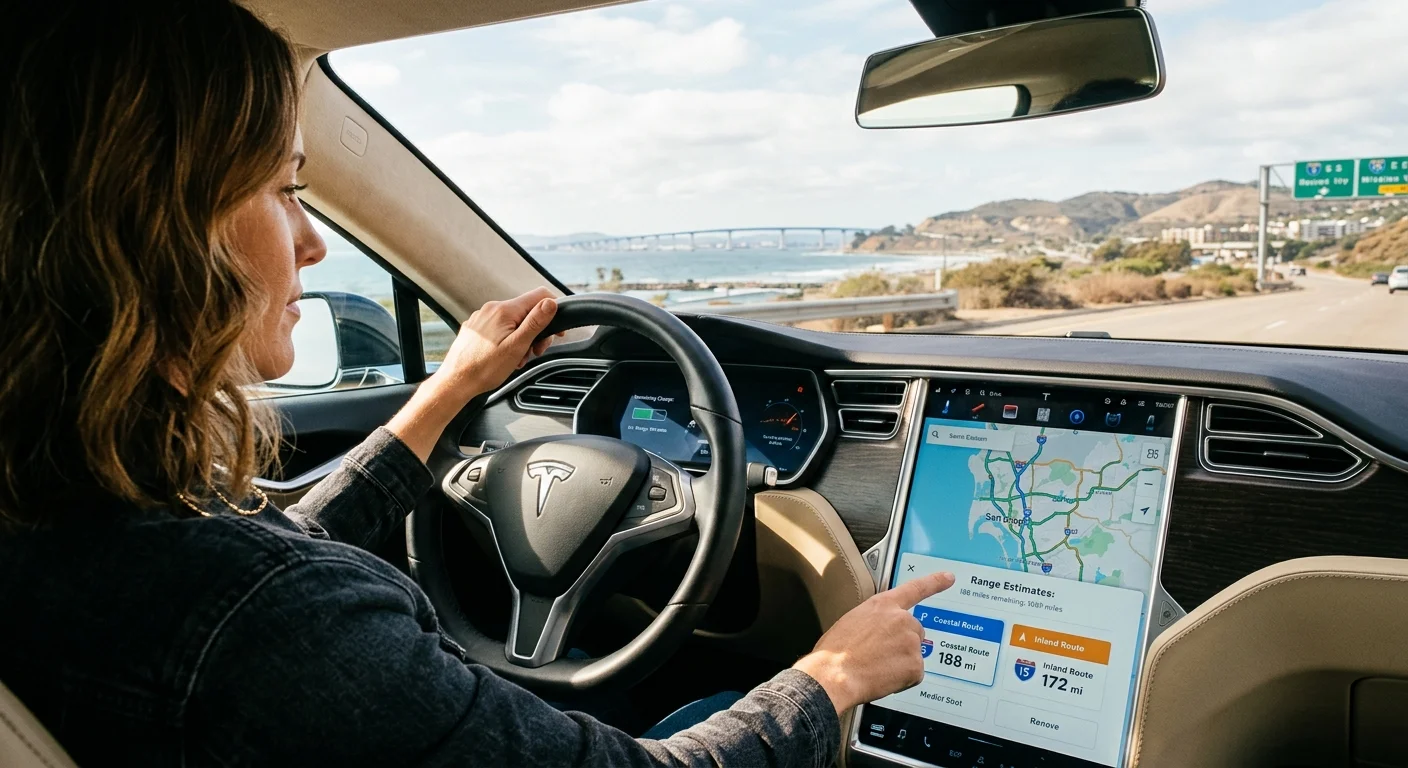
A Tesla charge may cover your whole day or only part of it. The answer depends on your specific car, current battery state, planned route, and displayed estimate. Check those details before treating any published range as your daily limit.

A Tesla traveling through San Diego while its driver reviews the remaining charg

Separate daily driving range from battery lifespan

The phrase “how long does Tesla battery last in a day” combines two different questions. One concerns how far the car may travel before it needs charging. The other concerns how long the main battery remains useful across ownership.

For a daily trip, focus on the charge available now. Compare the car’s displayed estimate with every part of the route. Include the drive home, another planned stop, and access to a suitable charger. Don’t rely on a general model figure when the car already shows information for its present battery state.

Long-term battery lifespan is a separate ownership topic. It concerns the battery over an extended period, not today’s remaining drive. Our guide to how long Tesla batteries actually last addresses that meaning.

Keeping these questions separate prevents a common planning mistake. A discussion about long-term battery life doesn’t tell you whether today’s charge supports a trip from Chula Vista to Oceanside. Likewise, one low-charge day doesn’t answer how long the battery will remain useful.

For today, start with three details: the Tesla model and configuration, the battery state shown in the car, and the complete route. If you need an exact specification, check the current Tesla documentation for that model and configuration. Don’t substitute another owner’s result for the estimate shown in your car.

Check the model, battery state, and displayed estimate

Begin with the vehicle in front of you. Record the model, current battery percentage, and estimated distance before leaving. Recheck the display when you add a destination or make a major route change.

Treat the estimate as a planning input, not a promise. Build your decision around what the car shows now. A number copied from a review, forum, or different Tesla configuration may not describe your vehicle.

Next, compare the estimate with the full day. Count the outbound trip, local driving, return trip, and the distance to a charger. A commute that ends near charging is a different plan from a long drive followed by street parking.

Charging access matters too. The U.S. Department of Energy identifies several charging levels. Its verified guidance says Level 1 charging uses 120-volt AC power and adds approximately five miles of range per charging hour for a midsize EV. Level 2 residential charging uses 240-volt power and adds approximately 25 miles per charging hour. Actual charging speeds vary by vehicle battery capacity, state of charge, and ambient temperature.

Those figures explain why the available charging setup matters. They don’t establish how far your Tesla will travel today. Check the connector, equipment, and vehicle compatibility before depending on a charging location.

If your displayed estimate leaves little room for the whole route, change the plan early. Add a reachable charging stop, shorten the route, or use another transportation option.

Account for the route without assuming a fixed range

San Diego County routes can carry a driver through very different areas. I-5 connects South Bay, central San Diego, and coastal North County. I-8 heads east from the city into East County. I-15 serves the inland corridor through communities such as Rancho Bernardo and Escondido.

Use those roads as route-planning anchors, not range guarantees. Write down each destination in order. Then identify a suitable charger near the route and a second option before departure. Check current access and compatibility through the provider responsible for that charger.

A displayed estimate that looks comfortable for one destination may feel less comfortable after another stop is added. The return trip also matters. Don’t plan only for reaching the farthest point and forget the drive back.

Avoid assigning a fixed distance penalty to traffic, weather, elevation, or climate. No verified figure in this site’s claims ledger supports a universal adjustment for those conditions. Watch the estimate shown by your Tesla as the route changes. If you need model-specific guidance, confirm it through current Tesla documentation.

Local geography should shape the backup plan. A driver staying near central San Diego can review chargers near the planned destinations. Someone continuing east on I-8 or north on I-15 should check options farther along that actual corridor. A charger located across the county isn’t a useful backup merely because it appears on a regional map.

Your daily range is therefore a route decision, not one permanent number. Base it on the car, the current charge, the complete drive, and reachable charging options.

Plan before no reachable charger remains

Low charge becomes easier to manage when you act before every reachable option disappears. If the remaining estimate no longer supports the original route, stop adding destinations. Select a compatible charger that the car can still reach safely.

Confirm the charger’s current status through its operator or network before depending on it. Also check whether access conditions fit your vehicle and location. If the first option won’t work, move to a verified alternative while the car still has usable charge.

Don’t assume that reaching the general area is enough. Your plan must reach the actual charging location. Account for the final streets, parking entrance, and any route change needed to enter the site.

If the Tesla is already very low, preserve a clear record of your location. Note the road, direction of travel, nearest exit, parking level, or nearby landmark. That information helps an operator understand where the vehicle is located. Never stop in an unsafe place merely to simplify the description.

Our guide on what to do when an EV is running low provides a decision sequence for this stage. The main point is simple: don’t keep driving toward a charger that is no longer clearly reachable.

If no reachable charger remains, begin arranging help. Charge Pro SD can connect you with an independent local operator. We don’t charge the car, transport it, own rescue equipment, or perform physical roadside work. The matched operator handles the service and explains the available options.

Choose charging, roadside help, or transport

The right next step depends on the vehicle’s condition and location. It also depends on what a local operator can safely provide there. Don’t assume every low-battery event has the same solution.

If the Tesla still has usable charge and a compatible station remains reachable, ordinary charging may be the simplest path. Confirm the location before driving there. Keep watching the vehicle’s displayed estimate during the trip.

If no charger is reachable, ask whether compatible mobile charging is available at your location. An operator may need the Tesla model, battery state, exact location, and surrounding access details before describing possible service. Our out-of-charge recovery service explains how we connect stranded drivers with local operators.

Transport may be the appropriate option when mobile charging isn’t available or isn’t suitable for the situation. It may also be considered when the vehicle has another problem beyond the main battery’s state of charge. Let the operator assess the service options rather than attempting electrical or transport work yourself.

A Tesla that won’t respond may have a different problem from a Tesla showing low main-battery charge. Don’t diagnose the issue from one symptom alone. Share the exact warning, screen condition, and vehicle behavior with the operator. The Tesla roadside rescue page outlines the referral service for Tesla drivers.

Before authorizing work, ask the independent operator to explain the service, price, payment terms, and any warranty it provides. Charge Pro SD doesn’t set the operator’s prices or provide warranties. You contract with and pay the professional directly.

When to call us

Call when your Tesla’s remaining estimate no longer supports a safe trip to a reachable charger, or when you need an operator to assess charging versus transport. Call us at (858) 400-4465 and we’ll connect you with a local EV rescue operator.