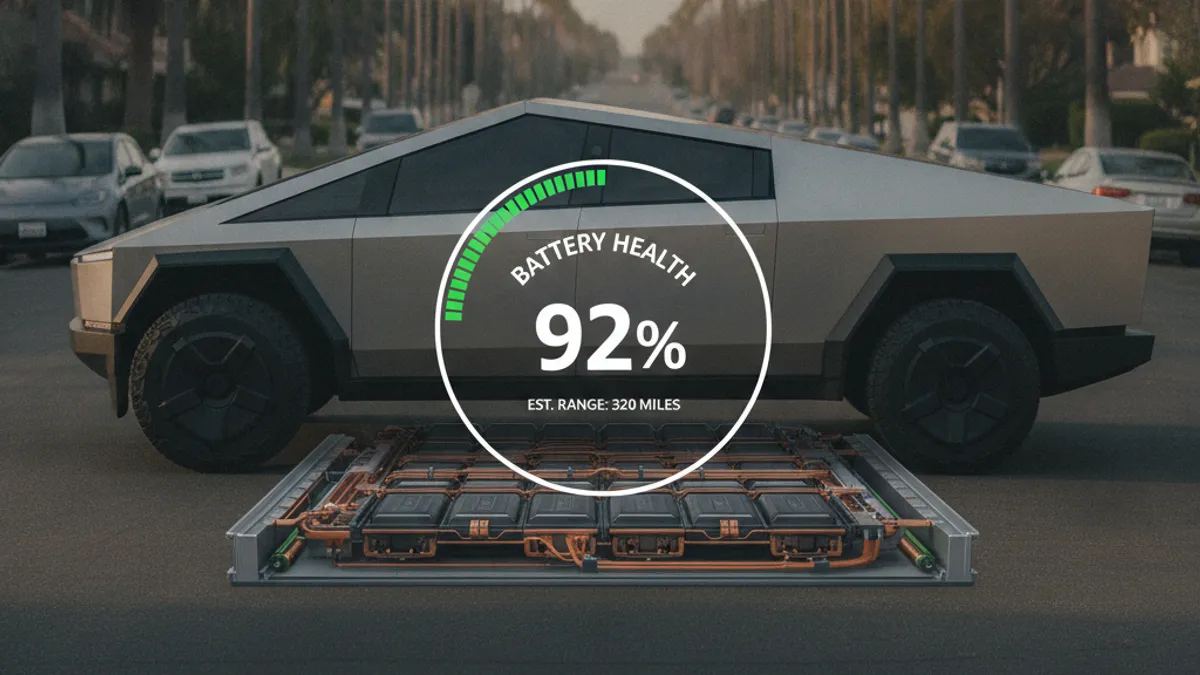
This question gets confused with a completely different one almost every time we hear it: the small 12V battery that dies and leaves your Tesla unable to power on at all. That’s not what we’re talking about here. The main high-voltage battery pack, the one that actually stores your driving range, is designed to outlast the rest of the car by a wide margin, and real-world data backs that up.
Main pack versus 12V battery: two different lifespans
Every Tesla has two batteries doing very different jobs. The main pack, built from thousands of lithium-ion cells, stores the energy that actually moves the car. The 12V battery is a small, separate unit that runs low-voltage systems like door locks, the touchscreen, and the contactors that wake up the main pack. The 12V battery typically needs replacement every few years and has nothing to do with the main pack’s long-term health. If your Tesla suddenly won’t power on despite a full charge showing on the app, that’s almost always the 12V battery, not the topic of this post. Our 12V battery dead diagnosis guide walks through that scenario separately.
What the real-world data shows about main pack degradation
Independent tracking of Tesla battery data, including studies from firms that monitor real-world EV fleets, has consistently found that most Tesla packs retain the large majority of their original capacity well past 150,000 to 200,000 miles. Meaningful degradation in the first year or two is common, often a few percentage points, and the rate slows down considerably after that. A pack that loses noticeable range every single year for a decade straight is the exception, not the norm.
That doesn’t mean every pack ages identically. Driving style, climate, and charging habits all move the number, sometimes by a lot.
What actually accelerates battery degradation
A handful of habits matter more than anything else for long-term pack health.
- Frequent DC fast charging. Supercharging occasionally is fine and part of normal EV ownership, but relying on it as your primary charging method, day after day, adds more heat cycling to the cells than slow home charging does.
- Charging to 100% routinely. Tesla recommends keeping most vehicles between 20% and 80% for daily driving, saving a full charge for road trips. Sitting at 100% for extended periods stresses the cells more than a partial charge does.
- Extreme heat exposure. Battery chemistry degrades faster in sustained high heat. This matters more in East County and North County Inland, where summer temperatures regularly clear 100°F, than it does along the coast where the marine layer keeps things cooler.
- Letting the battery sit near empty for long stretches. A car parked for weeks at a very low state of charge ages differently than one kept in a moderate range.
San Diego’s climate is actually a point in your favor
Compared to regions with harsh winters or sustained extreme heat, San Diego’s mild coastal climate is genuinely good for battery longevity. Coastal neighborhoods rarely see the kind of temperature swings that stress a pack, and even inland heat, while real, is not in the same category as a Phoenix or Las Vegas summer. If you’re weighing whether your Tesla’s battery will hold up here, the climate is working with you more than against you.
What the battery health percentage in your app actually means
Tesla vehicles don’t display a single “battery health” number in the same way a phone does, but you can get a real sense of degradation by comparing your car’s current maximum range to its original rated range when new, both visible in the car’s settings. A car showing a max range noticeably below its original rating has lost some capacity. A small gap in the first year or two is normal and expected. A large, sudden drop is worth a service visit, since that’s more likely a fault than ordinary aging.
Should you worry about buying a used Tesla with high mileage
Given how slowly most packs degrade after the first year or two, a high-mileage used Tesla is usually not the risk buyers assume it is. What matters more than the odometer is how the car was used and whether it’s still inside its original battery and drive unit warranty window, which transfers to a new owner based on the vehicle’s in-service date, not the sale date. Before buying a high-mileage Tesla, ask for the current max range shown in the car’s settings and compare it to the original rated range for that model and year. A modest gap is normal wear. A steep one is worth investigating before you buy, not after.
What actually replaces a main battery pack early
Outright pack failure requiring full replacement is uncommon and, when it happens outside of an accident, is usually covered under Tesla’s battery warranty. We cover exactly what that warranty guarantees, and what voids it, in our Tesla battery warranty guide. If you’re facing an out-of-warranty replacement, our main battery replacement cost breakdown covers what that actually runs, which is a different number entirely from a 12V battery swap.
Frequently asked questions
Do Tesla batteries degrade a lot over time?
Most owners see modest capacity loss, often a few percentage points in the first year or two, with the rate slowing significantly after that. Severe, ongoing degradation for a decade is rare.
Does frequent Supercharging ruin a Tesla battery?
Occasional fast charging is normal and won’t meaningfully shorten a pack’s life. Relying on it exclusively, day after day, adds more heat stress than home charging does, so it’s worth mixing in slower charging when you can.
Is San Diego’s climate good or bad for Tesla battery health?
Good, generally. Mild coastal temperatures are easier on battery chemistry than extreme heat or cold. Inland summer heat is a mitigating factor, but it’s far less severe than desert climates that see sustained triple-digit heat for months.
Does the main battery or the 12V battery die first?
The 12V battery almost always needs attention first, typically every few years, while the main pack is built to last the vehicle’s full lifespan. These are separate components with separate failure patterns.
If your Tesla won’t power on or you’re stranded with a dead battery anywhere in San Diego County, call (858) 400-4465 for same-day mobile rescue.