A Tesla with a dark screen may have a low-voltage problem, even when its traction battery wasn’t empty. Our approved sources don’t confirm whether AAA covers that specific failure, so check your exact membership benefits before requesting help.
What coverage can mean in this situation
The short answer is that AAA coverage for a dead Tesla 12V battery couldn’t be confirmed from the approved sources available for this page. Membership terms can change, and the answer may depend on your current plan. Confirm the benefit directly with AAA before treating the service as covered.
The word “coverage” can also hide several separate questions. Ask whether your membership includes help for a disabled Tesla with a low-voltage failure. Then ask what type of help applies. That might involve evaluating the vehicle, addressing the low-voltage problem, or moving it to another location. Don’t assume that general roadside assistance includes every one of those outcomes.
You should also confirm what happens if the requested service isn’t included. Ask who sets any price and whether you must approve it before work begins. No verified AAA price or limit appears in the Charge Pro SD claims ledger. That means this page can’t publish a fee, allowance, or service cap.
Describe the problem as a Tesla low-voltage failure, not simply a dead EV battery. That wording helps separate the smaller low-voltage system from an empty traction battery. If you’re unsure which problem you have, note the warning message and the vehicle’s behavior.
Our AAA and Tesla rescue comparison covers the broader decision. Your current membership documents remain the authority for your individual AAA benefit.
How to confirm AAA’s current membership terms
Start with the membership plan attached to your account. Review the current benefit language in AAA’s official app, website, or membership materials. Search for battery service, electric vehicles, towing, exclusions, and service limits. Don’t rely on an old screenshot, blog post, or another member’s experience.
If the wording isn’t clear, contact AAA through the channel listed in your account. Give the representative four details:
- Your exact membership level
- Your Tesla model and model year
- The warning or symptom shown by the vehicle
- Your location and whether the vehicle is safely accessible
Ask a narrow question: “Does my active plan cover roadside help for this Tesla’s low-voltage battery failure?” Follow that with questions about the service provided, any limits, and possible charges. If replacement is discussed, ask whether the battery itself is included or billed separately. This article can’t confirm those terms from the approved claims ledger.
Save the answer or note where it appears in the current terms. That can reduce confusion if the operator arrives expecting a different problem. It also helps you compare AAA with a local EV roadside option.
Location details matter when requesting help in San Diego County. A Tesla stopped near an I-805 interchange presents different access information than one inside a Downtown parking structure. Give the exact level, entrance, gate instructions, or freeway direction. Those details describe the scene without guessing what service your plan provides.
Why a 12V failure isn’t an empty traction battery
A dead low-voltage battery and an empty traction battery are different problems. Either can leave the Tesla stranded, but the assistance request isn’t the same. Use the symptoms and vehicle information to help the provider identify which system needs attention.
The traction battery stores energy used for driving. A low-voltage failure concerns a separate electrical system. A low-voltage jump doesn’t recharge an empty traction pack. Likewise, mobile charging for an empty traction battery doesn’t automatically resolve a failed low-voltage system.
Don’t guess based only on the battery percentage you last saw. Tell the provider whether the center screen is dark, whether the doors respond, and whether you saw a low-voltage warning. Report what happened without diagnosing the cause yourself. Our dead Tesla 12V diagnosis guide can help you organize those observations.
If the issue appears limited to the low-voltage system, ask specifically about a Tesla 12V battery jump. The independent operator determines the suitable procedure after identifying the vehicle and evaluating the situation.
If the traction battery may be empty, describe the remaining range and charging history instead. A Tesla roadside rescue operator can review the situation and explain the available next step. Charge Pro SD makes the connection. The matched operator performs the physical work.
Identify the Tesla model and low-voltage system
Don’t assume every Tesla uses the same low-voltage battery or access procedure. Before requesting service, identify the exact model, model year, and the low-voltage system described in the vehicle’s documentation.
Start with information you can verify. Check the Tesla app, registration, vehicle identification details, or owner’s manual. Copy any warning message exactly. Avoid shortening it to “battery dead” if the vehicle displayed more specific wording.
Some drivers use “12V battery” as a general label for the low-voltage system. The correct description for your Tesla should come from its current documentation. If the battery type isn’t confirmed, say that plainly. An operator can prepare more accurately when you don’t substitute a guess for a model-specific detail.
Also describe the vehicle’s current state. Note whether the screen responds, doors unlock, exterior lights work, or a charging cable remains connected. Don’t open panels, disconnect components, or follow instructions written for another Tesla model. Ask the provider what information is needed before touching the vehicle.
Our Model 3 and Model Y low-voltage guide provides more model-focused context. Still, confirm every procedure against the documentation for your exact vehicle. Model year and configuration matter, so a video showing a similar-looking Tesla isn’t enough.
Accurate identification also helps with the AAA coverage conversation. The representative can answer a more precise question when you provide the vehicle and failure details.
When a matched local operator is another option
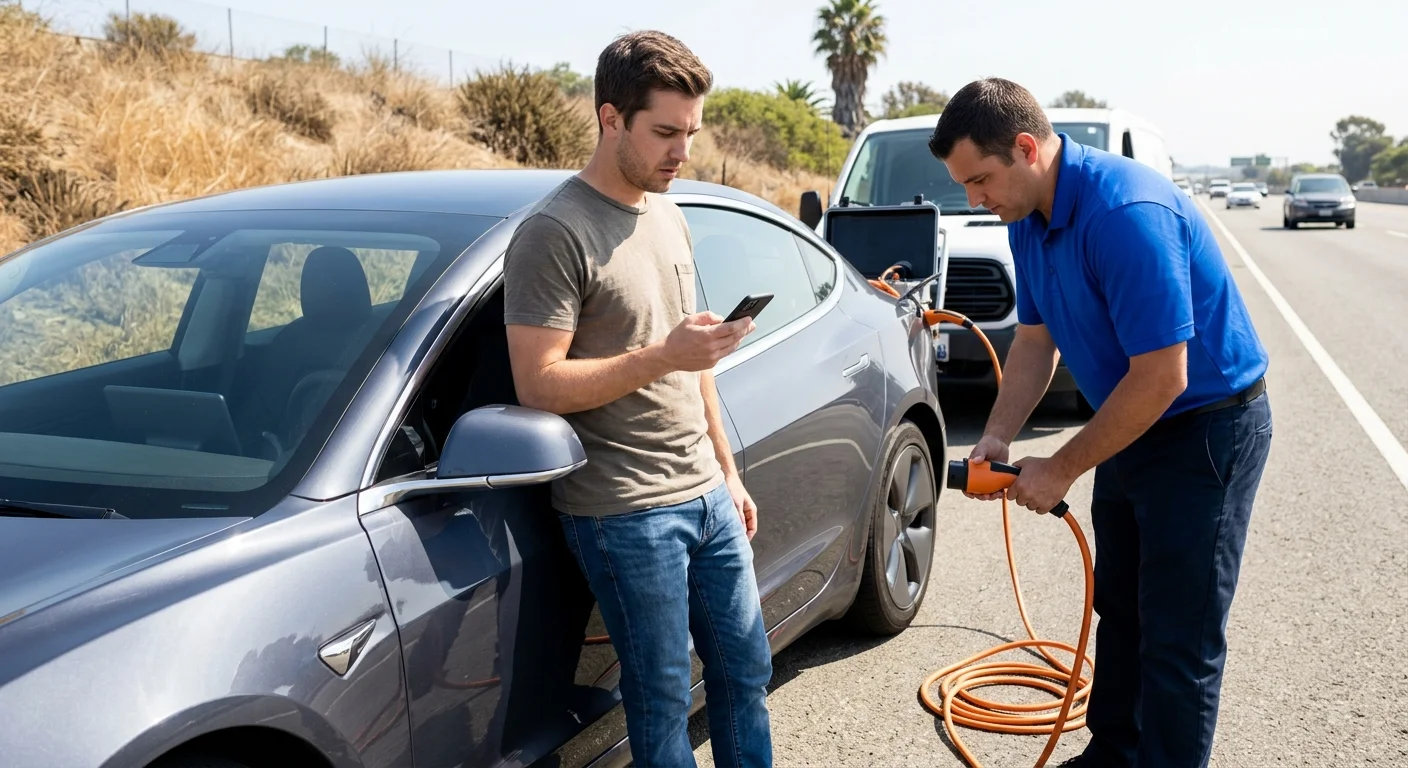
A local EV rescue operator is another option when AAA coverage remains unclear or the available service doesn’t match the problem. Charge Pro SD connects stranded drivers with independent local operators across San Diego County. The operator evaluates the Tesla and performs any physical roadside work.
Begin by sharing what you’ve already confirmed. Tell the operator your Tesla model, model year, low-voltage wording, visible symptoms, and location. Mention whether AAA reviewed the request and what service was offered. Don’t state that you need a jump unless the low-voltage problem has been identified.
San Diego location details can shape the request. A vehicle in a Chula Vista driveway differs from one in a Kearny Mesa garage. A stopped Tesla near San Ysidro, Escondido, or an I-5 exit needs clear access and direction information. If the car is in traffic or another unsafe position, call 911. In metropolitan areas, other roadside requests can go through 511 by saying Roadside Assistance.
Ask the matched operator what work is appropriate, what it will cost, and what approval is needed. Charge Pro SD doesn’t set the operator’s prices, provide the roadside work, or give a warranty. You contract and pay the independent professional directly.
The practical choice depends on confirmed membership terms and the vehicle’s actual problem. Compare the specific service available, not just the names of the providers. Clear information helps the operator distinguish a low-voltage failure from an empty traction battery.
When to call us
Call when your Tesla is stranded in San Diego County and you need a local EV rescue operator to assess a possible low-voltage failure. Have the model, model year, warning message, and exact location ready.
Call (858) 400-4465. Charge Pro does not send a Charge Pro crew. Tesla roadside is requested in the Tesla app. Confirm coverage on Tesla’s support pages. Current Tesla Model Y books describe a lithium-ion low-voltage battery after the hood is open.